
THE WINE SWEET SPOT: WHY PRICE VS. VALUE CHANGES EVERYTHING
The wine list at a certain establishment on Jermyn Street – let's call it 'where old money goes to lunch' – offers a 2009 Bordeaux for £469. It's very decent: round, well-made, creditable. The same bottle costs £75 at a venerable wine seller a few hundred yards away. This isn't hospitality pricing, it's a cognitive tax – a hefty markup designed to exploit the gap between what wine costs and what people think it should cost. The beautiful irony? The moment you understand wine, really understand it, these markups no longer represent a tax on impulse but irrelevant. Rather like discovering your expensive gym membership after becoming an avid park runner. Perfect information is impulse or ignorance pricing's kryptonite.
Everyone who's learned to trust their palate has had that other moment too. You're at home on a quiet Thursday, opening that £20 Saumur you picked up on a whim. Three sips in, you realise something: this tastes better than the £150 'flex' bottle that dominated conversation at last weekend's dinner. Not different. Better.
It's the realisation that expensive and good aren't the same thing. That somewhere between the supermarket shelf and the trophy cabinet lies a sweet spot where money and pleasure come together in harmony.
The mathematics are simple enough. At £9, half your money goes to the taxman before the bottle reaches the shelf. The breakdown is stark: £3 duty, £1.50 VAT, £2.25 retail margin, 80p packaging, 45p logistics, leaving just £1 for wine and farming. You're buying a tax-delivery system that happens to contain wine.
At £20, the economics transform: £3 duty, £3.33 VAT, £4 retail margin, £1 logistics and packaging, leaving £8.67 for actual winemaking - nearly nine times more liquid investment than the £9 bottle.
Below £10, you're mostly buying tax, glass, and logistics. The wine is almost incidental – a vehicle in a business model that treats grapes like any other commodity, somewhere between wheat and shampoo. Above £50, you're increasingly paying for scarcity, marketing, or social signalling. The bottle becomes a vessel for everything except what matters most: what's actually inside it. It's the vinous equivalent of buying a Hermès handbag for the leather quality.
But between £15 and £45? Here's where winemakers can focus on what matters: the liquid itself. Where small producers can afford proper fruit selection without charging for their degree from wine school or impending legal fees at the break up of the family estate. Where established regions offer real insight from unfashionable vintages or lesser-known villages – the viticultural equivalent of finding a brilliant novelist before they win prizes and start taking themselves too seriously.
"Price is what you pay. Value is what you get." – Warren Buffett
In wine, as in stocks, this wisdom cuts through decades of marketing mythology to reveal an uncomfortable truth: we're often our own worst enemies when it comes to spending well.
THE UNIVERSAL PATTERN
This curve appears everywhere taste meets commerce, once you know where to look.
The pattern holds across every category where skill, knowledge, and genuine craft compete against branding, scarcity, and social positioning.
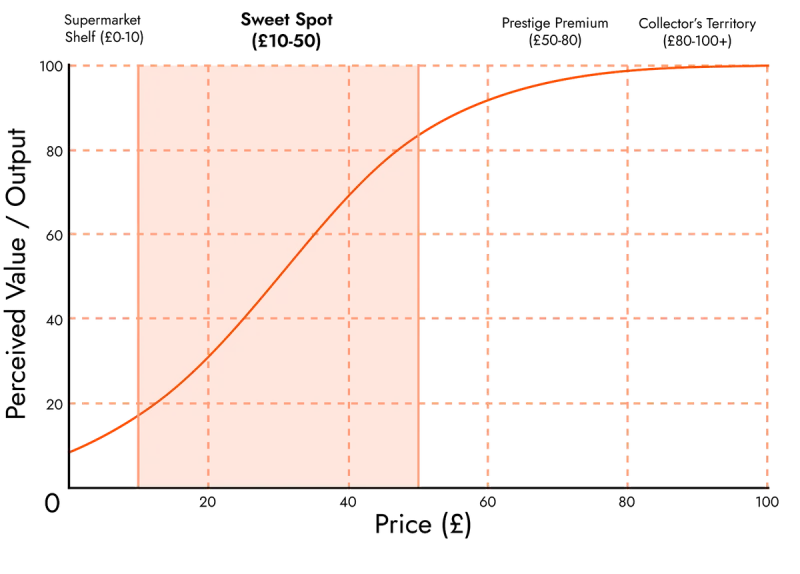
Perceived quality rises quickly to the £10–50 "sweet spot", then flattens. Above ~£50, extra spend buys scarcity, provenance and signalling more than proportional sensory gain.
Consider Radiohead's arc – Pablo Honey is the entry point, inviting you in with familiar structures and accessible melodies (including their bugbear Creep). The Bends hit peak accessibility for many, offering complexity without alienating casual listeners. OK Computer upped the stakes as an all-time classic, the album that launched a thousand beard scratchings. Then Kid A took a sharp left turn, separating casual fans from devotees with its electronic experimentalism. In Rainbows returned to that perfect middle ground – emotionally and musically complete, hitting all the bases without compromise or calculation. And to paraphrase Hannibal, it's always great when a band comes together.
Like the best winemakers, the returns are still there across their catalogue, but it pays to know both the crowd-pleasers and the work mostly enjoyed by completists. The sweet spot? Albums like Joni Mitchell's Blue, Dylan's John Wesley Harding or Stan Getz's Jazz Samba – where you get the artist's full vision and technique while remaining discernible to newcomers. They're the musical equivalent of that perfect £20 bottle: substantial enough to reward attention, approachable enough to enjoy without homework.
In cinema, Tarantino talks endlessly about how Back to the Future sits alongside Dunkirk in his personal canon – one a crowd-pleaser, the other less obvious, both perfectly crafted for their purposes. The films that film people keep returning to often aren't the obvious masterpieces but the ones that work on multiple levels. Hitchcock's Strangers on a Train lacks Vertigo's mystique but rewards every rewatch with new details, tight plotting, stranger psychology. It's the cinematic equivalent of a great Chablis Premier Cru from Dauvissat – not the flashiest choice on the list, but the one that reveals new layers each time you encounter it.
Even timepieces follow the pattern. An IWC pilot's watch prioritises engineering over flash, built for purpose. A Rolex Submariner sells heritage and recognition, designed for boardrooms rather than deep sea dives. Both tell time perfectly. One you buy for yourself, the other for others to notice. The difference lies not in functionality but in what job you're hiring the object to perform.
The principle holds everywhere: the middle is where craft meets accessibility without compromise. Like Sylvain Pataille's Burgundies – the wines that wine people actually drink at home, not just collect – offering real insight into terroir and technique without the trophy premium. They're made for drinking, not displaying, which makes them infinitely more rewarding for anyone whose primary interest lies in what's inside the bottle rather than status signalling.
Want to explore wines in the sweet spot? Browse our curated selection →
WHAT JOB ARE YOU HIRING WINE TO DO?
People don't just buy wine – they hire it for specific emotional and social jobs. Understanding this transforms how you think about choosing wine, because the mismatch between the job and the bottle explains most wine disappointment.
For celebration (£20-40): You want something that feels special without the anxiety of opening something truly precious. Champagne works here not because it's objectively the best-tasting wine, but because it performs celebration perfectly. The pop matters as much as the pour. You're buying theatre as much as liquid, and that's perfectly rational. A good Crémant de Loire at £18 often delivers more actual pleasure than entry-level Champagne at £35, but sometimes the situation demands bubbles from the right region.
For exploration (£15-35): When you're curious about a region, a grape, or a story, this is where quality to price ratio rises steeply. You want enough quality to understand what the fuss is about, without paying for reputation you haven't earned yet. Here's where small producers shine – makers like Catherine and Pierre Breton in Loire or Duncan Savage in South Africa, crafting wines that teach you something new about place and process without requiring a hard credit check.
For signalling (£100+): When social capital joins sensory pleasure and storytelling in the equation. These bottles can disappoint because recognition and marketing dollars inflate everything but the pleasure. The label impresses more than pleases your palate. This isn't necessarily wrong – wine has always carried social meaning – but understanding the job prevents disappointment when the £120 Barolo tastes less compelling than last week's £22 Barbera.
For comfort (£8-15): Your reliable Tuesday night pasta wine. It just needs to not get in the way of dinner or conversation. Here, consistency trumps complexity. A well-made Côtes du Rhône at £12 performs this job beautifully, offering familiar flavours with nothing wasted.
The revelation comes when you match the job to the bottle rather than defaulting to price as a guide. Understanding what you're actually buying – celebration, education, status, or simple pleasure and building a repertoire to suit – makes every purchase more satisfying and (less galling potentially).
This framework explains why wine pricing often seems so disconnected from actual quality. Different wines are solving different problems, serving different purposes in our social and emotional lives. The £200 Burgundy isn't necessarily ten times better than the £20 one – it's performing an entirely different function.
THE ECONOMICS OF THE SWEET SPOT
The magic happens between £15 and £45 because this is where the economics of winemaking align with the realities of drinking pleasure. Understanding why these numbers matter transforms how you think about wine pricing across all categories.
The £15 Threshold: Where Intention Begins
Why £15 matters: This is where producers can afford the decisions that actually affect what you taste. Economics affording proper fruit selection – demarcating uniquely expressive parcels rather than blending everything together. Some oak influence enters the equation, whether through barrel fermentation, ageing, or carefully managed contact with wood alternatives. Time becomes a luxury the producer can afford – allowing malolactic fermentation to complete naturally, letting the wine settle on its lees, waiting for the right moment to bottle.
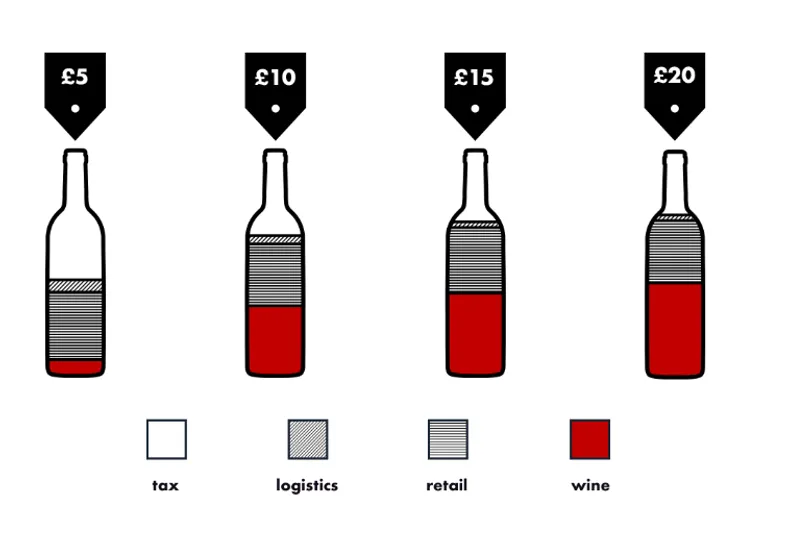
Above ~£10, duty, VAT, packaging and logistics consume most of the price; little reaches farming and cellar work. NB: Figures rounded; duty/VAT change over time.
Below this threshold, corners get cut that you can taste. Grapes are harvested for yield rather than flavour. Interventions become routine rather than applied when needed. Bottling happens on schedule rather than when the wine is ready. None of this makes for undrinkable wine, but it does mean you're tasting efficiency rather than intention. It's the difference between a meal cooked with love and one assembled to the demands of a spreadsheet.
Around £20-30: The breathing room expands. Small producers can afford hand-harvesting, gentler extraction methods, wild fermentations that take weeks rather than days. Estate-grown fruit becomes viable rather than purchased grapes from multiple sources. The winemaker can respond to what each vintage demands rather than following a predetermined industrial process.
The £50 Ceiling: Where Rarity Tax Kicks In
Why c. £50 signals a change - where pleasure per pound plateaus but beauty doesn't. Beyond here, you're often paying for scarcity (tiny production runs), prestige (famous vineyard names), or speculation (investment potential) rather than a direct upgrade in drinking pleasure. The wine might be technically excellent, even transcendent, but the pleasure-per-pound curve flattens. You're buying rarity, not just quality. Some bottles above £50 are transcendent; they are just priced for rarity and reputation as well as taste.
This isn't to diminish great wine from legendary producers. A bottle of Domaine de la Romanée-Conti can be genuinely life-changing – but you're not paying £3,000 for liquid that's 100 times better than a £30 bottle. You're paying for an experience that exists nowhere else, crafted from grapes grown in soil that hasn't been replicated anywhere on earth. The economics make sense when you understand what you're actually buying. It's rather like paying premium prices for front-row seats at Glastonbury – you're not buying better music, you're experiencing it live and unalloyed.
The genius in our trade exists where small producers can make something distinctive without charging for their reputation, where established regions offer real value from unfashionable vintages or overlooked appellations. It's the zone where craft and commerce find their natural balance, where wine takes priority over marketing markup.
"In wine, as in stocks, you want to buy value, not popularity."
The principle holds: the best investments are often hiding in plain sight, made by people who care more about the work than the recognition.
TASTE AS ECONOMIC FREEDOM
When you don't know what you like, price becomes your guide. And price lies.
This is luxury pricing's greatest trick: convincing consumers that cost correlates with quality when the relationship is far more complex. The £150 bottle at dinner gets reverential treatment not because it tastes better, but because the price suggests it should. We pour it carefully, discuss it seriously, find complexity that might not exist in a £20 bottle poured from an unmarked decanter. There's value in this but among other elements and not at their expense.
When you do know what you like, you can skip the theatre entirely. You know the artificial scarcity, brand premiums, and social signalling for what they are. You start making context-appropriate choices rather than status-appropriate ones – choosing the sleeper £25 Chablis that actually tastes like Chablis over the £50 bottle that tastes like everywhere and nowhere.
To be clear, none of this diminishes great wines; it reframes what you are paying for. Beyond ~£50, incremental spend often buys site, scarcity and time in barrel rather than a linear jump in flavour intensity. For many occasions, that is exactly the point.
"Understanding your own taste isn't about becoming a snob – it's about becoming economically independent from other people's snobbery."
This is the real liberation: taste isn't just preference – it's economic freedom disguised as cultural sophistication. You stop being prey and start being a player. You stop buying what you're supposed to want and start wanting what actually serves your life.
The transformation happens gradually, almost imperceptibly. You notice that the expensive Sancerre tastes thin and overextracted compared to the Touraine Sauvignon Blanc at half the price. You realise that small-grower Champagne from Leclerc Briant or Vouette et Sorbée offers more interest and authenticity than the cuvées for the 'gram that cost three times as much. You discover that Burgundy from the Hautes-Côtes or Marsannay can be more expressive than village-level wine from famous communes trading on reputation rather than terroir.
Knowledge becomes your compass, pointing you towards genuine value and away from expensive disappointment. You start seeking out producers like Hirsch Vineyards in California, making wines that taste like somewhere specific rather than satisfying committee-tested flavour profiles. You learn to spot the makers who prioritise farming and fermentation over marketing and mythology.
This matters beyond wine. The same pattern recognition applies is no different to when choosing restaurants, buying books, selecting music, or commissioning art. Quality often hides in the middle ground, created by people focused on craft rather than celebrity, substance rather than spectacle.
Understanding your own taste isn't about becoming a snob – it's about becoming economically independent from other people's snobbery. It's about spending your money on things that genuinely enhance your life rather than things that enhance your image. In a world designed to separate you from your money through manufactured anxiety about status and taste, knowing what you actually like becomes a form of resistance. The most radical act in modern consumer culture isn't buying expensive things – it's refusing to buy expensive things you don't actually want.
The goal isn't to impress anyone else. It's to build a cellar, or a record collection, or a bookshelf that reflects your actual preferences rather than borrowed opinions. To create a life filled with things you genuinely love rather than things you think you should love. There's something beautifully subversive about preferring the £30 Sonoma to the £90 Napa clunker, not because you're being contrarian, but because you've discovered what actually brings you pleasure.
THE PRESTIGE PREMIUM: WHY WE TRUST EXPENSIVE WINE
Before you're "into" wine, to use the modern parlance, price is a kind of safety blanket. Loss aversion says you'd rather stick with what you know or overpay depending on context than risk embarrassment; confirmation bias ensures the more you spend, the more convinced you are, or inclined to be convinced, it's good; priming means the label, the setting, and the service have you half-tasting the story before you've tasted the wine. Once you've crossed the wine threshold and become an enthusiast, a different pair of gremlins take over – scarcity and signalling – and you find yourself justifying a purchase because there were only six imported into the country, or because it says something clever about you when next having dinner with the Joneses.
This is why I like the watch analogy. A Glashütte or vintage IWC will match or arguably exceed a Rolex in technical excellence, often at a portion of the price – but the Rolex comes with a baked-in social and marketing premium, an instant social shorthand. Wine is much the same: a grower Champagne from a lesser known village can deliver more craft and pleasure than a famous cuvée at double the price, but it will win a nod from the wine lover at the table rather than the person parading the freshly minted Gucci handbag.
My time in advertising taught me that people rarely buy 'things' – they buy the promise of how those things will make them feel, and how others will see them. Understanding that is liberating. It lets you treat price not as a verdict on quality, but as one albeit important input and influence among the farming, the craft, the story, the occasion, the people you share it with. And it's exactly that mindset that leads you, more often than not, into the sweet spot where the best stories and the best drinking intersect (and where the smart money naturally gravitates in wine as it does with watches, cars, hi-fi and so on).
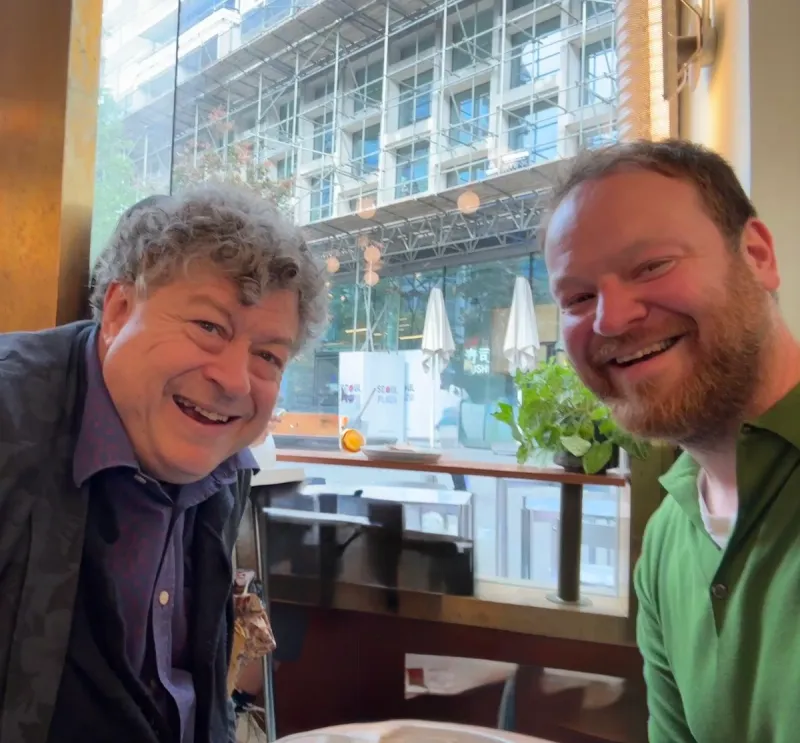
This is a pattern Rory Sutherland has been thinking about for years, and he captures it perfectly. Rory writes:
This piece was inspired by a conversation Ben and I had over the optimality of price - that price is an indicator of quality, but it is not an optimand. You should rarely buy the cheapest nor the most expensive thing in any category. I had once developed a heuristic, which was "buy the second most expensive toaster which Argos sells" The idea is that, somewhere at the upper end of the middle in any market, there is a sweet spot. For instance I have always been very fond of the watch brand Nomos - not to the extent of actually buying one, but to the extent of browsing very intently. I was intrigued to see a luxury watch expert on YouTube supporting my instinct by arguing that the optimal amount to spend on a luxury watch is between £1,500 and £3,500.
In economic terms, this makes sense. The sweet spot will vary depending on the mixture of fixed and variable costs which go into the creation of any good. Anything highly taxed should shift your price target upwards, as Ben explains below. But there is a happy medium on any priceline where gains to scale and investment in quality do not conflict, they rhyme. if you sell only 1,000 watches, there is a limit to the hours you can put into design without making the watch fiendishly expensive; if you make ten million, there is a limit to the labour you can lavish on each one. At the bottom end you are sacrificing quality; at the top end you are paying for a lot of things which aren't a watch: marketing, scarcity, cachet, perhaps - but not "watchness".
The trick is to become a connoisseur without getting silly about it.
As Adam Smith wrote in the Theory of Moral Sentiments:
A watch, in the same manner, that falls behind above two minutes in a day, is despised by one curious in watches. He sells it perhaps for a couple of guineas, and purchases another at 50, which will not lose above a minute in a fortnight. The sole use of watches, however, is to tell us what o'clock it is, and to hinder us from breaking any engagement, or suffering any other inconveniency by our ignorance in that particular point. But the person so nice with regard to this machine, will not always be found either more scrupulously punctual than other men, or more anxiously concerned… to know precisely what time of day it is. What interests him is not so much the attainment of this piece of knowledge, as the perfection of the machine which serves to attain it.
LIVING IN THE SWEET SPOT
Think of the sweet spot as where craft and cost align for everyday drinking. It doesn't preclude buying great bottles; it helps you do so knowingly.
The goal isn't to become a wine bore or to stop enjoying expensive bottles when the moment calls for them. Life offers occasions that deserve Champagne of fine breeding, Burgundy from the tiny Les Amoureuses vineyard, or a Barolo made from Ravera grapes. The point is understanding when you're paying for genuine rarity versus manufactured scarcity, authentic craft versus calculated marketing.
The most rewarding wines – the ones you remember, the ones that become part of your story – often cost much less than you think. They're the bottles hiding in plain sight between obvious and obscure, made with intent and integrity.
They're crafted by people like Thierry Allemand in Cornas, or Sylvain Pataille in Marsannay. Producers who measure success in vintages rather than quarters, who care more about the wine in your glass than the story on your Instagram feed. The kind of people who got into wine because they fell in love with transformation – watching grapes transcend their origins – rather than because they fancied themselves as lifestyle entrepreneurs.
These wines exist because their makers understand something fundamental: the best things in life are those made with care, attention, and genuine love for the craft.
That sweet spot isn't just a price point. It's a philosophy. It's about seeking quality over quantity, substance over spectacle, genuine pleasure over borrowed prestige. It's about building a relationship with the things you consume rather than simply consuming them.
In wine, as in life, the middle path often leads to the greatest satisfaction. Not because it's a compromise, but because it's where intention meets accessibility, where craft meets honesty, where the focus remains squarely on what matters most: the experience itself, not the story you'll tell about it afterwards.
"The wine sweet spot isn't about finding cheap wine that tastes expensive. It's about finding wine where your money flows toward what matters: soil, cellar work, and time."
When you understand the difference, every purchase becomes an investment in actual pleasure rather than the expensive theatre of drinking well.
Ready to discover the sweet spot for yourself?
For more on the fundamentals of wine pricing and production costs, explore our companion piece on wine economics. Ready to find wines in the sweet spot? Browse our curated boxes, chosen for their exceptional quality-to-price ratio and stories worth telling.
We're in the business of helping you spend less money on more pleasure – which, when you think about it, might be the most subversive business model of all.
CONTINUE EXPLORING TASTE DECODED
- Watch: Michael Sager on how to taste like a somm
- Read: Charles Spence on Sensory Science
- Article: What Makes Wine Cheap vs Expensive
About the Authors
Benedict Johnson is the founder of Ourglass, a London-based wine platform dedicated to helping people become confident wine lovers. He writes on everything to do with wine, and curates the Taste Decoded series, which brings together sommeliers, communicators, academics and creatives to decode what "great" actually tastes like.
Rory Sutherland (@rorysutherland) is Vice-Chairman of Ogilvy UK, a columnist for The Spectator, and author of Alchemy: The Surprising Power of Ideas That Don't Make Sense. A pioneer of applied behavioural science in business, he explores how perception, context and signalling shape value across every category imaginable, from watches to wine.