
WHAT TO DRINK INSTEAD OF CHIANTI
Five wines similar to Chianti, and a tasting game to find your favourite.
THE SHORT ANSWER
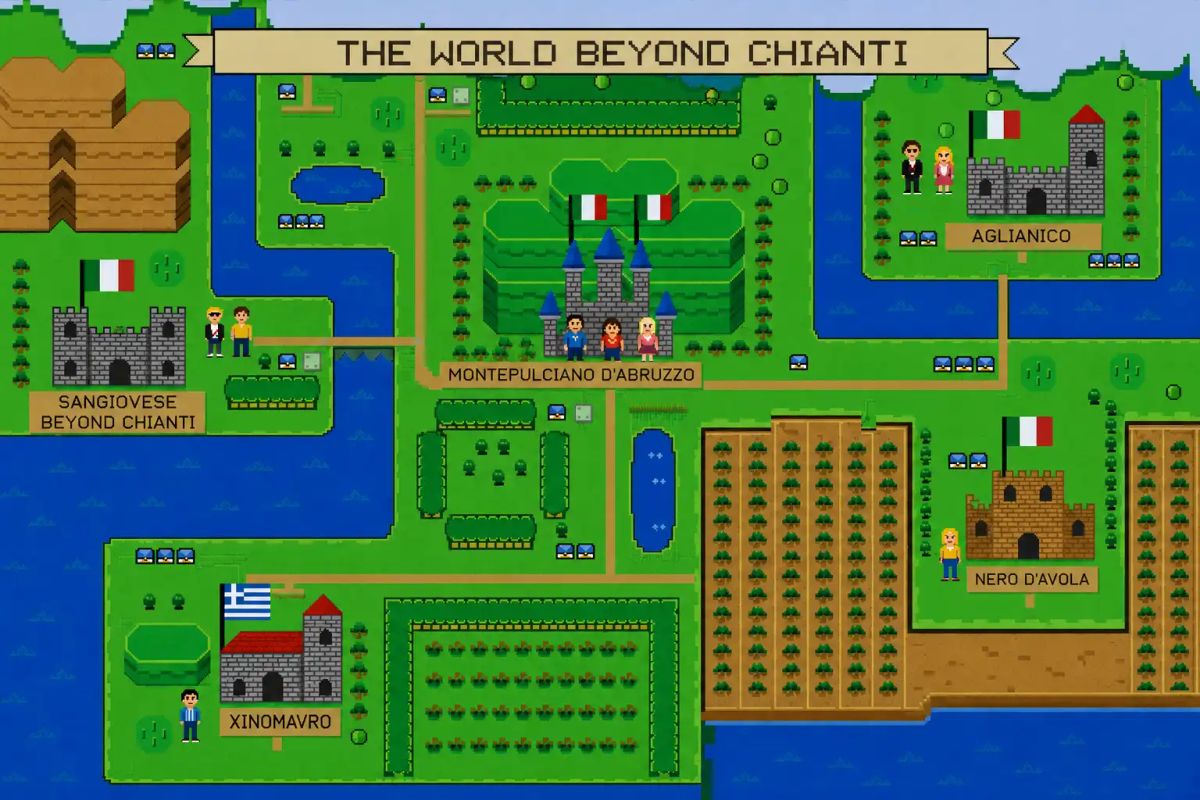
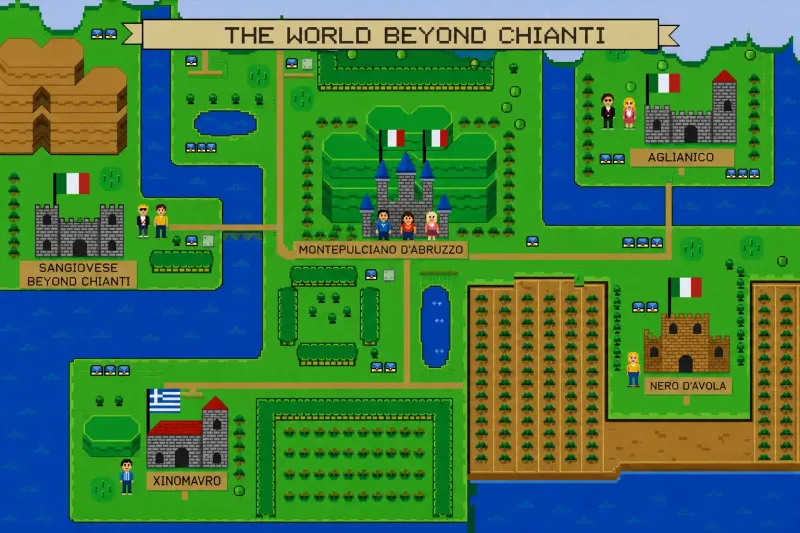
If you like Chianti, try these five wines: Sangiovese beyond Chianti, meaning Brunello di Montalcino and Vino Nobile di Montepulciano, for the same grape taken to its serious conclusion, Montepulciano d'Abruzzo for a softer, darker, everyday Italian red that asks for nothing, Nero d'Avola from Sicily for sun-baked dark fruit with a savoury edge, Aglianico from southern Italy for the structured, ageworthy, almost Barolo-like answer, and Xinomavro from Greece for the wine that tastes most like Chianti without being Italian at all.
Five wines to try if you like Chianti:
- Sangiovese beyond Chianti (Brunello, Vino Nobile): the grape, elevated (£20 to £50+)
- Montepulciano d'Abruzzo (Abruzzo, Italy): soft, dark, everyday (£8 to £16)
- Nero d'Avola (Sicily, Italy): sun-baked, savoury, generous (£8 to £18)
- Aglianico (Campania and Basilicata): structured, ageworthy (£12 to £30)
- Xinomavro (Naoussa, Greece): high-acid, tomato, herb (£12 to £25)
THE MAP
| Sangiovese (Brunello / Vino Nobile) | Montepulciano d'Abruzzo | Nero d'Avola | Aglianico | Xinomavro | |
|---|---|---|---|---|---|
| Body | Medium to full | Medium | Medium to full | Full | Medium |
| Acidity | High | Medium | Medium | High | High |
| Tannin | Firm | Soft | Medium | Very firm | Very firm |
| Closest match to Chianti | The grape itself | The everyday role | The fruit | The structure | The soul |
| Price band | £20 to £50+ | £8 to £16 | £8 to £18 | £12 to £30 | £12 to £25 |
| Best occasion | Sunday, cellar | Midweek, pizza | Roast, crowd | Slow-cooked, age | The table, debate |
QUICK LEGEND
If you love Chianti and want to see how far the grape goes: go Brunello or Vino Nobile.
If you want the everyday version with the corners softened: go Montepulciano d'Abruzzo.
If you want more sun and less grip: go Nero d'Avola.
If you want Chianti's structure turned up and made to last: go Aglianico.
If what you actually love is the savoury, food-demanding soul of it: go Xinomavro.
WHAT CONNECTS THESE WINES
For a long time Chianti was a punchline wrapped in a straw basket.
The fiasco, that round bottle in its woven jacket, became shorthand for cheap red and chequered tablecloths, and the wine inside mostly deserved the reputation. What almost nobody outside Italy noticed was that the same region quietly spent two decades fixing itself. Yields came down, the rules tightened, the worst grapes were pulled, and Chianti Classico became a serious wine again while its old image was still doing the talking.
The thing that survived the bad years is the reason Chianti matters at all: Sangiovese. It is not a wine built to impress you in the glass. It is built to disappear into a meal and make everything around it taste better. Sour cherry, dried herb, tomato leaf, tea, a firm savoury grip, and an acidity that resets your palate between bites. Drunk on its own it can seem austere. Put it next to food and it makes sense instantly.
That is the through-line here. Every one of these wines is built around savour and structure rather than soft fruit. Each one moves a single variable: more depth, more sun, more age, more edge.
Serve at 16 to 18 degrees Celsius, and ideally with something to eat.
THE FIVE WINES
1. Sangiovese Beyond Chianti, the Grape Elevated
The first answer to "what instead of Chianti" is the same grape, taken seriously.
Sangiovese does not stop at Chianti. In Montalcino it becomes Brunello: deeper, denser, longer-lived, the most powerful expression the grape has. In Montepulciano, the Tuscan hill town, it becomes Vino Nobile: a halfway house, more structured than Chianti, less monumental than Brunello, and very often the best value of the three. Rosso di Montalcino, the younger sibling of Brunello, is the everyday way in.
The recognisable Chianti signature is all still there, sour cherry, herb, savoury grip, but with more concentration and a longer finish. This is less an alternative than a promotion.
What you will recognise: sour cherry, dried herb, high acidity, savoury grip. What changes: more depth, firmer structure, the ability to age for a decade or more. Look for: Rosso di Montalcino to start, then Vino Nobile di Montepulciano and Brunello di Montalcino. Budget: £20 to £50 and beyond.
2. Montepulciano d'Abruzzo, the Everyday One
First, clear up the confusion the name causes. Montepulciano d'Abruzzo is a wine made from the Montepulciano grape in Abruzzo. Vino Nobile di Montepulciano is a wine made from Sangiovese in the Tuscan town of Montepulciano. Same word, two completely different wines. This entry is the grape, not the town.
Montepulciano d'Abruzzo is the soft, dark, dependable Italian red that Chianti often is not. Black cherry and plum, gentle tannin, low acidity, a faint rustic edge in the cheaper bottles and real plushness in the better ones. It does the job a basic Chianti is asked to do, weeknight red with food, with the rough corners taken off.
What you will recognise: dark fruit, the everyday Italian red role, food friendliness. What changes: softer, rounder, lower in acid, less savoury and grippy than Sangiovese. Look for: Montepulciano d'Abruzzo, with the Cerasuolo rosé version worth knowing in summer. Budget: £8 to £16.
3. Nero d'Avola, the Sun One
Nero d'Avola is what Chianti might taste like if Tuscany were hotter and closer to Africa.
Sicily's signature red gives you dark cherry, dried plum, herbs and a savoury, sun-baked edge. It keeps the Italian instinct for food and savour but trades Sangiovese's bright acidity for Mediterranean warmth and density. The mass-market versions are pleasant and forgettable; one tier up, particularly from the southeast around Noto or from higher volcanic sites, the character arrives.
This is the move for the Chianti drinker who likes the food-friendliness but finds the wine a little severe on a cold evening.
What you will recognise: dark fruit, savoury edge, a red built for the table. What changes: riper and warmer, softer acidity, more Mediterranean, less sour-cherry tension. Look for: Nero d'Avola from southeastern Sicily, and producers working volcanic Etna sites for more cut. Budget: £8 to £18.
4. Aglianico, the Structured One
If Sangiovese is the savoury grape of central Italy, Aglianico is its more imposing cousin from the south.
Grown mainly in Campania, as Taurasi, and Basilicata, as Aglianico del Vulture, it produces some of Italy's most structured, slowest-evolving reds. Dark fruit, leather, tar, dried herb and a tannin so firm that young examples can feel like a closed door. Given time, or a slow-cooked meal, it unfolds into something genuinely Barolo-like in seriousness, at prices that are still mostly sane.
This is for the Chianti drinker who has started buying older bottles and wants the structure dialled all the way up.
What you will recognise: savoury depth, high acidity, an unmistakable need for food. What changes: much firmer tannin, darker and more brooding, built to age for many years. Look for: Taurasi and Aglianico del Vulture; younger Campania Aglianico for an affordable introduction. Budget: £12 to £30.
5. Xinomavro, the Soul Match
The wine that tastes most like Chianti is not Italian.
Xinomavro, from Naoussa in northern Greece, is so close in spirit to Sangiovese and Nebbiolo that blind tasters routinely confuse it with both. The name translates as "acid-black", which tells you most of what you need. High acidity, firm tannin, and an aroma of dried tomato, sun-dried herb, olive and red fruit that lands almost exactly where great Chianti lands. It is also one of the most underpriced serious reds in Europe, largely because the name is hard to say and harder to find.
This is the discovery on the list. For a savoury, structured, food-built red, nothing here is closer to the heart of Chianti.
What you will recognise: sour red fruit, dried herb, high acidity, firm savoury grip. What changes: an olive and tomato-leaf note that is its own, even more demanding without food, a different country entirely. Look for: Naoussa and Amyndeon from Greece. Budget: £12 to £25.
A NOTE ON CHIANTI VERSUS SANGIOVESE
These two words get used interchangeably, and they are not the same thing.
Sangiovese is a grape. Chianti is a place, and a wine made mostly from that grape in a defined part of Tuscany. So Chianti always taste like Sangiovese, but Sangiovese does not always taste like Chianti. Brunello di Montalcino and Vino Nobile di Montepulciano are also Sangiovese, and they taste deeper and more structured because of where and how they are grown.
As for what Chianti tastes like: sour and red cherry, dried herbs, tomato leaf, a touch of tea and leather, firm tannin and bright acidity, with a savoury finish that wants food. Chianti Classico, from the historic heartland, is the more serious, age-worthy version and is marked by a black rooster on the neck of the bottle. If you have only met Chianti through cheap straw-covered bottles, you have not really met Chianti.
THE TASTING GAME
What You Need
Five bottles, one of each wine above. Four to five red wine glasses per person. A pen and the rating table below. One person who still pictures a straw basket when they hear the word Chianti. Tomato-based food on the table is not optional here. It is the test.
Optional but recommended: add a Chianti Classico as the reference point everything else is measured against.
The Rating Table
| Characteristic | What you are looking for |
|---|---|
| Acidity | How much the wine makes your mouth water |
| Sour cherry and red fruit | Tart cherry, cranberry, dried strawberry |
| Savoury edge | Herb, tomato leaf, leather, tea |
| Tannin | 1 = soft, 5 = firm and gripping |
| Food transformation | How much better the food tastes with the wine |
Ourglass Benchmarks
| Characteristic | Chianti | Brunello/Vino N. | Montepulciano | Nero d'Avola | Aglianico | Xinomavro |
|---|---|---|---|---|---|---|
| Acidity | 5 | 5 | 3 | 3 | 5 | 5 |
| Sour cherry and red fruit | 5 | 5 | 3 | 3 | 3 | 5 |
| Savoury edge | 4 | 5 | 2 | 3 | 5 | 5 |
| Tannin | 4 | 5 | 2 | 3 | 5 | 5 |
| Food transformation | 5 | 5 | 3 | 3 | 4 | 5 |
The decisive row is Food transformation. None of these wines is trying to be the centre of attention. The exercise is to find which one makes the meal in front of you taste best, because that, not the tasting note, is what Sangiovese was built to do.
If you would rather have wines chosen for the way they behave at the table than the way they read on a shelf, that is what Ourglass is for. Start here.
WHAT YOUR SCORES REVEAL ABOUT YOUR PALATE
Loved the acidity and sour cherry above all? You are a Sangiovese purist. Next: Chianti Classico Riserva, Vino Nobile, Rosso di Montalcino.
Wanted the food role with the edges softened? Montepulciano d'Abruzzo is your everyday wine. Next: Cerasuolo d'Abruzzo, southern Italian blends.
Drawn to structure and the long game? Aglianico is your grape. Next: Taurasi, Aglianico del Vulture, then Barolo when you are ready.
Found Xinomavro uncannily familiar? You respond to savoury, high-acid reds wherever they come from. Next: Nebbiolo, Greek reds, our grape guide to Barbera.
Not sure? Take the palate route through Taste Decoded, or read our guide to developing your palate.
YOUR SHOPPING LIST
| Brunello / Vino Nobile | Montepulciano d'Abruzzo | Nero d'Avola | Aglianico | Xinomavro | |
|---|---|---|---|---|---|
| Region | Tuscany, Italy | Abruzzo, Italy | Sicily, Italy | Campania / Basilicata | Naoussa, Greece |
| Budget | £20 to £50+ | £8 to £16 | £8 to £18 | £12 to £30 | £12 to £25 |
| Start with | Rosso di Montalcino | Any decent Montepulciano d'Abruzzo | Noto or Etna Nero d'Avola | Younger Campania Aglianico | Naoussa |
Chianti, Montepulciano d'Abruzzo and Nero d'Avola are easy in any UK supermarket. Brunello sits at the specialist end. Aglianico and Xinomavro almost always mean an independent merchant, which is exactly why both are still such good value.
GO DEEPER
A guide to the wine regions of Italy. Where most of this lives.
What to drink instead of Rioja. The other great food-red conversation.
The Ourglass grape guide to Barbera. Another high-acid Italian worth knowing.
A guide to matching wine and food. The point of all of these.
The definitive guide to wine grape varieties. Every grape here, in context.
How to develop your wine palate. The long game.
FREQUENTLY ASKED QUESTIONS
What does Chianti taste like?
Sour and red cherry, dried herbs, tomato leaf, a little tea and leather, with firm tannin, bright acidity and a savoury finish that asks for food. Chianti Classico, from the historic heartland and marked by a black rooster, is the more serious and age-worthy version.
Is Chianti the same as Sangiovese?
No. Sangiovese is a grape; Chianti is a wine made mostly from Sangiovese in a defined part of Tuscany. Brunello di Montalcino and Vino Nobile di Montepulciano are also Sangiovese, grown elsewhere in Tuscany, and taste deeper and more structured.
If I like Chianti, what else will I like?
Brunello and Vino Nobile for serious Sangiovese. Montepulciano d'Abruzzo for a softer everyday red. Nero d'Avola for sun-baked Sicilian fruit. Aglianico for structure and ageing. Xinomavro from Greece for the closest thing to Chianti's savoury soul.
What is the difference between Chianti and Chianti Classico?
Chianti Classico comes from the original historic zone between Florence and Siena, with stricter rules, lower yields and more ageing potential. It carries a black rooster seal. Chianti without "Classico" is the broader, generally simpler category.
Is Brunello better than Chianti?
It is deeper, more powerful and longer-lived, because it is Sangiovese grown and aged for that purpose in Montalcino. Whether it is "better" depends on the occasion. Chianti is the more versatile everyday wine; Brunello is the Sunday and cellar version.
What food pairs with Chianti and its alternatives?
Anything tomato-based, first of all: ragù, pizza, pasta al pomodoro. Also roast and grilled meats, hard Italian cheese and charcuterie. The high acidity and savoury grip are designed to cut through rich, salty and tomato-led food.
What is Xinomavro?
A Greek red grape from Naoussa in the north, often compared to both Sangiovese and Nebbiolo for its high acidity, firm tannin and aromas of dried tomato, herb and olive. It is one of the most underrated and best-value serious reds in Europe.
Which Chianti alternative should a beginner try first?
Montepulciano d'Abruzzo. It is cheap, widely stocked, soft and forgiving, and it scratches the Italian-red itch without Chianti's firmer structure. Nero d'Avola is a close second for the same reasons.