
WHAT TO DRINK INSTEAD OF GRENACHE
Five wines similar to Grenache, and a tasting game to find your favourite.
THE SHORT ANSWER
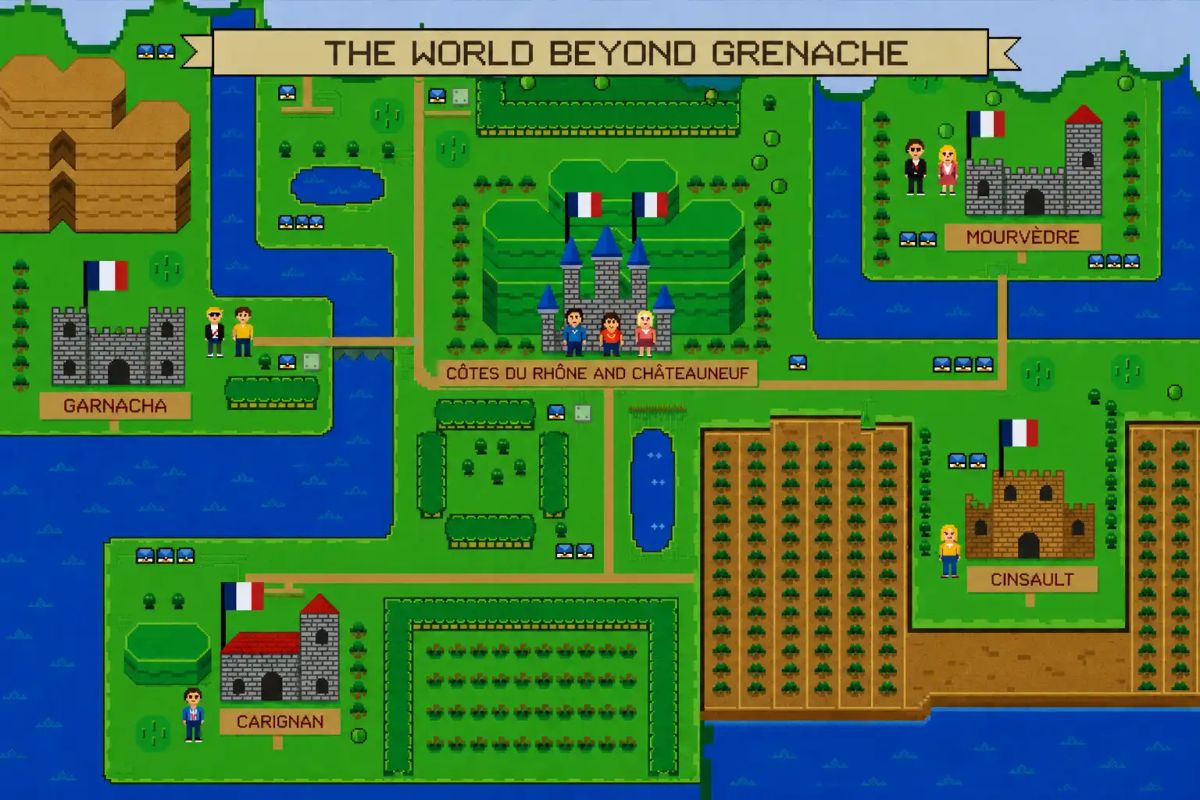
If you like Grenache, try these five wines: Garnacha from Spain for the same grape with more intensity and a lower price, Côtes du Rhône and Châteauneuf blends for Grenache the way it most often shows its best, in company, Cinsault for the pale, perfumed, lightly chilled version that the natural-wine world rediscovered, Carignan from old Mediterranean vines for darker fruit and a savoury bite, and Mourvèdre for the structured, earthy, age-worthy end of the same family.
Five wines to try if you like Grenache:
- Garnacha (Aragón and Catalonia, Spain): riper, denser, great value (£8 to £20)
- Côtes du Rhône and Châteauneuf blends (southern Rhône): Grenache in company (£9 to £35+)
- Cinsault (Languedoc and beyond): pale, perfumed, chillable (£10 to £20)
- Carignan (old-vine Mediterranean): dark, savoury, characterful (£10 to £22)
- Mourvèdre (Bandol and the south): structured, earthy, age-worthy (£12 to £30)
THE MAP
| Garnacha | Côtes du Rhône blends | Cinsault | Carignan | Mourvèdre | |
|---|---|---|---|---|---|
| Body | Medium to full | Medium to full | Light | Medium | Full |
| Acidity | Medium | Medium | Medium to high | Medium to high | Medium |
| Tannin | Soft to medium | Medium | Low | Medium to firm | Firm |
| Closest match to Grenache | The grape itself | The natural habitat | The lighter side | The savoury side | The structured side |
| Price band | £8 to £20 | £9 to £35+ | £10 to £20 | £10 to £22 | £12 to £30 |
| Best occasion | Crowd, warmth | Anything, reliably | Summer, chilled | Roast, character | Slow food, age |
QUICK LEGEND
If you want Grenache with the volume turned up: go Garnacha.
If you want Grenache doing what it does best, in a blend: go Côtes du Rhône or Châteauneuf-du-Pape.
If you want it pale, fragrant and lightly chilled: go Cinsault.
If you want more savour and grip: go Carignan.
If you want structure and the long game: go Mourvèdre.
WHAT CONNECTS THESE WINES
Grenache is the most generous grape almost nobody asks for by name.
It is one of the most planted red grapes in the world and one of the least demanded, because for most of its life it worked anonymously, as the engine of a blend, while other grapes took the billing. Then two things happened. The natural-wine movement fell for it, because old-vine Grenache picked at the right moment gives exactly the kind of bright, perfumed, low-intervention red that scene was built around. And serious drinkers rediscovered Châteauneuf-du-Pape and the old Garnacha vineyards of Spain, where the grape has been quietly making profound wine all along.
What Grenache offers is warmth without weight. Sweet red fruit, strawberry and raspberry, white pepper and dried herb, a soft tannic frame and a generous, slightly heady finish. Picked late it becomes rich and powerful. Picked early it stays pale and fragrant. Few grapes cover that much ground.
These five wines map that range. One pushes it riper, one keeps it in its natural blend, one lightens it, one darkens it, one gives it structure. None of them asks much of you. That has always been the point of Grenache.
Serve at 15 to 17 degrees Celsius, and do not be afraid to put the lighter ones in the fridge for twenty minutes.
THE FIVE WINES
1. Garnacha, the Same Grape, Louder
Grenache and Garnacha are the same grape. The accent changes and so does the dial.
In Spain, particularly the old, low-yielding vineyards of Aragón, Catalonia and Madrid, Garnacha tends to be riper, denser and more intense than its French counterpart, with darker fruit and a warm, spiced depth. Priorat shows what the grape can do when ancient vines and steep slate slopes drop yields to almost nothing. Campo de Borja and Calatayud deliver a remarkable amount of that character for everyday money.
This is the cleanest switch on the list, because it is not really a switch at all. It is Grenache from a hotter address.
What you will recognise: sweet red fruit, soft tannin, warmth, easy generosity. What changes: riper and denser, darker fruit, more spice and power, often better value. Look for: old-vine Garnacha from Campo de Borja or Calatayud for value, Priorat to go deeper. Budget: £8 to £20.
2. Côtes du Rhône and Châteauneuf Blends, Grenache in Its Element
Grenache is not really a solo artist. It is the lead voice in a band.
Across the southern Rhône it is the backbone of the blend, rounded out by Syrah for structure and Mourvèdre for depth, the combination usually shortened to GSM. Côtes du Rhône is the everyday version and, taken seriously, one of the best-value reds in France. Côtes du Rhône Villages and named communes such as Cairanne and Rasteau move up a level. Gigondas and Vacqueyras are the serious step. Châteauneuf-du-Pape is the summit, and the better bottles justify the reputation.
We have not given Côtes du Rhône its own guide on purpose. This is where it belongs, as the natural habitat of the grape this whole piece is about. For the producers worth knowing, our Rhône producers guide goes deeper.
What you will recognise: sweet red fruit, warmth, herb and pepper, soft approachability. What changes: more complete and balanced, more savoury and structured, more consistent than varietal Grenache. Look for: Côtes du Rhône Villages, Cairanne, Rasteau, Gigondas, Châteauneuf-du-Pape. Budget: £9 to £35 and beyond.
3. Cinsault, the Light One
Cinsault is the grape the natural-wine world reached for when it wanted Grenache with less weight.
Pale in colour, low in tannin, high in perfume: red cherry, pomegranate, dried rose and a faint earthiness. It has always been a blending grape in the south of France and a backbone of old Cape vineyards, but on its own, lightly chilled, it is one of the most refreshing reds you can drink in summer. The good versions are delicate and precise. The thin ones are just thin, so this is a wine where producer choice matters.
This is the move for the Grenache drinker who realised the part they liked best was the lightness.
What you will recognise: red fruit, fragrance, soft and easy drinking. What changes: paler, lighter, lower tannin, best slightly chilled, more delicate than Grenache. Look for: varietal Cinsault from the Languedoc and old-vine bottlings from South Africa. Budget: £10 to £20.
4. Carignan, the Savoury One
Carignan spent decades as the workhorse blamed for Europe's wine lake. Old vines tell a different story.
From low-yielding old vineyards in the Languedoc, Catalonia and Sardinia, where it is also called Cariñena or Carignano, it gives dark fruit, dried herb, a wild savoury edge and a firm, slightly rustic grip. It has more colour, more bite and more grump than Grenache. Carbonic winemaking, increasingly common, keeps the fruit bright while taming the structure.
This is for the Grenache drinker who wants the Mediterranean warmth but a bit more attitude with it.
What you will recognise: red and dark fruit, southern warmth, food friendliness. What changes: darker and more savoury, firmer tannin, more rustic character, less sweet-fruited. Look for: old-vine Carignan from the Languedoc, Catalonia or Sardinia. Budget: £10 to £22.
5. Mourvèdre, the Structured One
Mourvèdre is the depth in the southern blend made into the main event.
In Bandol, on the Provence coast, it produces dense, tannic, slow-evolving reds full of dark fruit, leather, earth and dried herb. Where Grenache is open and warm, Mourvèdre is closed and serious in youth and built to age. It is also called Monastrell in Spain, where Jumilla and Yecla offer the everyday entry point at remarkable prices.
This is where Grenache drinkers end up when they want the same Mediterranean roots with far more structure beneath them.
What you will recognise: dark fruit, southern character, food friendliness. What changes: much firmer tannin, earthier and more savoury, slow to open, built for the long term. Look for: Bandol for the benchmark, Jumilla or Yecla Monastrell for affordable Mourvèdre. Budget: £12 to £30.
A NOTE ON FRENCH GRENACHE VERSUS SPANISH GARNACHA
Same grape, two temperaments.
French Grenache, in the southern Rhône, tends towards red fruit, herb and a savoury lift, usually expressed through a blend and aiming for balance. Spanish Garnacha, particularly from old vines in Aragón and Catalonia, tends towards darker fruit, higher ripeness, more spice and more raw power, and is more often bottled on its own. Neither is better. They are different settings of the same instrument, and which one you prefer tells you something useful about your palate.
If you like restraint and savour, you lean French and towards Mourvèdre and Cinsault. If you like richness and intensity, you lean Spanish and towards old-vine Garnacha and Priorat. Tasting a Côtes du Rhône and an old-vine Garnacha side by side is the fastest way to find out which you are.
THE TASTING GAME
What You Need
Five bottles, one of each wine above. Four to five red wine glasses per person. A pen and the rating table below. One person who orders "something easy and red" and never specifies further.
Optional but recommended: add a varietal southern Rhône Grenache and a Châteauneuf-du-Pape as reference points. The jump between them is half the lesson.
The Rating Table
| Characteristic | What you are looking for |
|---|---|
| Sweet red fruit | Strawberry, raspberry, red cherry |
| Warmth | The heady, slightly sweet-fruited finish |
| Savoury edge | Herb, pepper, earth, leather |
| Tannin | 1 = soft and light, 5 = firm and structured |
| Chillability | How well it drinks with twenty minutes in the fridge |
Ourglass Benchmarks
| Characteristic | Grenache | Garnacha | Rhône blend | Cinsault | Carignan | Mourvèdre |
|---|---|---|---|---|---|---|
| Sweet red fruit | 5 | 5 | 4 | 4 | 3 | 2 |
| Warmth | 5 | 5 | 4 | 2 | 3 | 3 |
| Savoury edge | 3 | 3 | 4 | 3 | 5 | 5 |
| Tannin | 2 | 3 | 3 | 1 | 4 | 5 |
| Chillability | 3 | 2 | 3 | 5 | 3 | 1 |
The interesting row is Chillability. It quietly sorts the table into the wines you reach for on a hot afternoon and the wines you open for a long dinner. The exercise is to work out which half of Grenache you actually drink most often, and to stock accordingly.
If you would rather have that split judged for you, season by season, that is what Ourglass is for. Start here.
WHAT YOUR SCORES REVEAL ABOUT YOUR PALATE
High sweet fruit and warmth, low tannin? You are an old-vine Garnacha drinker. Next: Campo de Borja, Calatayud, then Priorat.
Liked the blend best? You respond to balance over intensity. Next: Côtes du Rhône Villages, Gigondas, Châteauneuf-du-Pape, and our Rhône producers guide.
High chillability, high fragrance? Cinsault is your summer red. Next: chilled Cinsault, light Languedoc reds, lighter Grenache.
High savoury and tannin scores? You want Carignan or Mourvèdre. Next: old-vine Carignan, Bandol, Jumilla Monastrell, and our Shiraz and Syrah alternatives.
Not sure? Take the palate route through Taste Decoded, or read our guide to developing your palate.
YOUR SHOPPING LIST
| Garnacha | Côtes du Rhône blends | Cinsault | Carignan | Mourvèdre | |
|---|---|---|---|---|---|
| Region | Aragón / Catalonia, Spain | Southern Rhône, France | Languedoc; South Africa | Languedoc / Catalonia / Sardinia | Bandol, France; Jumilla, Spain |
| Budget | £8 to £20 | £9 to £35+ | £10 to £20 | £10 to £22 | £12 to £30 |
| Start with | Campo de Borja or Calatayud | Côtes du Rhône Villages | Languedoc Cinsault | Old-vine Languedoc Carignan | Jumilla Monastrell, then Bandol |
Côtes du Rhône and Spanish Garnacha are in every UK supermarket. Cinsault and old-vine Carignan are increasingly on better high streets. Bandol almost always means a specialist, which is also where it earns its price.
GO DEEPER
The Ourglass Rhône producers guide. The natural home of this grape.
What to drink instead of Shiraz and Syrah. The other half of the southern-red conversation.
A brief guide to the wine regions of France. The wider map.
A brief guide to the wine regions of Spain. Where Garnacha comes from.
The definitive guide to wine grape varieties. Every grape here, in context.
How to develop your wine palate. The long game.
FREQUENTLY ASKED QUESTIONS
What does Grenache taste like?
Warm and generous: sweet strawberry and raspberry fruit, white pepper and dried herb, soft tannin and a slightly heady, high-alcohol finish. Picked late it is rich and powerful; picked early it is pale and fragrant.
Is Grenache the same as Garnacha?
Yes, the same grape under its French and Spanish names. Spanish Garnacha, especially from old vines in Aragón and Catalonia, tends to be riper, darker and more powerful. French Grenache tends to be more savoury and is usually part of a blend.
If I like Grenache, what else will I like?
Spanish Garnacha for the same grape with more intensity. Côtes du Rhône and Châteauneuf blends for Grenache at its most complete. Cinsault for the light, chillable version. Carignan for more savour and grip. Mourvèdre for structure and ageing.
What is GSM wine?
A blend of Grenache, Syrah and Mourvèdre, the classic combination of the southern Rhône and much of Australia. Grenache gives fruit and warmth, Syrah gives structure and spice, Mourvèdre gives depth and grip. Côtes du Rhône and Châteauneuf-du-Pape are the reference points.
Is Châteauneuf-du-Pape just Grenache?
Mostly, but not only. It is usually Grenache-led, blended with Mourvèdre, Syrah and others from a permitted list of grape varieties. It is the most celebrated expression of southern Rhône Grenache and the benchmark for the style.
What food pairs with Grenache and its alternatives?
The warm, fruit-led styles suit roast lamb, sausages, grilled vegetables and Mediterranean cooking. Cinsault, lightly chilled, handles charcuterie and warm-weather food. The structured options, Carignan and Mourvèdre, want slow-cooked and richer dishes.
Why is Grenache popular in natural wine?
Old-vine Grenache picked early gives a bright, perfumed, lower-alcohol red with soft tannin that suits low-intervention winemaking. It delivers immediate drinkability and fragrance without heavy extraction, which is much of what the natural-wine style is built around.
Which Grenache alternative should a beginner try first?
A good Côtes du Rhône Villages. It is inexpensive, in every UK supermarket, and shows exactly what Grenache does best within a balanced blend. Spanish Garnacha from Campo de Borja is an equally easy starting point.