
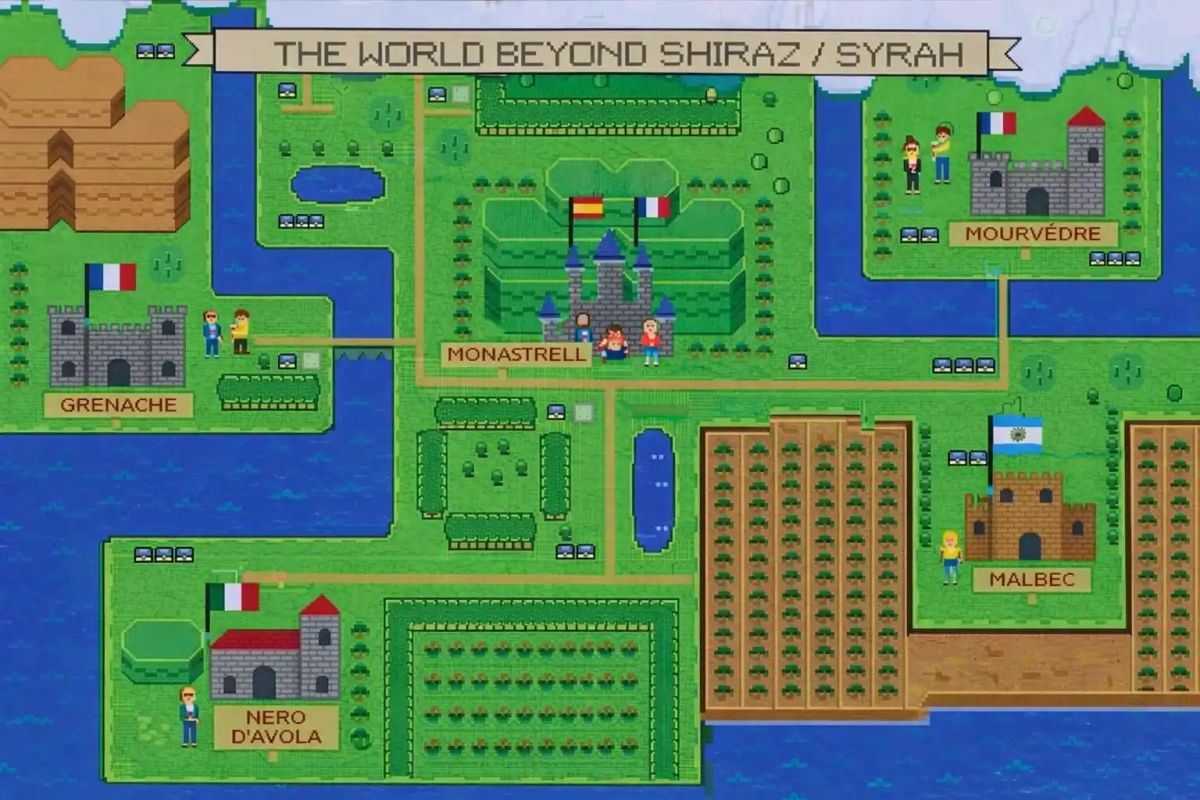
WHAT TO DRINK INSTEAD OF SHIRAZ / SYRAH
Five wines similar to Shiraz and Syrah, and a tasting game to find your favourite.
THE SHORT ANSWER
If you like Shiraz or Syrah, try these five wines: Grenache from the southern Rhône for warmth and spice without the inky weight, Monastrell from Murcia for dark, sun-driven density at a price that still feels like a mistake, Malbec from Mendoza for plush, velvety fruit that lands in the same place by a different route, Mourvèdre from Bandol for structure, earth, and the long game, and Nero d'Avola from Sicily for dried fruit, heat, and a mineral edge that feels closer to rock than soil.
Five wines to try if you like Shiraz or Syrah:
- Grenache (Southern Rhône, France): warm, spiced red fruit, less weight (£9 to £22)
- Monastrell (Murcia, Spain): dark, dense, sun-driven (£8 to £18)
- Malbec (Mendoza, Argentina): plush, velvety, crowd-pleasing (£9 to £22)
- Mourvèdre (Bandol, France): structured, savoury, age-worthy (£12 to £30)
- Nero d'Avola (Sicily, Italy): dried fruit, herbs, volcanic edge (£8 to £18)
THE MAP
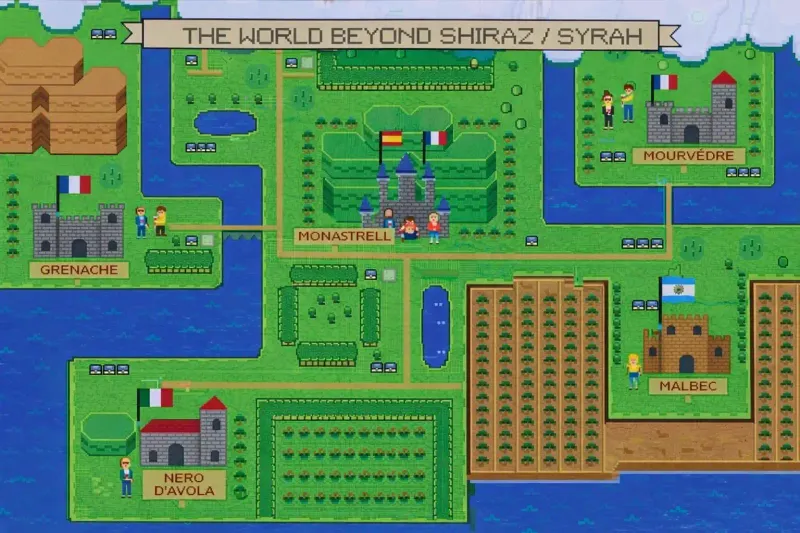
QUICK LEGEND
If you like the ripe, generous, fruit-forward style: go Grenache or Malbec.
If you like density and heat: go Monastrell or Nero d'Avola.
If you like structure, savoury depth, and wines that take their time: go Mourvèdre.
If what you really like is Northern Rhône Syrah, stop here and buy more of it. Everything else is adjacent, not identical.
WHAT CONNECTS THESE WINES
Shiraz and Syrah drinkers are not chasing complexity first. They are chasing presence.
Not just power. Not tannin for its own sake. Something warmer, more immediate. A wine that arrives, takes up space, and stays there. You do not have to work to find it. It does the work for you.
That is why the category works.
The complication is that Shiraz and Syrah are not one thing. The grape is the same. The intention is not.
Northern Rhône Syrah is tight, structured, peppered. It feels like it has been built. Australian Shiraz is riper, rounder, more immediate. It feels like it has been released.
Same dial. Different settings.
These five wines sit across that same spectrum. Each one shifts a single variable. More warmth, more density, more structure, more earth.
Serve at 17 to 18 degrees Celsius. Too warm and they blur. Too cold and they close.
THE FIVE WINES
1. Grenache, the Warm One
Grenache is what happens when you keep the warmth of Shiraz and take away the weight.
Raspberry, red plum, dried herbs, a softness to the tannin that makes the wine feel open from the first sip. Where Syrah builds structure, Grenache relaxes into it. The finish is warmer, looser, more generous.
Good Grenache feels like it has spent longer in the sun than you have.
Châteauneuf-du-Pape is the reference point, and the best bottles justify it. Gigondas gives you most of the experience at a more reasonable price. Côtes du Rhône, when taken seriously, is one of the better everyday reds available.
Spanish Garnacha pushes the dial further. Higher alcohol, riper fruit, more intensity. Priorat shows what the grape can do when yield drops and old vines take over.
This is the move if you like Shiraz but find yourself leaving the last glass in the bottle.
What you will recognise: dark red fruit, warmth, medium tannin, food-friendliness. What changes: more spiced and herbal, less ink and black fruit, rounder, more immediately approachable. Look for: Gigondas and Châteauneuf-du-Pape for the Rhône benchmark. Old-vine Garnacha from Priorat or Campo de Borja for the Spanish version. Budget: £9 to £22.
2. Monastrell, the Dense One
Monastrell is heat made visible.
Grown in Jumilla and Yecla, often in poor soils with very little water, it produces wines that are dark, concentrated, and unapologetically physical. Blackberry, dried plum, a savoury edge that can tip towards game in older examples. The colour alone tells you what you are in for.
This is not subtle wine. It is not trying to be.
What separates good Monastrell from bad is tension. The best bottles hold onto enough acidity to stop the density collapsing in on itself. When that balance is right, the wine feels grounded rather than heavy.
The value remains one of the better secrets in wine. £10 to £12 buys you something that would be £20 elsewhere if people talked about it more.
If Shiraz is your default big red, Monastrell is the version that turns the dial one notch further and leaves it there.
What you will recognise: dark fruit, full body, intensity. What changes: drier and more savoury than Australian Shiraz, more mineral, slightly gamey, less fruit-forward. Look for: Jumilla DO and Yecla DO from Spain. Budget: £8 to £18.
3. Malbec, the Plush One
Malbec and Shiraz often solve the same problem.
You want something dark, full, and reliable. Something that works with food, but does not require it. Something that delivers on the first sip.
The difference is texture.
Shiraz leans savoury. Malbec leans plush. More violet, more dark cherry, less olive and pepper. The tannins are softer, the mid-palate rounder. It feels like it has been upholstered.
Mendoza is the centre. Go one step above entry level and the wines gain freshness and precision. Higher altitude sites in Luján de Cuyo and the Valle de Uco deliver that most reliably.
If Shiraz is doing what you want but you would like it to be slightly more forgiving, Malbec is the cleanest switch you can make.
What you will recognise: dark fruit, full body, easy approachability. What changes: more plush and velvety, more violet and cherry, less savoury and pepper-edged than Shiraz. Look for: Mendoza Malbec, particularly Luján de Cuyo or Valle de Uco. Budget: £9 to £22.
4. Mourvèdre, the Structured One
Mourvèdre in Bandol is Syrah with patience.
Dense, tannic, and built to unfold slowly. Dark fruit, leather, dried herbs, something unmistakably savoury that sits closer to meat than fruit. In youth it can feel closed. Over time it becomes something else entirely.
This is not a wine that tries to win you over in the first five minutes.
The comparison is Northern Rhône Syrah, not Australian Shiraz. Both have structure, both have savouriness, both reward time. Mourvèdre trades pepper for earth, precision for depth.
Domaine Tempier is the reference point. The argument still holds further down the ladder if you are patient enough to wait and willing to go looking.
This is where Shiraz drinkers end up when they realise they care less about impact and more about what happens after it.
What you will recognise: dark fruit, structure, savoury complexity. What changes: earthier, more leather and herb, more demanding in youth, less fruit-forward, built for ageing. Look for: Bandol AOC for the benchmark. Corbières and Minervois in the Languedoc for more accessible Mourvèdre-dominant blends. Budget: £12 to £30.
5. Nero d'Avola, the Mediterranean One
Nero d'Avola is what Shiraz would taste like if it grew up closer to the sea.
Dark cherry, dried plum, herbs, a hint of cocoa, and a mineral edge that feels sun-baked rather than cool. The heat is present, but so is movement. Good examples carry their weight lightly.
There is a push and pull here that makes the wine work. Ripeness against freshness. Density against lift.
The best bottles come from the southeast around Noto, and from volcanic sites where the structure tightens and the fruit sharpens. The mass-market versions are pleasant and forgettable. One tier up and the character appears.
If Shiraz feels too polished, Nero d'Avola gives you something rougher, drier, and more grounded without losing the warmth.
What you will recognise: dark fruit, full body, Mediterranean warmth. What changes: more dried fruit and herbs, more mineral, more savoury, Sicilian rather than Australian in register. Look for: Nero d'Avola from Noto or southeastern Sicily. Producers from the Etna area for more volcanic character. Budget: £8 to £18.
A NOTE ON SYRAH VERSUS SHIRAZ
Same grape. Different intent.
Northern Rhône Syrah is built around tension. Black fruit, olive, and a white pepper note that sits at the back of the finish like a signature. The structure is firm. The wine asks for attention.
Australian Shiraz is built around release. Riper fruit, softer tannin, more immediate generosity. Blackberry, plum, sometimes chocolate or eucalyptus. The edges are rounded off.
If you prefer ripeness, you are closer to Malbec, Monastrell, and Nero d'Avola.
If you prefer structure, you are closer to Mourvèdre and serious Rhône Syrah.
Most people have not tried both side by side. They should.
THE TASTING GAME
What You Need
Five bottles, one of each wine above. Four to five glasses per person. A pen and the rating table below. One person who always orders Shiraz without looking at the list.
Optional but recommended: add an Australian Shiraz and a Northern Rhône Syrah as reference points. The gap between them is the point of the exercise.
The Rating Table
| Characteristic | What you are looking for |
|---|---|
| Dark fruit intensity | Blackberry, plum, dark cherry |
| Body and warmth | Weight in the mouth, warmth of finish |
| Savoury and earthy | Leather, herbs, olive, meat |
| Spice and aromatics | Pepper, dried herbs, floral lift |
| Length | How long the wine stays with you |
Ourglass Benchmarks
| Shiraz (AUS) | Syrah (N. Rhône) | Grenache | Monastrell | Malbec | Mourvèdre | Nero d'Avola | |
|---|---|---|---|---|---|---|---|
| Dark fruit | 5 | 4 | 3 | 5 | 5 | 4 | 4 |
| Body/warmth | 5 | 4 | 4 | 5 | 4 | 4 | 4 |
| Savoury/earthy | 3 | 5 | 3 | 4 | 2 | 5 | 4 |
| Spice/aromatic | 2 | 5 | 4 | 2 | 3 | 3 | 3 |
| Length | 4 | 5 | 3 | 4 | 3 | 5 | 3 |
Most people expect the alternatives to be the interesting part. They are not. The interesting part is discovering how far apart Shiraz and Syrah actually are.
The Five Questions
Between rounds, pour one wine blind and ask:
1. Australia or Europe?
2. More fruit or more earth?
3. Would you drink this without food?
4. More or less pepper than Shiraz?
5. Is this Wine A or Wine B?
Question 4 is the diagnostic one. Northern Rhône Syrah has a white pepper character that is almost as distinctive as Grüner Veltliner's. Australian Shiraz barely has it. Mourvèdre does not have it. Grenache does not have it. If someone scores a wine high on pepper, they are most likely holding a Northern Rhône expression.
If you want someone to keep finding wines like these, that is exactly what Ourglass is for. Start here.
WHAT YOUR SCORES REVEAL ABOUT YOUR PALATE
High dark fruit + high body + low savoury? You like the Australian style. Malbec and Monastrell are your territory. Next: Primitivo from Puglia, Zinfandel from California, Negroamaro from Salento.
High savoury + high length + moderate dark fruit? You are drawn to the Northern Rhône style. Mourvèdre from Bandol is the closest relative. Next: aged Corbières, Priorat, Ribera del Duero Reserva.
High spice + high aromatic lift? You like the pepper and violet character of Syrah specifically. Next: Crozes-Hermitage for the entry point, Hermitage when the occasion warrants it.
High body + high warmth + Mediterranean character? Nero d'Avola and Monastrell are your grapes. Next: Aglianico from Campania, Sagrantino from Umbria, Primitivo from Manduria.
YOUR SHOPPING LIST
| Grenache | Monastrell | Malbec | Mourvèdre | Nero d'Avola | |
|---|---|---|---|---|---|
| Region | Southern Rhône, France | Jumilla/Yecla, Spain | Mendoza, Argentina | Bandol, France | Sicily, Italy |
| Budget | £9–22 | £8–18 | £9–22 | £12–30 | £8–18 |
| Start with | Gigondas or Côtes du Rhône | Jumilla DO | Luján de Cuyo or Valle de Uco | Bandol AOC | Noto or southeastern Sicily |
GO DEEPER
What to drink instead of Malbec. The other half of this conversation.
What to drink instead of Cabernet Sauvignon. The structured red version.
What to drink instead of Rioja. The oak-aged red version.
What to drink instead of Rose. The pink version.
What to drink instead of Pinot Grigio. The non-obvious version.
A guide to Barolo. Where structured red drinkers often end up.
How to develop your wine palate.
Is a wine subscription worth it?
FREQUENTLY ASKED QUESTIONS
If I like Shiraz, what else will I like?
Grenache from the southern Rhône for warm red fruit without the weight. Monastrell from Spain for dark, dense Mediterranean intensity. Malbec from Mendoza for plush dark fruit with a similar approachability. Mourvèdre from Bandol for the structured, earthy, age-worthy version. Nero d'Avola from Sicily for sun-baked intensity and volcanic mineral depth.
What is the difference between Shiraz and Syrah?
Same grape, different styles. Syrah from the Northern Rhône is peppery, precise, and structured. Shiraz from Australia, particularly Barossa and McLaren Vale, is riper, rounder, and more immediately generous. The white pepper that defines Northern Rhône Syrah is largely absent in Australian Shiraz.
What wine is most similar to Australian Shiraz?
Malbec from Mendoza for texture and dark fruit character. Monastrell from Jumilla for similar intensity at lower prices. Nero d'Avola from Sicily shares the body and warmth with a more Mediterranean savour.
What is Monastrell?
A Spanish red grape grown primarily in Jumilla, Yecla, and Alicante. Makes full-bodied, dark-fruited, savoury wines of remarkable value. One of the most underpriced reds in the world.
What is Mourvèdre?
A red grape grown in Bandol in Provence, where it makes structured, earthy, age-worthy wines. The same grape as Monastrell in Spain and Mataro in Australia. In Bandol it produces some of the most compelling and least-known reds in France.
What is Nero d'Avola?
A red grape from southeastern Sicily. Makes full-bodied wines with dark cherry, dried plum, dried herbs, and volcanic mineral character. Reliable value and genuine personality. The choice for Shiraz drinkers who want Mediterranean intensity over Australasian warmth.
Is Grenache similar to Shiraz?
In warmth and approachability, yes. Grenache is lighter in body, more red-fruited, and less ink-dark than Shiraz. It shares the food-friendliness and the southern warmth without the weight. Côtes du Rhône is the accessible starting point.