
WHAT TO DRINK INSTEAD OF ORANGE WINE
Five wines similar to orange wine, and a tasting game to find your favourite.
THE SHORT ANSWER
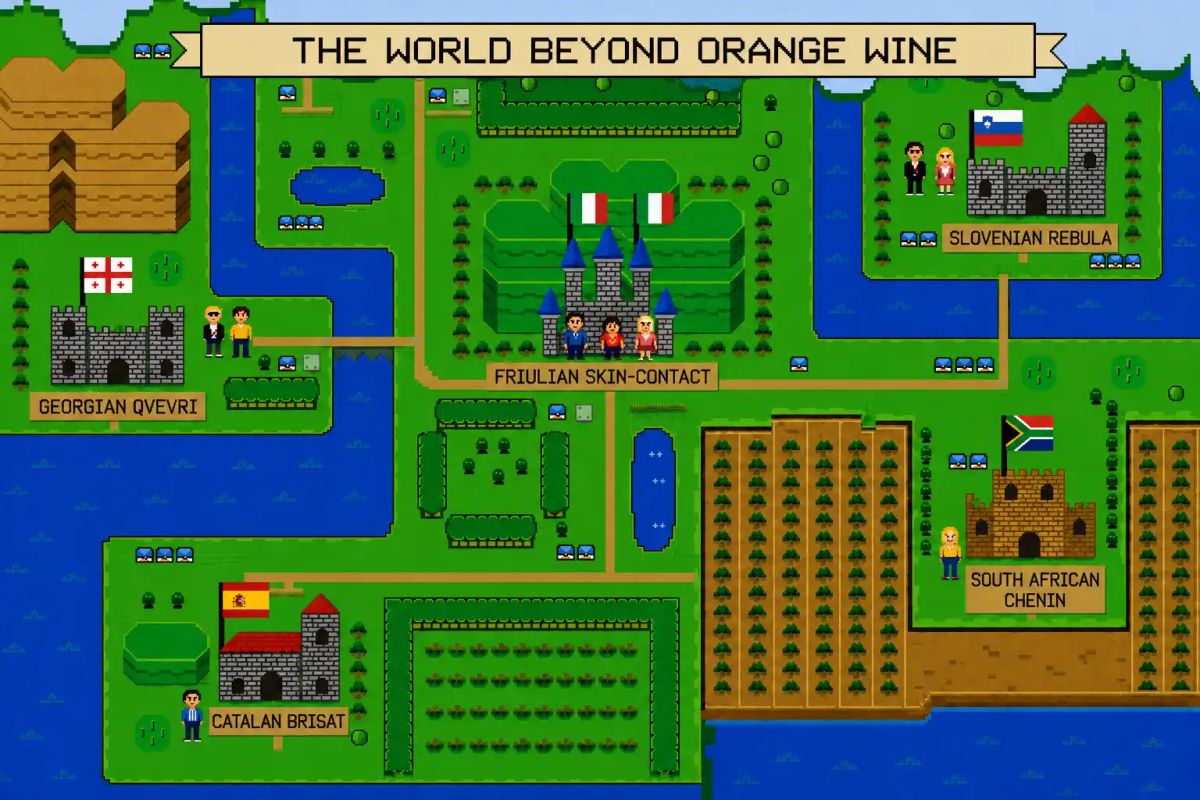
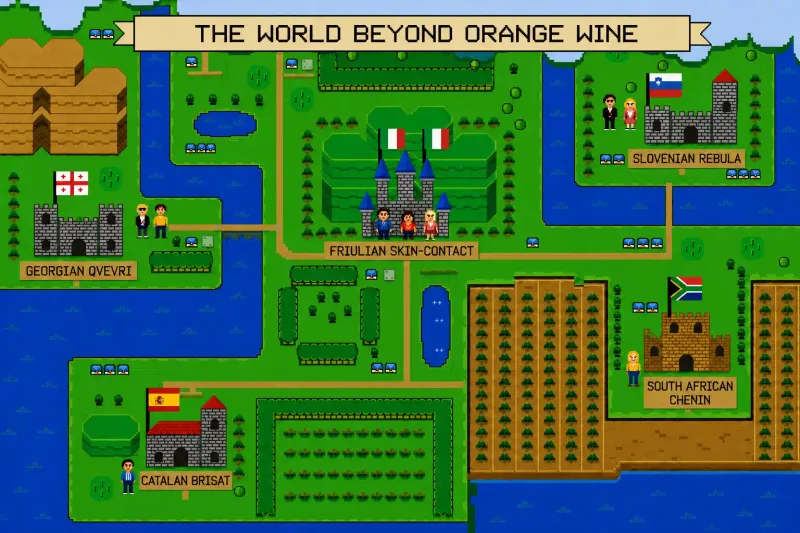
If you like orange wine, try these five wines: Georgian qvevri amber wine for the original article, made the same way for eight thousand years, Friulian skin-contact white for the European benchmark that started the modern revival, Slovenian Rebula from just across the border for the same hills in a different language, South African skin-contact Chenin for the bright new-world take, and Catalan brisat for Spain's own quiet version of the style.
Five wines to try if you like orange wine:
- Georgian qvevri amber (Kakheti, Georgia): the eight-thousand-year original (£15 to £35)
- Friulian skin-contact (Friuli, Italy): the modern benchmark (£18 to £45)
- Slovenian Rebula (Brda, Slovenia): the cross-border twin (£15 to £35)
- South African Chenin (Swartland, South Africa): the bright new-world one (£14 to £28)
- Catalan brisat (Empordà, Spain): the Spanish revival (£14 to £30)
THE MAP
| Georgian qvevri | Friulian skin-contact | Slovenian Rebula | South African Chenin | Catalan brisat | |
|---|---|---|---|---|---|
| Body and texture | Full, grippy | Full, structured | Medium to full | Medium | Medium |
| Tannin (grip) | High | High | Medium to high | Medium | Medium |
| Aromatics | Dried fruit, tea | Nut, orchard fruit | Floral, citrus peel | Quince, herb | Citrus, almond |
| Closest match to orange wine | The origin | The benchmark | The twin | The fresh one | The gentle one |
| Price band | £15 to £35 | £18 to £45 | £15 to £35 | £14 to £28 | £14 to £30 |
| Best occasion | Long lunch, feast | Cheese, debate | Aperitif onward | Sunny terrace | Tapas table |
QUICK LEGEND
If you want the wine that started it all, made in clay buried underground: go Georgian qvevri.
If you want the serious European benchmark that launched the revival: go Friulian.
If you want the same style from the same hills in a fresher register: go Slovenian Rebula.
If you want skin-contact with new-world brightness and less grip: go South African Chenin.
If you want the gentlest, most approachable way in: go Catalan brisat.
WHAT CONNECTS THESE WINES
Orange wine is the most misunderstood drink on any modern wine list.
It is not made from oranges, and it is not a natural-wine gimmick. It is simply white wine made like red wine. Instead of pressing the juice off the grape skins straight away, the winemaker leaves the juice in contact with the skins for days, weeks or months. Those skins give white grapes what they normally never get: colour, ranging from gold to deep amber, plus tannin, texture and a savoury, dried-fruit complexity. The result is a wine that smells like a white and behaves like a red, with grip on the finish and a genuine ability to stand up to bold food.
That single technique, skin contact, is the thread running through all five of these wines. Each one applies it to a different grape in a different place, from clay vessels buried in a Georgian courtyard to a modern South African cellar. What they share is texture over fruitiness, savour over sweetness, and a refusal to be background wine.
Skin-contact whites are food wines above all. They reward the same dishes that defeat ordinary white: roast vegetables, hard cheese, fermented and spiced food, anything with real savour.
Serve cool but not cold, around 12 to 14 degrees Celsius, in a generous glass so the aromatics open.
THE FIVE WINES
1. Georgian Qvevri Amber, the Original
Every orange wine on earth descends from what they have been making in Georgia for eight thousand years.
In the country of Georgia, white grapes such as Rkatsiteli and Mtsvane are fermented on their skins inside qvevri, large clay vessels buried up to the neck in the ground. The wine that emerges is deep amber, firmly tannic and tastes of dried apricot, walnut, black tea, orange peel and honey. This is not a trend to the Georgians. It is the everyday wine, poured by the jug at feasts that last for hours. To drink it is to taste the source of the entire category.
This is the move for the orange-wine drinker who wants the real, uncompromising article rather than a polished imitation.
What you will recognise: amber colour, grip, dried-fruit and tea aromatics. What changes: a deeper, earthier, more tannic profile than most modern orange wines, made by a method no one else can claim to have invented. Look for: qvevri or amber wine from Kakheti, with Rkatsiteli the classic grape. Budget: £15 to £35.
2. Friulian Skin-Contact, the Benchmark
If Georgia is the origin, Friuli is where the modern world rediscovered the idea and made it serious.
In the north-east corner of Italy, on the Slovenian border, a handful of growers revived long skin contact in the 1990s and turned it into some of the most respected wines of the style anywhere. The grapes are local, chiefly Ribolla Gialla, alongside skin-contact versions of Pinot Grigio, which turns a coppery pink known as ramato. Expect orchard fruit, almond, dried herb, a saline savour and a fine tannic grip. These are structured, ageworthy wines that argue for skin contact as a mark of quality rather than novelty.
This is for the drinker who wants orange wine at its most polished and complete.
What you will recognise: texture, savour, a serious tannic frame. What changes: more precision and orchard-fruit clarity than the Georgian style, less earth and more finesse. Look for: Ribolla Gialla and ramato Pinot Grigio from Friuli, especially the Collio and Colli Orientali zones. Budget: £18 to £45.
3. Slovenian Rebula, the Cross-Border Twin
The same hills that make Friulian skin-contact wine carry on across the border, where Italian becomes Slovenian and Ribolla Gialla becomes Rebula.
Brda, in western Slovenia, shares the geology, the climate and the tradition of its Italian neighbour, and makes skin-contact whites every bit as good, usually for less money. Rebula is the signature grape, giving citrus peel, white flower, stone fruit and a savoury, faintly waxy texture from time on the skins. The styles range from a few days of contact, which keeps things fresh and only lightly amber, to months in barrel, which deepens both colour and grip. It is the value play of the category.
This is for the orange-wine drinker who has met the famous Friulian names and wants the same quality at a kinder price.
What you will recognise: skin-contact texture, savoury fruit, a gentle grip. What changes: often a touch fresher and more floral than the Italian side, and reliably better value. Look for: Rebula from Brda, in both lighter and extended-contact styles. Budget: £15 to £35.
4. South African Chenin, the Bright One
South Africa took skin contact and made it sing in a brighter, sunnier key.
In the Swartland, north of Cape Town, a generation of growers has applied gentle skin contact to old-vine Chenin Blanc, the country's signature white grape. The contact is usually shorter than in Georgia or Friuli, so these wines sit at the fresher, paler end of orange, gold rather than deep amber. They give you quince, dried pear, honey, fynbos herb and a textural, faintly grippy finish, with more juicy fruit than the European styles. It is skin contact as seasoning rather than the whole dish.
This is for the drinker who finds full-amber wines too austere and wants the texture with more brightness and fruit.
What you will recognise: gentle grip, savoury texture, a golden hue. What changes: fresher, fruitier and less tannic, with the herbal lift of the Cape. Look for: skin-contact or skin-fermented Chenin Blanc from the Swartland. Budget: £14 to £28.
5. Catalan Brisat, the Gentle One
Spain has quietly been making skin-contact white for years, and calls it brisat.
In Catalonia, particularly the Empordà near the French border and parts of Penedès, growers ferment local white grapes such as Garnatxa Blanca and Macabeu on their skins to make brisat, sometimes labelled vi brisat or simply skin-contact. The wines tend to be approachable: citrus, almond, dried herb and a light, pleasant grip rather than a heavy one. They were never a marketing exercise, just a traditional way of making white wine with more flavour and texture, now finding a new audience. It is the easiest entry point on this list.
This is for the curious drinker who wants to understand orange wine without being thrown in at the deep end.
What you will recognise: savoury texture, citrus and almond, a mild tannic edge. What changes: lighter and friendlier than the amber heavyweights, with Mediterranean herb and a gentle touch. Look for: brisat from Empordà or Penedès, made from Garnatxa Blanca or Macabeu. Budget: £14 to £30.
A NOTE ON ORANGE WINE VERSUS NATURAL WINE
These two terms get tangled together constantly, and they are not the same.
Orange wine describes a method: white grapes fermented in contact with their skins, which gives colour, tannin and texture. That is all it means. Natural wine describes a philosophy: low-intervention winemaking with little or no added sulphur and minimal manipulation, which can apply to any colour of wine. Plenty of orange wine is made naturally, which is why the two became linked in people's minds, but an orange wine can be made conventionally, and a natural wine can be a crisp white, a red or a rosé.
The reason it matters is expectation. Some people taste a cloudy, funky natural orange wine and conclude they dislike the whole category, when what they actually disliked was the natural-winemaking style. A clean, precise Friulian skin-contact wine tells a completely different story. Judge the method on its own terms. If you enjoy a wine that smells like a white but grips like a red, you enjoy skin contact, whatever else is on the label.
THE TASTING GAME
What You Need
Five bottles, one of each wine above. Four to five white wine glasses per person, ideally a wider bowl to let the aromatics open. A pen and the rating table below. Savoury food on the table, not sweet: hard cheese, roast vegetables, a spiced dish or two. One person who thinks orange wine is a hipster invention, so the Georgian bottle can correct them.
Optional but recommended: add a crisp unoaked white, such as a Pinot Grigio with no skin contact, as a control, to show exactly what the skins are doing.
The Rating Table
| Characteristic | What you are looking for |
|---|---|
| Colour | How deep the gold or amber runs |
| Grip (tannin) | The drying, textural pull on the finish |
| Savoury character | Dried fruit, nut, tea, herb rather than fresh fruit |
| Aromatics | What you smell before you taste |
| Food transformation | How much better the savoury food tastes with the wine |
Ourglass Benchmarks
| Characteristic | Orange wine | Georgian qvevri | Friulian | Slovenian Rebula | SA Chenin | Catalan brisat |
|---|---|---|---|---|---|---|
| Colour | 4 | 5 | 4 | 4 | 3 | 3 |
| Grip (tannin) | 4 | 5 | 4 | 3 | 3 | 2 |
| Savoury character | 4 | 5 | 4 | 4 | 3 | 3 |
| Aromatics | 4 | 4 | 5 | 4 | 4 | 4 |
| Food transformation | 4 | 5 | 4 | 4 | 3 | 3 |
The decisive row is grip. Tannin in a white wine is the whole point of skin contact, and it is exactly what divides the people who love this style from the people who do not. The game is to find how much grip you actually enjoy, from the full Georgian pull to the gentle Catalan touch, because that single preference will guide every orange wine you buy from now on.
If you would rather have wines chosen for the way they behave at the table than the way they read on a shelf, that is what Ourglass is for. Start here.
WHAT YOUR SCORES REVEAL ABOUT YOUR PALATE
Loved the deepest colour and the most grip? You are a true amber drinker. Next: more Georgian qvevri wine, and extended-contact Friulian.
Drawn to the polish and precision of the Friulian? You value structure and savour. Next: Ribolla Gialla, ramato Pinot Grigio, and ageworthy skin-contact whites.
Preferred the value and freshness of the Slovenian? You have found the smart corner of the category. Next: more Brda Rebula, and the wider orange wines of central Europe.
Found the South African the easiest to drink? You want texture with fruit and brightness. Next: skin-contact Chenin and other lightly amber new-world whites.
Happiest with the gentle Catalan style? You like the idea more than the extreme. Next: brisat, ramato, and any wine labelled lightly skin-contact.
Not sure? Read our guide on how to taste wine, or look up the grapes in the definitive guide to wine grape varieties.
YOUR SHOPPING LIST
| Georgian qvevri | Friulian | Slovenian Rebula | South African Chenin | Catalan brisat | |
|---|---|---|---|---|---|
| Region | Kakheti, Georgia | Friuli, Italy | Brda, Slovenia | Swartland, South Africa | Empordà, Spain |
| Budget | £15 to £35 | £18 to £45 | £15 to £35 | £14 to £28 | £14 to £30 |
| Start with | Rkatsiteli qvevri | Ribolla Gialla | Brda Rebula | Skin-contact Chenin | Empordà brisat |
None of these is a supermarket regular. Skin-contact wine almost always means an independent merchant or a specialist online list, which is part of the fun and the reason the prices stay fair. A good independent will happily point you to a starter bottle in any of these five styles.
GO DEEPER
What to drink instead of Pinot Grigio. The grape that, left on its skins, turns into ramato orange wine.
What to drink instead of Sauvignon Blanc. For the other end of the white spectrum, all freshness and no grip.
What to drink instead of Sherry. Another wine worth meeting on its own terms.
The definitive guide to wine grape varieties. Every grape here, in context.
How to taste wine. The method behind the game.
If you like that wine, try this. The full map of alternatives.
FREQUENTLY ASKED QUESTIONS
What is orange wine?
White wine made like red wine. The juice is left in contact with the grape skins for days, weeks or months, which gives it colour ranging from gold to deep amber, plus tannin, texture and a savoury, dried-fruit character. It is not made from oranges.
What does orange wine taste like?
Dried apricot, orange peel, nut, black tea, honey and dried herb, with a savoury edge and a drying grip on the finish. It smells like a white wine but behaves like a red, which is exactly what makes it so good with food.
If I like orange wine, what else will I like?
Georgian qvevri amber for the original style, Friulian skin-contact for the polished benchmark, Slovenian Rebula for the same hills at better value, South African skin-contact Chenin for a fresher take, and Catalan brisat for the gentlest way in.
Is orange wine the same as natural wine?
No. Orange wine is a method, skin contact on white grapes. Natural wine is a low-intervention philosophy that can apply to any colour. Much orange wine is made naturally, which is why they get confused, but they are different things.
Where does orange wine come from?
The technique is around eight thousand years old and originates in Georgia, where white grapes are fermented on their skins in buried clay vessels called qvevri. The modern revival was led from the 1990s by growers in Friuli in north-east Italy and neighbouring Slovenia.
What food goes with orange wine?
Savoury and bold dishes that defeat ordinary white wine: hard cheese, roast vegetables, mushrooms, fermented food, and many spiced and aromatic dishes. The tannin and savour let it behave like a light red at the table.
Why is orange wine so expensive?
Skin contact takes longer, ties up the cellar, and is mostly done by small artisan producers in low volumes, so prices run higher than mass-market white. Slovenian Rebula and South African Chenin are the best-value ways into the style.
Which orange wine should a beginner try first?
A lighter Catalan brisat or a South African skin-contact Chenin, both gentle and approachable. Once you enjoy the texture, step up to a Friulian benchmark and finally a full-amber Georgian qvevri wine to taste the whole range.