
WHAT TO DRINK INSTEAD OF RIESLING
Five wines similar to Riesling, and a tasting game to find your favourite.
THE SHORT ANSWER
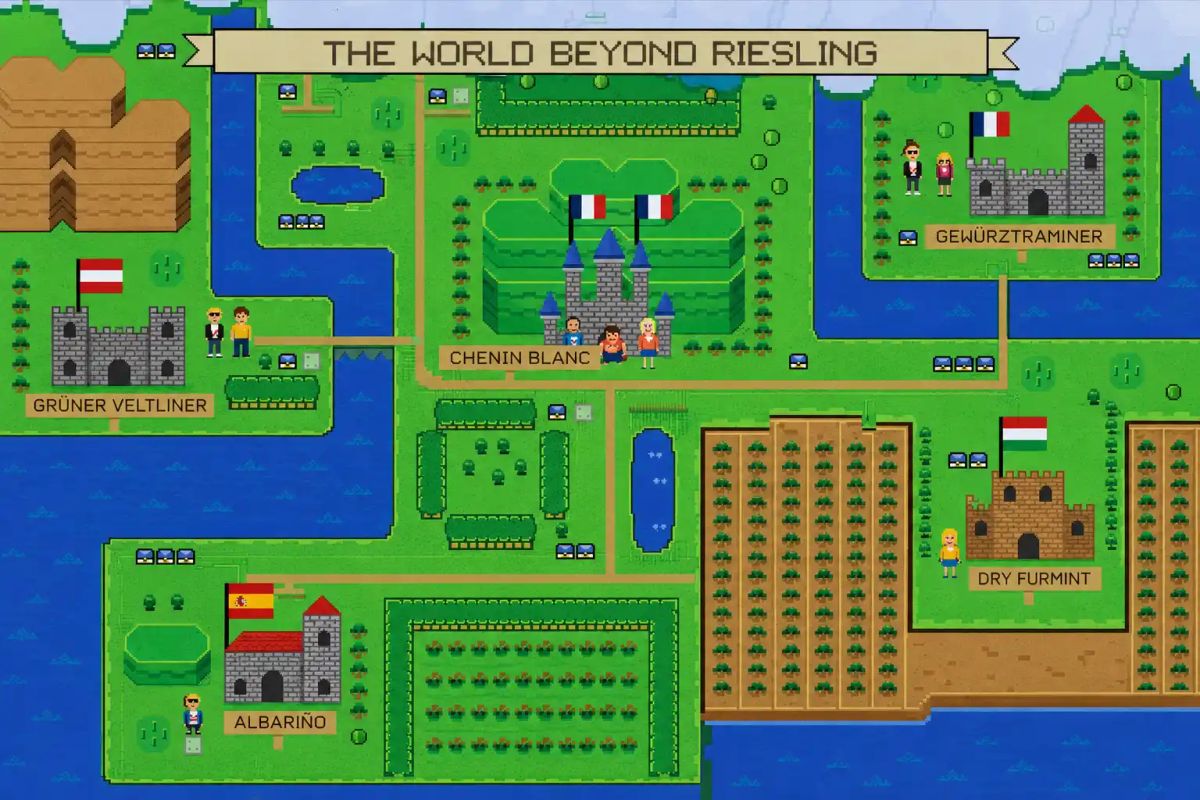
If you like Riesling, try these five wines: Grüner Veltliner from Austria for the same high-acid, mineral cut in a reliably dry style, Chenin Blanc from the Loire for a wine that runs the exact same line from bone dry to genuinely sweet, Gewürztraminer from Alsace for the perfume turned up and the acid turned down, dry Furmint from Tokaj for smoke and stony intensity at a price almost nobody has noticed yet, and Albariño from the Atlantic coast of Spain for the salt-and-citrus version that was built for a plate of shellfish.
Five wines to try if you like Riesling:
- Grüner Veltliner (Wachau and Kamptal, Austria): dry, citrus, white pepper, mineral (£9 to £20)
- Chenin Blanc (Vouvray and the Loire; South Africa): dry to sweet, honeyed, high acid (£10 to £25)
- Gewürztraminer (Alsace, France): lychee, rose, ginger, low acid (£12 to £24)
- Dry Furmint (Tokaj, Hungary): smoke, citrus pith, beeswax, mineral (£11 to £22)
- Albariño (Rías Baixas, Spain): stone fruit, salt, citrus, slight spritz (£9 to £18)
THE MAP
| Grüner Veltliner | Chenin Blanc | Gewürztraminer | Dry Furmint | Albariño | |
|---|---|---|---|---|---|
| Body | Light to medium | Medium | Medium to full | Medium | Light to medium |
| Acidity | High | High | Low to medium | High | High |
| Sugar | Dry | Dry to sweet | Off-dry | Dry | Dry |
| Closest match to Riesling | The dry version | The sweetness range | The aromatics | The minerality | The coastal edge |
| Price band | £9 to £20 | £10 to £25 | £12 to £24 | £11 to £22 | £9 to £18 |
| Best occasion | Aperitif, vegetables | Anything, any course | Spice, hard cheese | Smoked fish, age | Shellfish, sun |
QUICK LEGEND
If you like the dry, mineral, citrus-edged style: go Grüner Veltliner or dry Furmint.
If what you like is the full sweet-to-dry range: go Chenin Blanc.
If you like the perfume more than the acid: go Gewürztraminer.
If you like Riesling with seafood and a sea breeze: go Albariño.
If what you really like is great German Riesling, stop here and buy more of it. Everything else is adjacent, not identical.
WHAT CONNECTS THESE WINES
Riesling has spent forty years serving a sentence for a crime it did not commit.
The crime was Liebfraumilch. A generation of British drinkers met German wine through Blue Nun and Black Tower, decided German white meant sweet and apologetic, and never went back. Riesling took the blame. The grape that fills the great bottles of the Mosel and the Rheingau is the opposite of that: the most transparent white grape in the world, hiding nothing, tasting ferociously of the place it grew.
What Riesling drinkers chase is not sweetness. It is tension. A line of acidity so precise it feels drawn rather than tasted, carrying citrus, orchard fruit, and a wet-stone note no winemaking trick can fake. The sweetness, where it exists, balances the acid, the way a tightrope walker carries a pole.
These five wines hold that line. Each moves a single variable: more earth, more perfume, more salt, more flexibility. None is Riesling. All answer the same question.
Serve all five well chilled, 8 to 10 degrees Celsius. Too cold and the aromatics close. Too warm and the acid turns shrill.
THE FIVE WINES
1. Grüner Veltliner, the Dry Cousin
If your Riesling is always dry, this is the cleanest switch you can make.
Grüner Veltliner is Austria's signature white, and it shares Riesling's spine almost exactly: high natural acidity, citrus and green orchard fruit, and a savoury note somewhere between white pepper and crushed lentil that is entirely its own. Where Riesling can flirt with sweetness, Grüner rarely bothers. It is dry by temperament.
The reference points are the terraced vineyards of the Wachau, where the wines gain weight and a stony grip, and the broader Kamptal and Kremstal, where they stay lighter. Federspiel is the everyday weight, Smaragd the serious one. This is the move for the Riesling drinker who has quietly given up explaining that no, it is not sweet.
What you will recognise: high acid, citrus, mineral cut, food versatility. What changes: drier by default, more savoury and peppery, less floral, less honey. Look for: Wachau, Kamptal or Kremstal from Austria; Federspiel for everyday, Smaragd to go deeper. Budget: £9 to £20.
2. Chenin Blanc, the Shape-Shifter
Chenin Blanc is the only other white grape that does what Riesling does with sugar.
It runs the entire spectrum, bone dry through off-dry to lusciously sweet, all on a frame of bracing acidity. Quince, baked apple, honey, and a lanolin texture that coats rather than slides. The acidity is the constant. Everything else moves.
The benchmark is the Loire: Vouvray for the full sweetness range, Savennières for the bone-dry, ageworthy version Riesling drinkers fall hardest for. South Africa, particularly the old bush vines of the Swartland, gives you dry, textured Chenin at prices the Loire stopped offering years ago. If what you love about Riesling is that one grape can be both aperitif and dessert, Chenin understands you.
What you will recognise: high acid, honeyed fruit, a sweet-to-dry range, ageworthiness. What changes: rounder texture, more quince and lanolin, less petrol and lime, more obviously food-shaped. Look for: Vouvray and Savennières from the Loire; Swartland Chenin for dry value. Budget: £10 to £25.
3. Gewürztraminer, the Aromatic One
Gewürztraminer is Riesling with the perfume turned up and the acid turned down.
Lychee, rose petal, Turkish delight, ginger, and an oily weight that fills the mouth in a way Riesling never does. It is the most overtly aromatic white in circulation, and it divides people instantly. There is no quiet Gewürztraminer.
Alsace is the home, and the best bottles hold just enough freshness to stop the perfume becoming cloying. That balance is the whole game: when it tips, the wine turns to soap; when it holds, it is almost unmatched with strong cheese and aromatic spice. This is for the Riesling drinker who, if honest, was always there for the smell as much as the taste.
What you will recognise: aromatic intensity, off-dry sweetness, exotic fruit. What changes: much lower acid, fuller body, rose and lychee instead of lime and stone, more divisive. Look for: Alsace Gewürztraminer; the better cooperatives are reliable, named producers more so. Budget: £12 to £24.
4. Dry Furmint, the Mineral One
Furmint is best known for the sweet wines of Tokaj. Its dry version is the secret.
Smoke, citrus pith, beeswax, bruised apple, and a stony intensity that feels mined rather than grown. High acid, real weight, and a savoury grip that puts it at the structured end of the Riesling spectrum, closer to a serious dry Mosel than to anything soft. It also ages, gaining a waxy depth while keeping its cut.
Hungary has spent a decade rebuilding dry Furmint as a serious category, and the wines are still priced as if nobody has noticed. Mostly, nobody has.
This is where dry-Riesling drinkers go when they want more weight and smoke without losing the line.
What you will recognise: high acid, mineral drive, ageworthiness, savoury depth. What changes: smokier, waxier, more textured, less overtly fruity, less famous. Look for: dry Furmint from Tokaj, Hungary; "száraz" on the label means dry. Budget: £11 to £22.
5. Albariño, the Coastal One
Albariño is what Riesling tastes like when it grows within sight of the Atlantic.
From Rías Baixas in Galicia, on Spain's wet, green, north-west corner, it pours pale, brisk and faintly spritzy: white peach, grapefruit pith, almond, and a salinity that tastes like the wine was made to be drunk beside the sea, because it was. The acidity is high, the finish dry, the whole thing built around shellfish the way Riesling is built around the table.
The good bottles add a citrus-oil weight without losing the freshness; one step up from the supermarket and the salt and stone appear. We go deeper on this grape in our Albariño grape guide, and it earns its own piece in this series shortly.
What you will recognise: high acid, citrus, dry finish, food friendliness. What changes: more saline and coastal, more stone fruit, slightly spritzy, no petrol note. Look for: Rías Baixas from Spain; the subzone Val do Salnés for the saltiest, most mineral style. Budget: £9 to £18.
A NOTE ON SWEET VERSUS DRY RIESLING
This is the question that follows Riesling everywhere, so answer it plainly.
Most Riesling sold today is dry. The confusion comes from the German label, which describes ripeness at harvest, not sugar in the glass. Kabinett, Spätlese and Auslese tell you how ripe the grapes were when picked, not how sweet the wine tastes; a Spätlese can be bone dry. The word that guarantees dryness is "trocken", and "feinherb" or "halbtrocken" means off-dry. No qualifying word on a classic Mosel usually means deliberate sweetness, balancing acidity that would otherwise strip paint.
Australian Riesling, from the Clare and Eden Valleys, removes the question: bone dry, lime-driven, built like a blade.
If you have avoided Riesling assuming it is sweet, you have avoided the wrong wine for the right reason. Buy one bottle marked trocken and one classic Mosel Kabinett, and taste them side by side. The gap is the entire point.
THE TASTING GAME
What You Need
Five bottles, one of each wine above. Four to five white wine glasses per person. A pen and the rating table below. One person at the table who insists they do not like Riesling and has never knowingly tried a dry one.
Optional but recommended: add a German Riesling trocken and a classic Mosel Kabinett as reference points. Tasting those two side by side is half the lesson.
The Rating Table
| Characteristic | What you are looking for |
|---|---|
| Acidity | How much the wine makes your mouth water |
| Citrus and orchard fruit | Lime, lemon, green apple, pear |
| Aromatic lift | How loudly the wine announces itself before you sip |
| Dryness | 1 = noticeably sweet, 5 = bone dry |
| Mineral or saline edge | Wet stone, smoke, salt on the finish |
Ourglass Benchmarks
| Characteristic | Riesling | Grüner V. | Chenin | Gewürz. | Furmint | Albariño |
|---|---|---|---|---|---|---|
| Acidity | 5 | 5 | 4 | 2 | 5 | 5 |
| Citrus and orchard fruit | 5 | 4 | 4 | 2 | 4 | 4 |
| Aromatic lift | 4 | 2 | 3 | 5 | 3 | 3 |
| Dryness | 3 | 5 | 3 | 4 | 5 | 5 |
| Mineral or saline edge | 5 | 4 | 3 | 1 | 5 | 4 |
The most revealing row is Dryness. Riesling sits at 3 not because it is sweet but because the category genuinely spans the range, and that flexibility is the thing most people misread. The exercise is to find which alternative gives you the part of Riesling you actually wanted, with one less argument attached.
If you want to keep finding wines chosen for what you respond to rather than what the label says, that is what Ourglass is for. Start here.
WHAT YOUR SCORES REVEAL ABOUT YOUR PALATE
High acidity and high dryness, low aromatic lift? Grüner Veltliner is your wine. Next: dry Furmint, Australian Riesling trocken, Assyrtiko from Santorini.
High acidity with a pull towards sweetness when it is balanced? Chenin Blanc is your range. Next: Vouvray demi-sec, Mosel Kabinett, aged Savennières.
High aromatic lift, lower interest in acid? Gewürztraminer is the honest answer. Next: Alsace Pinot Gris, Torrontés, Muscat sec.
Mineral and saline edge above everything? You are a Furmint or Albariño drinker. Next: dry Tokaji, Val do Salnés Albariño, Chablis.
Not sure yet? That is the useful result. Take the palate route through Taste Decoded, or read our guide to developing your palate for the slower version.
YOUR SHOPPING LIST
| Grüner Veltliner | Chenin Blanc | Gewürztraminer | Dry Furmint | Albariño | |
|---|---|---|---|---|---|
| Region | Wachau / Kamptal, Austria | Loire, France; Swartland, South Africa | Alsace, France | Tokaj, Hungary | Rías Baixas, Spain |
| Budget | £9 to £20 | £10 to £25 | £12 to £24 | £11 to £22 | £9 to £18 |
| Start with | Kamptal Grüner everyday, Wachau Smaragd to go deeper | Vouvray for the range, Swartland for dry value | Alsace Gewürztraminer, a named producer if you can | Dry Furmint marked "száraz" | Rías Baixas, Val do Salnés for the saltiest style |
Widely stocked across the major UK supermarkets and wine merchants. Grüner Veltliner and Albariño are the easiest to find on a normal high street. Dry Furmint is the one most likely to need an independent or an online specialist, which is precisely why it is still good value.
GO DEEPER
What to drink instead of Chardonnay. The other half of the dry-white conversation.
The Ourglass grape guide to Albariño. The coastal alternative, in full.
A guide to the wine regions of Germany. Where Riesling actually comes from.
The definitive guide to wine grape varieties. The map behind all of this.
If you like that wine, try this. Fourteen more of these jumps.
How to develop your wine palate. The long game.
FREQUENTLY ASKED QUESTIONS
Is Riesling sweet or dry?
Most Riesling sold today is dry. The grape is made across the full range, from bone dry to genuinely sweet. On a German label, "trocken" means dry and "halbtrocken" or "feinherb" means off-dry. Australian Riesling, especially from the Clare and Eden Valleys, is almost always bone dry.
If I like Riesling, what else will I like?
Grüner Veltliner from Austria for the dry, mineral, high-acid version. Chenin Blanc from the Loire for the same sweet-to-dry range. Gewürztraminer from Alsace for the aromatics without the acid. Dry Furmint from Tokaj for smoke and stony intensity. Albariño from Rías Baixas for the saline, seafood-friendly side.
What does Riesling taste like?
Lime, green apple, pear and white peach over a high line of acidity, with a wet-stone mineral note. Older bottles develop a distinctive petrol character that signals quality rather than a fault. The acidity defines it, not the sweetness.
What does Kabinett or Spätlese mean on a Riesling label?
They are rungs on the German Prädikat ladder, which grades how ripe the grapes were when picked, rising from Kabinett to Spätlese to Auslese. They indicate ripeness, not guaranteed sweetness. A Spätlese can be dry if the label also says trocken.
Is dry Riesling the same as Grüner Veltliner?
No, but they are close in style: both high-acid, citrus-driven, mineral and food-friendly. Grüner is reliably dry with a savoury, peppery edge, which makes it the cleanest substitute for a dry-Riesling drinker.
What food pairs with Riesling and its alternatives?
High acidity makes all of them unusually flexible. Dry styles handle shellfish, roast chicken and vegetables. Off-dry styles are the classic answer to Thai and Indian spice. Gewürztraminer is the specialist for strong washed-rind cheese.
What is the difference between German and Australian Riesling?
German Riesling is the more delicate, transparent version and spans the full sweetness range. Australian Riesling, especially Clare and Eden Valley, is bone dry, lime-driven and tightly built. Tasting the two side by side is the fastest way to understand the grape.
Which Riesling alternative is best for a beginner?
Albariño: dry, fresh, widely stocked in UK supermarkets, reliably good at an everyday price and hard to dislike. Grüner Veltliner is a close second.