
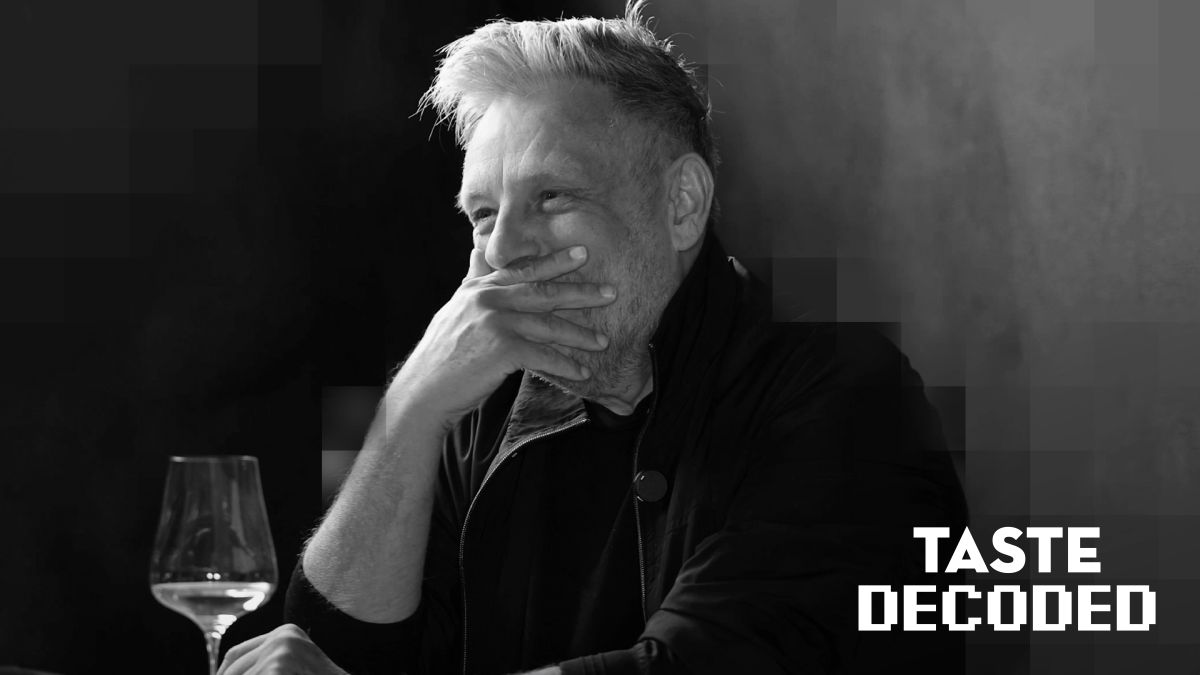
RANKIN ON TASTE: THE REAL HONOUR
Filmed at Planque, Haggerston, East London
"Your intuition shouldn't be undermined or underrated because that's why the work's good."
This is the second conversation with photographer Rankin for Taste Decoded. In Part 1, we explored why instinct beats intellect. Here, he goes deeper: why Desert Island Discs is the real honour, the Damien Hirst test for critics, and how he stopped pre-judging anyone around 1998.
DESERT ISLAND DISCS VS KNIGHTHOOD
Rankin has clear views on cultural hierarchy.
"More people get knighted than get asked to do Desert Island Discs. In terms of hierarchy, Desert Island Discs is better than the honour system."
Why? "The honour system has been hacked. You can brief a company – here's a hundred grand – to lobby for it. But Desert Island Discs? That's national treasure level. It means people respect you."
His interview was with Kirsty Young. "Kirsty was, is, an amazing interviewer. I've never been so scared in my life. She's a news journalist. Being interviewed by a news journalist versus an entertainment one? Chalk and cheese. News journalists are prodding you."
He pauses. "I was more proud to be on Desert Island Discs than I would ever have been if someone had given me an OBE."
Would he accept a knighthood?
"I don't think so. No."
One of his mates used to call him Sir Rankalot. "They kept asking: have you got your knighthood yet? But for me, Desert Island Discs was the real thing."
NATIONAL TREASURE OR CUBIC ZIRCONIA?
Still, Rankin resists the label.
"I don't think I'm a national treasure. Kathy Burke's a national treasure. I'm more of a cubic zirconia at the bottom of the ocean."
This humility runs through everything he does. Confidence without arrogance. It's the same quality Amelia Singer highlights when she describes Ourglass as "fresh, not patronising. These sound like decent, cool people."
THE GRAHAM NORTON MISTAKE
Rankin made a mistake early in his career that changed how he approaches everyone.
"I made a massive mistake with Graham Norton. I slagged him off in the press and I didn't know the guy. I was really just judging him on his media persona. Actually, I think he's probably the exact opposite from what I now know."
"He's probably the best talk show host out there. And I would, when he comes on, I'll watch him."
Around 1998–2000, Rankin made a decision: stop pre-judging anyone at all.
"The media generally is very manipulative. I feel like it's my job to be more objective as a portrait photographer. To photograph the person that I meet. If I start to bring all the baggage, I lose that."
Same with wine. Come to it without prejudice – ignore the label, the price, the reputation. Often reveals something unexpected. Our guide to discovering affordable quality wines explores how great bottles hide behind outdated reputations.
THE DAMIEN HIRST TEST
Rankin has a simple challenge for Damien Hirst critics.
"People are very critical of him. If someone says Damien is a bit of a blogger or a shock merchant, I ask: have you ever seen a piece of his work in the flesh? Have you looked at his work in reality?"
"I challenge anyone to go and see one of his formaldehyde pieces – especially the sheep, Away from the Flock – and not be, and not think of death. It's a dead sheep, but it looks completely alive."
"Everything that somebody like he does has got that balance and it's always got that intellectual thing. He could have a factory making them and it wouldn't matter because it would still have that paradox. Which I think is very important."
Judge the work, not the reputation. Tim Hayward's reflections on the new language of taste show how younger drinkers are reshaping wine by prioritising curiosity over inherited assumptions.
THE CONTRARIANS
Rankin looks to people who ask uncomfortable questions.
"I look to people like Louis Theroux – somebody who makes you ask the questions that we should be asking. Or Kirsty Young or Ian Hislop. They're all contrarians in their own right."
That quality matters. Not performing. Not seeking validation. Just responding honestly to what's in front of you.
It's the philosophy behind Michael Sager's approach to wine without dogma and Max Halley's case for play over rigid pairing rules.
TASTE WITHOUT PRE-JUDGEMENT
"There are a lot of barriers associated with wine. But if you come to wine and judge it on its own terms, which is what we're talking about here – becoming a better and better judge, the gifted amateur – it applies to everything, doesn't it?"
"If something hits you, if something breaks through that wall and surprises you – that's what matters."
Rankin applies this to everything: photography, wine, people.
"I do that every night."
ALWAYS TELL SOMEONE
Rankin wrote to James Brown, the editor of Loaded, after reading his memoir.
"I read it and I loved his book so much because I thought it was so funny and it was so interesting for me reading it. He literally made me laugh out loud about 30 times. I listened to the audiobook – my father-in-law says that isn't reading, but anyway – and he's the person reading it. He makes himself laugh. He's reading it, laughing out loud, and I'm laughing at him laughing at himself."
Why write to him?
"I think you should always, if you enjoy something, you should always tell someone. Always tell someone."
Brown wrote back: "The problem with us is that we were just about the UK. The thing about you guys is you're about the world. That's why you are still going."
Rankin reflects on that. "Of course that could have easily been a platitude, although knowing James, he's not much for platitudes. But it was true. We didn't think about – we wanted the world to read Dazed. We were obsessed by having a Japanese edition and a Russian edition. We just wanted the world to have that outlook, which was: there is room and space for the people that are on the periphery. You don't have to be at the centre."
Then something shifted. "What kind of destroyed us all at Dazed is we became at the centre and we weren't the outsiders. I'm an outsider. I'm not an inner circle guy. I feel very weird being part of any – I'm the Groucho Marx thing. I am a member of the Groucho Club, but only because they gave it to me for free."
COMMON QUESTIONS ABOUT RANKIN AND TASTE
Why does Rankin think Desert Island Discs is better than a knighthood?
Rankin believes Desert Island Discs represents genuine cultural respect rather than a title that can be lobbied for. More people get knighted than get asked to do Desert Island Discs, making it a rarer honour. He states the honour system "has been hacked" – you can brief a company to lobby for a knighthood. Desert Island Discs, by contrast, signals that "people respect you" at a national treasure level.
What is the Damien Hirst test?
The Damien Hirst test is Rankin's challenge to critics: have you seen the work in person before judging? He specifically references Away from the Flock, the formaldehyde sheep that looks alive but is dead. The paradox only works when experienced directly. It's about judging the work, not the reputation – a principle that applies equally to wine, photography, and people.
How did Rankin stop pre-judging people?
After publicly criticising Graham Norton based only on his TV persona around 1998–2000, Rankin realised he'd made a massive mistake. Norton was "probably the exact opposite" of what Rankin assumed. This led to a conscious decision: stop pre-judging anyone. As a portrait photographer, his job is to photograph the person he meets, not the baggage he brings. The media is manipulative; objectivity requires setting aside assumptions.
Who interviewed Rankin on Desert Island Discs?
Kirsty Young interviewed Rankin on Desert Island Discs. He describes it as the most scared he's ever been in an interview. Young is a news journalist, and Rankin notes the difference between news journalists (who prod you) versus entertainment presenters. He was more proud to appear on the show than he would be to receive an OBE.
THIRSTY FOR MORE?
This is the second in our series with Rankin for Taste Decoded. Next: visual taste, context, and how setting shapes perception.
The best taste – in art or wine – comes when you stop judging and start seeing.
Or continue exploring:
Michael Sager on how to taste wine
Tim Hayward on the changing language of taste
Amelia Singer on food and wine pairing
Our complete wine confidence guide
TL;DR
Rankin on why Desert Island Discs beats a knighthood, the danger of pre-judging anyone, and how instinct creates better work. Taste decoded. Taste liberated.
About the Contributors
Rankin is one of the world's most influential portrait photographers, known for founding Dazed & Confused and photographing everyone from the Queen to David Bowie. In this series, he explores how trusting instinct over analysis leads to better work – whether in photography or wine.
Benedict Johnson is the founder of Ourglass, a London-based taste platform. He writes on the psychology of taste and curates Taste Decoded, a series designed to help people become more confident in their taste.
Art Direction by David Tokley
Filming by Anton Rodriguez
Location: Planque, Haggerston, London