
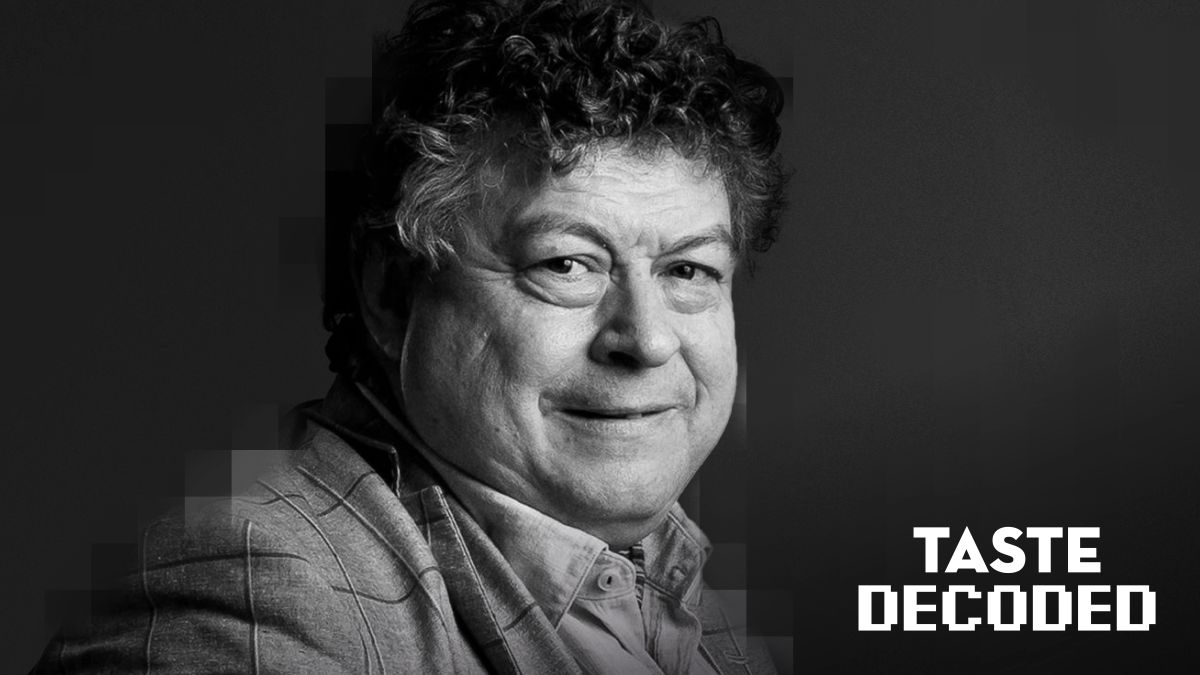
Rory Sutherland is Vice Chairman of Ogilvy UK and co-founder of its Behavioural Science Practice. A Cambridge Classics graduate who joined Ogilvy as a trainee copywriter in 1988, he has spent over thirty years arguing that perceived value is real value and that changing how people see a problem is often more effective than solving it. Author of the international bestseller Alchemy (Penguin, 2019), founder of the Nudgestock behavioural science festival, and a TED speaker with over seven million views, he writes on wine, price, and taste for the Ourglass Taste Decoded series.
In the early 2000s, the engineering teams responsible for the Channel Tunnel Rail Link proposed spending six billion pounds to reduce the London-to-Paris journey time by forty minutes. The tracks would be straighter. The trains would be faster. The problem, as defined by engineers, was speed.
Rory Sutherland's counter-proposal, delivered to a room that did not know what to do with it, was to spend a fraction of that sum on Wi-Fi, better food, and supermodels serving free Chateau Petrus to every passenger. 'You'd have five million left over,' he told the TED audience that later carried the story to seven million views, 'and people would ask for the train to slow down.'
Funny. Also true. The engineers assumed a faster journey was a better journey because speed is measurable. Sutherland assumed a more enjoyable journey was a better journey because enjoyment is what people actually remember. Both assumptions contain truth. Only one had ever been tested.
The train got faster anyway. Billions were spent. But the experience improved too, because once you ask 'how does this feel?' instead of 'how long does this take?', the answers change.
'The opposite of a good idea can also be a good idea.'
Rory Sutherland explains why value is not in the wine but in the perception of the person drinking it, and why developing taste means understanding how meaning shapes what your senses report.
THE CLASSICS GRADUATE IN THE ADVERTISING AGENCY
Sutherland read Classics at Christ's College, Cambridge. Latin and Greek, rhetoric and persuasion, the structure of argument in languages that have been dead for centuries. When he arrived at Ogilvy as a graduate trainee in 1988, the connection was not obvious. It became obvious soon enough.
Advertising is applied rhetoric. You are not selling a product. You are constructing a frame through which a product becomes desirable, necessary, or meaningful. A diamond is a compressed carbon crystal. An engagement diamond is a declaration of intent, a two-month-salary signal, a De Beers campaign from 1947 that rewired how the Western world marks commitment. The crystal did not change. The frame changed everything.
A diamond is a compressed carbon crystal. An engagement diamond is a declaration of intent. The crystal did not change. The frame changed everything.
Sutherland spent over two decades as a copywriter and creative director before founding Ogilvy's Behavioural Science Practice in 2012. The practice employs psychology graduates to study how people actually make decisions. Between 2008 and 2012 he served as president of the Institute of Practitioners in Advertising. He writes the long-running 'Wiki Man' column in The Spectator, which treats everything from train timetables to restaurant menus as problems of perception and framing.
The trajectory matters because it explains how Sutherland thinks about wine: not as a product to be evaluated on its chemical merits, but as an experience to be understood through perception, context, and meaning.
THE ALCHEMY PRINCIPLE
Red Bull tastes bad on purpose. The flavour signals potency: if it tasted like apple juice, you would not believe it worked. Expensive restaurants serve small portions not to cheat you but to signal care. A placebo works even when the patient knows it is a placebo, because the ritual of treatment activates the same neural pathways as the drug.
These are Sutherland's central argument, laid out across 340 pages of Alchemy: The Surprising Power of Ideas That Don't Make Sense. Rational models of human behaviour are not wrong. They are radically incomplete. People do not maximise utility. They maximise, as Sutherland puts it in the premiumisation paradox, 'the feeling of having made a good decision.'
People do not maximise utility. They maximise 'the feeling of having made a good decision.'
For wine, this changes everything. An £18 bottle opened deliberately on a Tuesday evening creates more psychological satisfaction than three £6 bottles grabbed without thought. It is the reason a subscription built around discovery outperforms a shopping list built around habit. The liquid volume is identical. The experience is not. During economic pressure, people concentrate treats rather than eliminate them. One considered bottle replaces three unconsidered ones. This is the lipstick effect: the small luxury that survives austerity because it delivers outsized meaning relative to its cost.
His heuristic for navigating this: buy the second most expensive toaster. Not the cheapest (guaranteed mediocrity). Not the most expensive (guaranteed overpay). The second most expensive avoids both failure modes. It works because it acknowledges uncertainty rather than pretending to resolve it.
PATTERN RECOGNITION UNDER CONDITIONS OF UNCERTAINTY
In a 2025 essay for Ourglass, Sutherland borrowed a phrase from Paul Graham to redefine what cultivated taste means. Not knowledge. Not experience. Cultivated taste is 'pattern recognition under conditions of uncertainty.'
The phrase is precise. Pattern recognition means noticing that Gevrey-Chambertin brings dark cherry, blackcurrant, and earth, while Chambolle-Musigny brings violets, red cherry, and fine tea. You do not need to know why. You need to notice the difference. Under conditions of uncertainty means you are doing this without a label visible, a price known, or a critic's score to lean on.
This is the opposite of 'I like what I like.' Sutherland is direct: the phrase sounds humble but functions as a refusal. It closes the door on pattern recognition. It treats taste as fixed when taste is, by definition, something that develops.
His Spectator column is a weekly exercise in this kind of noticing. In one instalment, he observed that a restaurant wine list sorted by price trains customers to navigate status rather than flavour. Sort by weight (lightest to heaviest) or by occasion (Tuesday kitchen supper through Saturday dinner party) and you produce entirely different choices from the same wines, because the frame invites pattern recognition rather than anxiety management. Every week: take an ordinary object, question the frame, notice what the accepted explanation leaves out.
Applied to wine, developing your palate is not about memorising a taxonomy. It is about drinking with enough attention to notice when something surprises you. The pattern builds itself. You supply the attention.
THE SWEET SPOT
The numbers are stark. At seven pounds retail, approximately sixty-two pence reaches the actual wine. At twenty pounds, six pounds twenty-two reaches the wine. Ten times the product for less than three times the price. The economic floor for intentional winemaking has shifted from eight to ten pounds a decade ago to twelve to fifteen pounds today.
The sweet spot sits roughly between fifteen and forty-five pounds, where craft aligns with accessibility. A producer in the Jura or the Adelaide Hills can afford genuine intention at this level, and each additional pound the drinker spends delivers proportional returns. Above this band, you are paying for scarcity and signalling. Neither is illegitimate. Neither should be confused with proportional improvement in the liquid.
The premiumisation data confirms the shift. British wine volumes have fallen eleven per cent since 2011. Value has risen. English sparkling wine grew thirty-one per cent. Budget brands lost seventy-five million pounds in combined sales in a single year. People are drinking fewer, better bottles because the economics finally reward it.
WHAT ADVERTISING UNDERSTOOD THAT WINE FORGOT
The wine industry built its communication around objectivity: scores, medals, appellations, vintage charts. Engineering solutions to what is actually a perceptual problem.
Sutherland's career has been a sustained argument that this misunderstands how people experience value. Context shapes what we taste. Expectation shapes what we taste. Professor Charles Spence's research at Oxford has demonstrated the neuroscience: the brain constructs flavour from everything around the glass, not just from what is in it.
What advertising understood, decades before behavioural science formalised the insight, is that meaning is not decoration applied after manufacture. It is part of the product. The wine is not the liquid plus the label. It is the liquid and the label and the context and the company and the Tuesday evening and the deliberate decision to open this bottle rather than any other.
The wine industry forgot this. Or decided that acknowledging it was somehow dishonest. Scores were objective. Medals were earned. Terroir was real. All true. Incomplete. The same wine tastes different under candlelight than under fluorescents, with Bach than with silence, from a tulip glass than from a tumbler.
'We don't value things,' Sutherland writes. 'We value their meaning.'
This is not cynicism about wine. It is the most useful thing anyone has said about how to drink it.
The train from London to Paris takes two hours and sixteen minutes now. The engineers got their straighter tracks. But what most passengers remember is not the speed. It is the meal, or the conversation, or the quality of light over the French countryside as the Champagne vineyards appear through the window. The experience, not the metric.
Sutherland's Eurostar proposal was never about supermodels and Chateau Petrus. It was about the question underneath: when you strip away the measurements, what is the journey actually for?
Wine works the same way. The scores and the medals and the vintage charts measure real things. But they measure the track, not the journey. The bottle matters. The context matters. The meaning you bring to the glass matters at least as much as what the winemaker put into it.
This is what Sutherland brings to the Taste Decoded series, alongside Professor Charles Spence on the neuroscience of perception, Tim Hayward on the craft of critical thinking, and Amelia Singer on the practice of drinking with curiosity. Sutherland's discipline is meaning: why we value what we value, and what changes when we understand the valuing.
The opposite of a good idea can also be a good idea. The second most expensive toaster is often the right one. And the wine that changes how you think about wine is rarely the one that costs the most or scores the highest. It is the one you chose with intent, drank with attention, and remembered not for its rating but for what it meant.
MORE FROM TASTE DECODED
- The Wine Sweet Spot: Why Price vs. Value Changes Everything
- Cultivating Taste: What Paul Graham Can Teach Us About Wine
- The Premiumisation Paradox: Why Drinking Less Wine Means Drinking Better
- The Context Effect: How Setting, Company, and Mood Change Wine Taste
- How Taste Works: The Science of Wine Flavour and Memory
- Watch the Taste Decoded series
ABOUT THE AUTHOR
Benedict Johnson is the founder of Ourglass, a London-based taste platform dedicated to helping people become confident wine lovers. He writes on the psychology of taste, the economics of wine, and the culture of drinking, and curates the Taste Decoded series, which brings together sommeliers, communicators, academics, and creatives to decode what great actually tastes like.