

THE PREMIUMISATION PARADOX: WHY DRINKING LESS MEANS DRINKING BETTER
A Taste Decoded article by Ourglass, with Rory Sutherland, Amelia Singer, Tim Hayward, Michael Sager and referencing Jancis Robinson
Cheap wine is no longer a compromise: it’s become a category error.
A mistake, structurally embedded in the economics of how wine reaches your glass.
Volume is down 11% since 2011. Half of that happened after 2019. Market value is flat at £15 billion. The gap between those numbers is not decline. It is correction. People are buying fewer bottles but spending more on each one. The interesting question is not whether this is happening. It is why it took so long.
The short version
Since 2019, UK wine volume is down 5%, but market value remains flat at £15 billion. At £7, only 62p goes to the wine itself. At £20, it’s £6.22. The economic floor has moved to £12–15. This is not decline. It is correction: fewer bottles, chosen with more intent.
Premiumisation, in wine, means drinking less often but spending more per bottle because economics and psychology now reward intention over volume. It is not about status. It is about where the money actually goes.
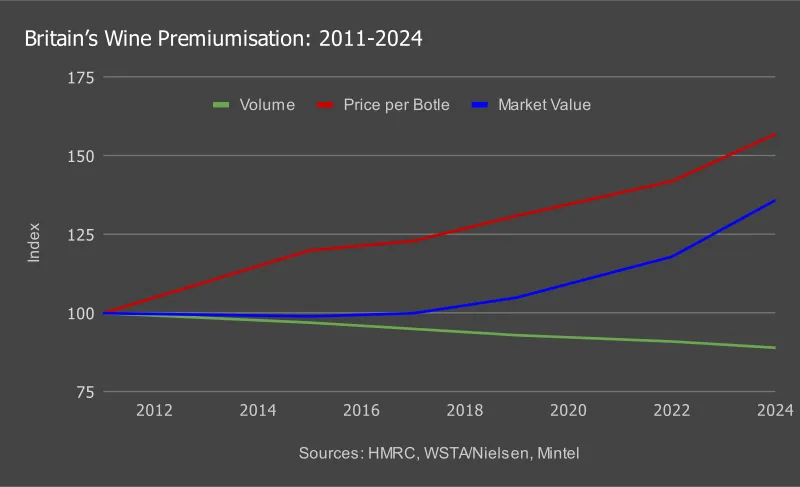
Indexed to 2011 (= 100). Volume down 11%, price per bottle up 57%, market value up 36%.
THE MATHS THAT CHANGES EVERYTHING
The difference between £7 and £20 is not £13. It is the difference between 62p of wine and £6.22.
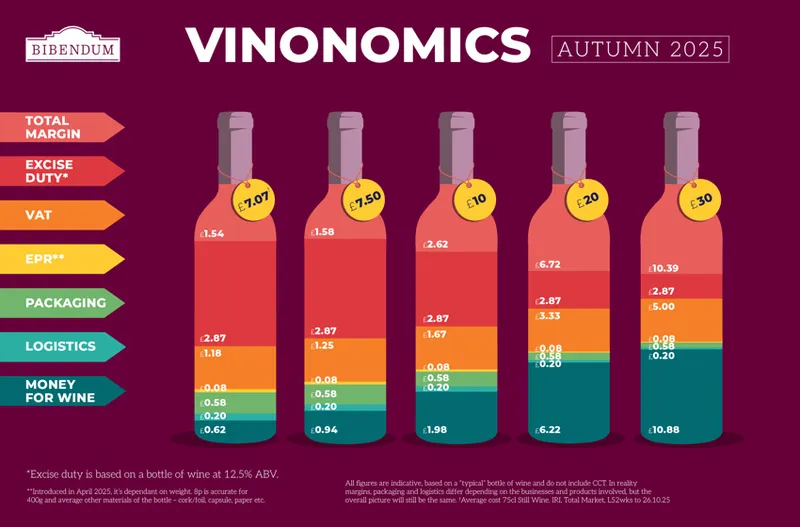
Bibendum's Vinonomics model breaks down where your money actually goes when you buy a bottle of wine.
Credit: Bibendum
At £7.07, after duty (£2.87), VAT (£1.18), retailer margin, packaging, logistics and the new EPR levy, you are left with 62p for the actual wine. Sixty-two pence. That is not enough to buy a middling flat white, let alone produce something worth drinking.
At £10, you get £1.98 of wine. At £20, you get £6.22. At £30, it is £10.88.
This is not a linear relationship. Moving from £7 to £20 gets you ten times more wine investment for less than three times the price. We wrote about this in The Wine Sweet Spot, but the short version is: the economics have moved, and they are not moving back.
The sweet spot has shifted. Five years ago, £8-10 was reliable. Today, with duty up 20% since August 2023 and every input cost higher, that floor is £12-15. Below it, too much of your money goes to the Treasury and logistics. Above it, nearly all of it goes to wine.
TWO FORCES, ONE DIRECTION
People are drinking less wine not because they care less, but because attention, intention and economics now favour fewer, better bottles.
The shift has two drivers working in parallel.
The first is aspirational. A growing number of drinkers are actively choosing to trade up. They want wines with stories, provenance, something to say. Sixty-seven percent now say they would rather have one or two exceptional glasses than five forgettable ones. When they open a bottle, they want it to matter.
You may recognise this in yourself. The bottle you actually think about versus the one you grab because it is there. The difference is not price. It is attention and intention.
Amelia Singer, who has spent sixteen years as a wine educator, sees this in the questions she gets asked. “People know far more about wine than ever before. The questions I receive are far more informed and relate to clear preferences and intention. This empowers people to choose wine with intent, not just grab whatever is nearest at the checkout.”
The second is structural. The economics of cheap wine have become brutal. Anyone who has watched Tom Gilbey's videos on what budget brands like Blossom Hill actually taste like knows what happens when you try to make wine for 62p. It is not wine. It is a logistics exercise with alcohol in it.
Meanwhile, discounters have built award-winning ranges that compete aggressively on quality, often as a loss leader. The traditional supermarket mid-tier is being hollowed out from both ends.
Some consumers are trading up because they want to. Others because the alternative has become untenable. The direction is the same.
DEMOCRACY, NOT EXCLUSION
Premiumisation is not about excluding people from wine. It is about including them in wines that can still be made honestly.
Tim Hayward, the FT's food columnist, has spent years thinking about what makes hospitality work. His conclusion is simple: "What they were about was democracy and supplying the needs of a local audience, making people feel comfortable."
The same principle applies to wine. Premiumisation is not about excluding people from cheap wine. It is about including them in good wine. The economics have simply moved where that inclusion happens.
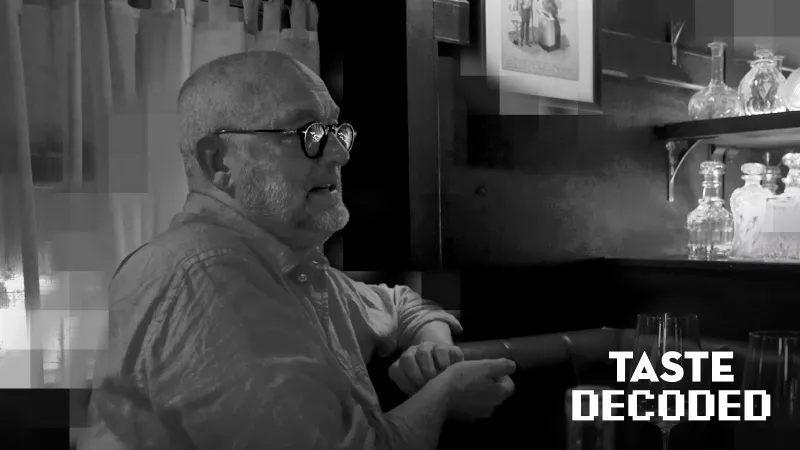
Tim Hayward with Ourglass at Noble Rot, Mayfair
As Michael Sager puts it: "Wine is meant to transport you. The moment you place too many people or too much margin in between, the magic disappears. That's why we're returning to our original vision: making great wine affordable to everyone. Not dumbed down, not stripped of story. Just honest. Fewer hands between vine and glass. Premiumisation shouldn't mean exclusion. It should mean we stop pretending you can make real wine for 62p and start helping people find the wines that will actually transport them somewhere."

Michael Sager with Ourglass, Sager + Wilde, Hackney
THE PSYCHOLOGY OF LESS, BETTER
People do not maximise consumption. They maximise the feeling of having made a good decision.
This is where Rory Sutherland comes in.
Rory has spent decades studying the gap between what economists think people want and what people actually do. His view on premiumisation is counterintuitive, as one might expect.
"The standard economic assumption is that people maximise utility. More wine, more happiness. But that is not how human satisfaction works. We do not only maximise utility. We maximise the feeling of having made a good decision.
A single considered purchase that feels like a treat delivers more satisfaction than multiple unconsidered ones. The pleasure is not just in the consumption. It is in the choosing. This is why premiumisation is not irrational. It is deeply rational, just not in the way economists expect.
Think about it this way: an £18 bottle opened with intent, discussed, remembered, beats three £6 bottles knocked back and forgotten instantly. Even if the liquid volume is identical - the psychological return on investment is completely different.
This also explains why the cost-of-living crisis has not crushed premium wine. In tough times, people concentrate treats rather than eliminate them. Economists call it the lipstick effect, but the psychology is simpler than that.
A nice bottle is affordable enough to justify, special enough to feel like a reward. Cut frequency, protect quality. That is not a compromise. That is an upgrade.”
As Amelia Singer puts it: “When people crave special experiences without breaking the bank, a well-made bottle of wine is a reliable life enhancer.”
There is a reason the martini came back. Not the 1990s Absolut neon cocktail, but the proper one: cold, clear, deliberate. It is a drink that refuses to be background noise. You cannot doomscroll through a martini. Tim Hayward has written beautifully about this: the drinks that matter are the ones that create a small ceremony in an otherwise frictionless day. The same instinct is reshaping wine. People want drinks that ask something of them.
The BMO 2025 Wine Report captured the shift in five words: "People are drinking less, but better."
IT'S NOT JUST WINE – IT'S NOT JUST THE UK
Across drinks categories globally, volume is falling while value concentrates in the middle where quality, not excess, lives.
The pattern repeats across categories. Beer volumes are down but craft and premium lagers grow share every year. Gin surged from £1.3bn to £2.7bn between 2013 and 2019; volumes have since plateaued but the mix is far more premium. Instant coffee stagnates while UK specialty coffee grows 20% annually.
Globally, the same. US wine volume has fallen 12% since its 2017 peak, yet 2024 market value hit a record $109 billion. In France, consumption hit record lows by volume while Champagne and fine wine hit record highs by value.
In fine wine, the same logic applies. Liv-ex’s 2025 Power 100 shows 35 brands recording price gains versus just 11 the year before. The wines outperforming are not the most expensive. They are the mid-range bottles - priced for drinking, not speculating. Burgundy’s growth is coming from wines under £2,000 per case that appeal to collectors and drinkers alike. Value-seeking, not bargain-hunting.
Even at the top end, the signal is not excess. It is confidence that the wine will actually be opened.
This is not just a UK or wine phenomenon. It is a global reorientation of how people relate to consumption.
THE MODERATION MINDSET
Moderation does not mean abstinence. It means intention, smaller quantities, and higher standards.
Half of global wine drinkers now consciously limit their consumption. Among Gen Z, it is 67%. But moderation does not mean abstinence. It means intent.
Amelia points to a small but telling shift: the rise of the 125ml glass. “It used to be that you had to specifically ask for a small pour. Now it signals that people are willing to try more, spend a bit more, and drink a bit less.”
When you drink twice a week instead of five times, each occasion carries more weight. You are not grabbing whatever is on promotion. You are choosing something worth the moment. As we explored in The Context Effect, setting frames taste. But intention shapes it.
Ironically, premiumisation makes wine feel more culturally in tune even as fewer bottles are sold. Each occasion now carries more narrative and meaning. The question is no longer "what shall we drink?" but "what is this drink for?"
THE GENERATIONAL SHIFT
Millennials are not rejecting wine. They are rejecting default wine.
There is a persistent myth that millennials are killing off wine. The data does not support it.
According to the Wine Market Council, 31% of US millennials drink wine compared with 26% of boomers. By headcount, millennials are now the largest wine-drinking generation in America. The problem is not demand disappearing. It is demand dispersing.
Wine is no longer a default. It competes with many other ways of drinking, and many ways of not drinking at all. The loss is not drinkers, but occasions.
Where this becomes more complicated is in behaviour.
Younger drinkers do not replace older ones glass for glass. Under-40s account for only around 20% of US wine volume, even as their cultural influence rises. This creates a structural imbalance: production built for frequency meets consumers optimised for selectivity.
What has changed is not interest, but criteria.
Younger drinkers tend to enter wine through discovery rather than inheritance. Native varieties over famous names. Emerging regions over established hierarchies. Process and intent over provenance alone.
Values matter. Transparency, honesty, sustainability. So does authorship: who made it, how, and why. Wine is approached less as a product category and more as a cultural object, one that signals curiosity rather than compliance.
This does not make millennials anti-tradition. It makes them anti-default.
The consequence is paradoxical. Wine becomes more meaningful even as it becomes less frequent. Cultural importance rises while volume falls. Identity strengthens while habit weakens.
The industry is left with an uncomfortable reality. It must serve a generation that cares deeply, drinks selectively, and refuses to be predictable. Wine can meet people where they are. The harder question is whether an industry built for repetition can survive a generation built around choice.
THE CATEGORY ERROR
At today’s duty and cost structure, a £7 bottle cannot be authentic wine. It can only resemble it.
Here is the thing nobody wants to say directly.
At £7, the wine is not just worse. It is increasingly dishonest: about labour, about farming, about what is actually being consumed. You cannot produce something authentic for 62p. You can only produce something that resembles wine close enough to pass as wine.
Cheap wine used to be a compromise. Now it is a category error. Economics no longer support it. The quality no longer justifies it. The only reason it persists is inertia and the supermarket assumption that wine must have a £5.99 entry point.
That assumption is breaking.
THE GATEKEEPING RISK
The danger is not premiumisation itself, but replacing old gatekeepers with new ones.
There is a danger here. As Tim Hayward observes, "We could take almost anything and codify it and manage it so it becomes wanky."
Premiumisation can easily curdle into a new snobbery: the £15 bottle replacing the £50 bottle as the marker of who belongs. That misses the point. The point is that the floor has moved, and pretending it has not helps no one. The goal is not to create new gatekeepers. It is to help people drink better without needing a sommelier's blessing or a banker's salary.
THE AFFORDABILITY QUESTION
When the floor rises to £12–15, some people trade up, others step off. Both responses are rational.
There is another tension people prefer not to dwell on.
For some, “drink less but better” is a lifestyle upgrade. For others, it is simply “drink less” - or not at all. When the floor moves to £12-15, wine becomes a considered luxury rather than a casual pleasure. The monetary cost has risen, but so has the opportunity cost: in a stagnant economy where showing up matters more than ever, the hangover carries a price it didn’t before.
This shift has losers, not just winners. Premiumisation is also a form of exclusion, even if unintentional. Wine risks becoming something people opt out of entirely - not because they don’t care, but because the entry point no longer makes sense for them.
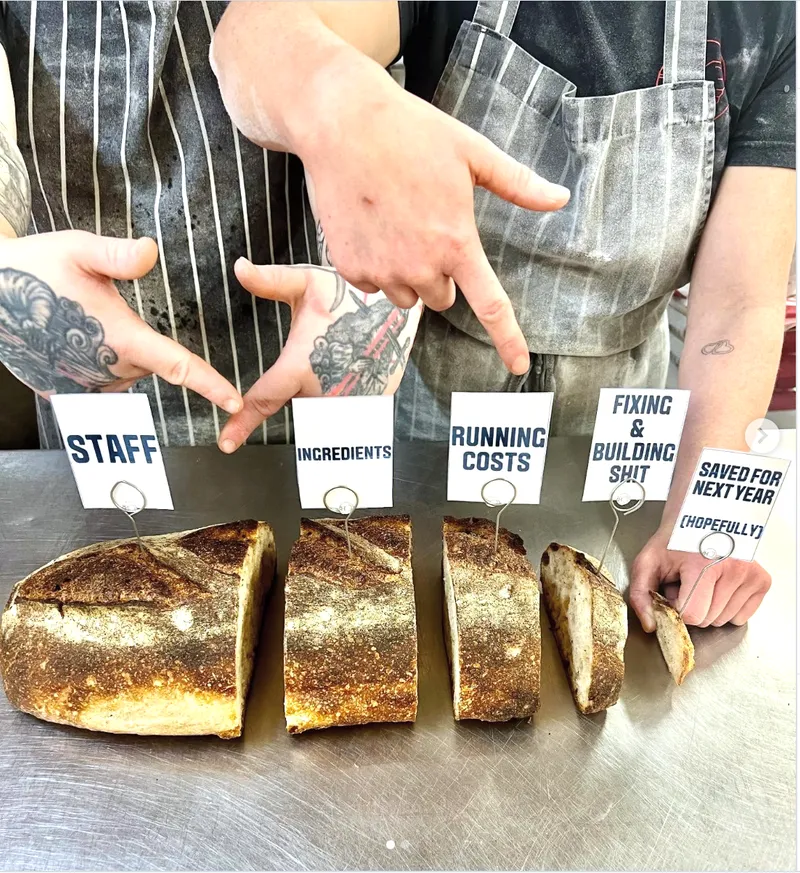
Credit: Dusty Knuckle Bakery
The Dusty Knuckle bakery recently posted a photo of a loaf sliced into segments: staff, ingredients, running costs, fixing and building shit, saved for next year (hopefully). It got 28,000 likes. People are not allergic to the economics. They are allergic to pretending the economics do not exist.
THE UNCOMFORTABLE TRUTH
Premiumisation is real. But some of the audience is leaving, not trading up.
The realist case is harsher still: premiumisation is a story the wine industry tells itself to feel better about declining relevance. Volume is down because wine is losing share of occasion to spirits, RTDs, cannabis and sobriety - not because consumers are making enlightened quality choices. The “drink less but better” narrative flatters the remaining customers while ignoring the multitudes who’ve slipped away.
There is something to this. Jancis Robinson, writing in the FT and JancisRobinson.com was surprised to note that the only wines currently growing in Italy and Spain are those selling for €2 or less. The middle is being squeezed from both ends.
Both things can be true. The structural reality is that economics dictate that if you import wine, you need margin after cost of goods, shipping, duty, tastings, storage, labour. You had better be sure you can shift it. Better is not defined by price - as we argued in The Wine Sweet Spot - but the gravity of economics means they broadly correlate dynamically. Good luck finding a £9 Georgian qvevri wine even at trade prices. The romance of wine as agriculture, as politics, as community rather than consumer good is real.
The honest position is this: premiumisation is real, but it is not universally accessible. The floor has moved. Some will trade up. Others will step off. Both responses are reasonable.
Amelia sees a reason for optimism: “Education and confidence will trickle down faster to the younger generation than it has done in the past.” If that is true, premiumisation may not be permanent. It may be a transitional floor that a more informed generation learns to navigate.
WHAT THIS MEANS FOR YOU
If you are buying wine less often but caring more when you do, you are not an outlier. You are the trend.
The drinker base is not shrinking. IWSR data shows the number of wine drinkers in the UK has actually increased. What has changed is the distribution of frequency and intensity. People drink less often, in smaller quantities, but they care more about what is in the glass.
If you have noticed yourself buying wine less frequently but spending more when you do, that shift is structural, not personal.
Britain's top budget brands lost £75 million in combined sales last year. English wine, mostly premium sparkling, grew 31%. Online wine retail went from virtually zero to 14% of purchases. The long tail of quality is outperforming the old volume staples.
Sixty-two pence does not buy good wine. But £6.22 marks the start. And the difference in price is smaller than you think.
The question was never really about wine. It was about what purpose it serves: simply booze, or something worth paying attention to.
Sources
- Bibendum, Vinonomics model
- IWSR Drinks Market Analysis
- BMO Wine Report 2025
- Liv-ex Power 100 2025
- Wine Market Council
About Ourglass
Ourglass finds exceptional wines in the £12-50 range where your money actually goes to wine, not tax and logistics. Discover your taste at ourglass.wine.
EXPLORE MORE WITH TASTE DECODED
- Watch: Michael Sager on how to taste like a somm
- Read: Charles Spence on Sensory Science
- Article: What Makes Wine Cheap vs Expensive
- Guide French wine regions guide
- Guide: Italian wine regions guide
- Bonus: Spain, Germany, Australia, Argentina, South Africa and the USA country guides
About the Authors
Benedict Johnson (@benedictegjohnson) is the founder of Ourglass, a London-based taste platform dedicated to helping people become confident wine lovers. He writes on everything to do with wine, and curates the Taste Decoded series.
Rory Sutherland (@rorysutherland) is Vice-Chairman of Ogilvy UK, a columnist for The Spectator, and author of Alchemy: The Surprising Power of Ideas That Don't Make Sense. A pioneer of applied behavioural science in business, he explores how perception, context and signalling shape value across every category imaginable, from watches to wine.
Amelia Singer (@amelias_wine) is an award-winning wine communicator, TV presenter and educator with sixteen years' experience making wine accessible. She appears regularly on Channel 4's Sunday Brunch and hosts tastings for everyone from beginners to collectors.
Tim Hayward (@timhayward) is the Financial Times' food columnist and author of several books on food and hospitality. A former restaurateur, he writes on what makes eating and drinking meaningful.
Michael Sager (@michael__sager) is co-founder of Sager + Wilde, the London wine bar that helped reshape how a generation drinks. He focuses on making great wine affordable without stripping it of story.
Jancis Robinson (@JancisRobinson) is the world's most respected wine writer, author of The Oxford Companion to Wine and JancisRobinson.com. She has been writing about wine for over four decades and holds the Master of Wine qualification.