
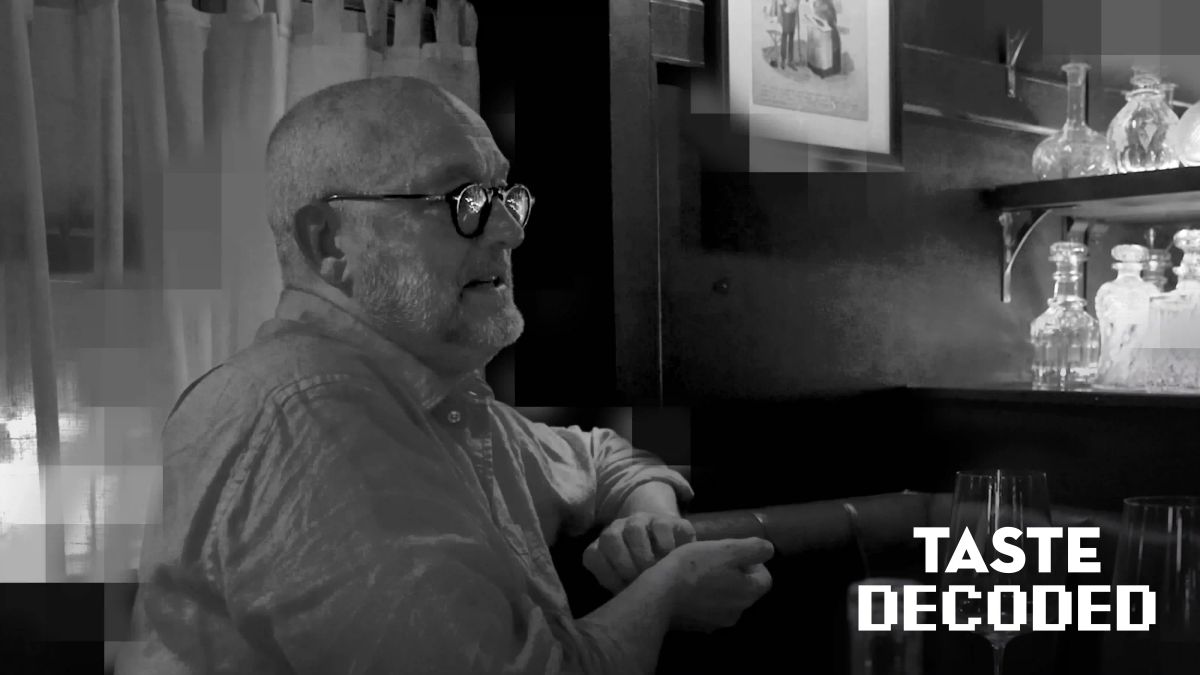

Tim Hayward is the Financial Times restaurant critic, a BBC Radio 4 broadcaster, and co-owner of Fitzbillies, the hundred-year-old Cambridge bakery he rescued with his wife Alison Wright. Born in Bristol in 1963, he trained at art college, worked as a bouncer and across six advertising agencies before becoming a stay-at-home father, then one of Britain's most awarded food writers. Author of seven books including the eight-language bestseller Knife, winner of the Fortnum and Mason and Guild of Food Writers awards, he writes on taste, hospitality, and democratic access to good food and wine for the Ourglass Taste Decoded series.
In 2011, a tweet appeared in Tim Hayward's timeline. Fitzbillies, a Cambridge bakery that had been making Chelsea buns by hand since 1920, was about to close. Ninety-one years of daily baking would end, not because the product had failed but because the business model had.
Hayward and his wife Alison Wright left London. They bought the bakery. He had no restaurant experience. No hospitality training. He had a conviction that a place which had survived two wars, a depression, and nine decades of Cambridge students queuing at opening time was worth more than its lease value.
By any rational analysis, a bad decision. The spreadsheet would have killed it. The argument for it was not financial. It was structural: some things matter because of what they mean, not because of what they earn.
This is the test Hayward applies to everything. Not 'is it good?' but 'what is it doing?' Not 'do I like it?' but 'does the argument hold?'
'You are not writing. You are not performing. You are transmitting an idea from your head to somebody else's.'
Tim Hayward explains why most wine writing fails because it performs expertise rather than transmits observation, and why the only test that matters is whether you noticed what you were drinking.
ART COLLEGE, ADVERTISING, AND THE LONG WAY ROUND
Hayward did not attend university. He trained at Bournemouth and Poole College of Art and Design as a photographer and filmmaker. He worked as a bouncer, standing outside nightclub doors in the kind of role that teaches you to read a room before anyone has spoken. Television. Six advertising agencies. Stay-at-home father. His first book, Food DIY, was published in 2013, when he was fifty.
The detours were the training. Art college taught him structure and composition, not vocabulary and technique. Advertising taught him that communication is about the receiver: what matters is not what you say but what arrives.
His influences were essayists, not food writers. Pauline Kael, who made film criticism a form of argument. Hunter Thompson, who proved subjective experience could carry journalistic rigour. Above all Clive James, who demonstrated you could write about popular culture with the same structural care academia reserved for the canon. Hayward writes about food with the same conviction: the Big Mac deserves the same analytical attention as a tasting menu, not because they are equivalent but because the argument is what matters, not the prestige of the subject.
Seven books: Food DIY (2013), The DIY Cook (2015), Knife (2016, eight languages), The Modern Kitchen (2017), Loaf Story (2020), Fitzbillies (2020, with Alison Wright), Steak: The Whole Story (2024). Radio 4 documentaries including Bacteria: The Tiny Giants (Gold, 2023 New York Festivals Radio Awards). Guild of Food Writers 'Food Writer of the Year' in 2014, 2015, 2022, and 2024. Fortnum and Mason 'Restaurant Writer of the Year' in 2024.
The awards are listed not as credentials but as evidence. This is a writer whose arguments land, whose thinking is tested every week in the Financial Times.
WHAT WINE WRITING GETS WRONG
Most wine writing performs expertise. 'Tertiary aromas of leather and tobacco give way to a mid-palate of cassis and graphite.' The sentence communicates nothing except that the writer knows the lexicon. It does not transmit an idea. It does not help the reader notice anything they were not already noticing.
Hayward's critique, developed across three decades of writing about food, is that this model gets the direction of transmission wrong. The writer faces inward, toward the guild, performing membership. The reader is not the audience. The reader is the occasion for the performance.
Good criticism faces outward. It starts with an observation and builds toward a point. The reader leaves not with a score but with a way of paying attention.
He tested this against AI. ChatGPT, asked to write in his style, produced what he describes as generic TripAdvisor prose: description without argument, evaluation without observation. No structure. No point going through it. The machine could replicate the vocabulary. It could not replicate the thinking, because the thinking is what most food writing has already abandoned.
A wine note that says '92 points, drink 2026-2034' is a verdict without an argument. A wine note that says 'this Jura Savagnin tastes like someone put a piece of walnut bread under a microscope and found an ocean' is at least trying to transmit an experience. The first tells you what to buy. The second helps you notice what you are drinking.
THE DINER, THE WINE LIST, AND WHO GETS TO BE COMFORTABLE
Sitting at Noble Rot in Mayfair over a glass of Jura wine, Hayward made a claim that sounds simple until you think about what it requires. 'A diner is a place for authentic exchange,' he told Ourglass. 'It's not about making people feel uncomfortable just because they're not rich enough to pay for civility.'
'It's not about making people feel uncomfortable just because they're not rich enough to pay for civility.'
The wine industry has a version of this problem. A twenty-page wine list in twelve-point font with no descriptions and no visible prices is not neutral information architecture. It is a gatekeeping mechanism that rewards prior knowledge and punishes curiosity.
Hayward's argument, extended in his contribution to the premiumisation conversation, is that premiumisation should mean democracy: including more people in good wine by making the economics transparent. When the economic floor rises from eight to fifteen pounds, the honest response is to explain what is in the bottle at fifteen pounds and why it is worth the difference.
Kate Hawkins, the wine and drinks writer whose work spans the Guardian, Telegraph, and Independent, and whom Hayward cites in their conversation about generational shift, observes that younger drinkers are already past the gatekeeping: 'fewer magnums and more by-the-glass experimentation. Less prestige, more permission.' Wine by the glass is the equivalent of the diner. Try this. No commitment. No performance required.
KNIFE, BREAD, STEAK: THE OBJECT THAT THINKS
Each of Hayward's books takes a single object and turns it into an argument about something larger. Knife (2016) is an argument about the relationship between a craftsperson and their instrument, about the difference between a knife that was made and one that was manufactured. Translated into eight languages, including Japanese, because the argument translates: craft is not a price point. It is a relationship with materials.
Loaf Story (2020) asks what happens when a culture industrialises its most fundamental food.
Steak: The Whole Story (2024) traces meat from pasture to plate, through welfare, sustainability, butchery, and the cultural politics of eating animals. It refuses to simplify any of it. The steak, like the knife, carries more weight than its materials suggest.
Each project starts with something concrete and asks what it reveals about how humans relate to the things they make, eat, and value. Wine fits the pattern exactly. A bottle is an object carrying an argument: about place, craft, economics, and who made it and why. The question is not whether the wine is good. The question is whether you are paying enough attention to understand what it is doing.
WHAT TASTE ACTUALLY REQUIRES
Hayward's test for taste is not knowledge or experience. It is whether you are thinking.
'When encountering any experience,' he says, 'wine, food, criticism, ask what it is doing, not merely whether you like it.'
Ask what it is doing, not merely whether you like it.
'I like this' is a verdict. 'This is doing something I did not expect' is the beginning of an argument. The verdict closes the conversation. The argument opens it.
The best wine drinkers Hayward knows are not the ones who can identify a grape variety blind. They are the ones who notice when a wine surprises them, who ask why, who build a personal framework that lets them navigate a wine list with confidence rather than anxiety. They have an absolutely airtight argument for what they like, even if that argument is as simple as 'I prefer wines that make me think over wines that make me relax.' The argument is the palate. The structure is the taste confidence.
This is what Hayward brings to the Taste Decoded series, alongside Rory Sutherland on the behavioural economics of value, Professor Charles Spence on the neuroscience of perception, and Amelia Singer on the practice of drinking with curiosity and intent. Sutherland explains why perceived value is real value. Spence explains why the brain constructs flavour from everything around the glass. Singer explains why permission matters more than expertise. Hayward explains why none of it means anything without a structure, a point that goes through it, and the discipline to notice what is actually in front of you.
The bakery is still there. Fitzbillies has been open every day since Hayward and Wright took it over, making Chelsea buns by hand the way they have been made since 1920. The tweet that started it all has long since vanished. The bakery outlasted the platform.
Hayward's career is a series of these moves: taking things that resist easy explanation and building arguments that make you see them differently. Not better or worse. Differently.
The question he keeps asking, across seven books and hundreds of restaurant reviews and a hundred-year-old bakery, is always the same. Not 'is it good?' but 'what is it doing?'
The argument holds. The point goes through it. And the wine, like the Chelsea bun, like the steak, like the knife, is worth paying attention to. Not because someone told you it was good. Because you noticed it yourself.
MORE FROM TASTE DECODED
ABOUT THE AUTHOR
Benedict Johnson is the founder of Ourglass, a London-based taste platform dedicated to helping people become confident wine lovers. He writes on the psychology of taste, the economics of wine, and the culture of drinking, and curates the Taste Decoded series, which brings together sommeliers, communicators, academics, and creatives to decode what great actually tastes like.