
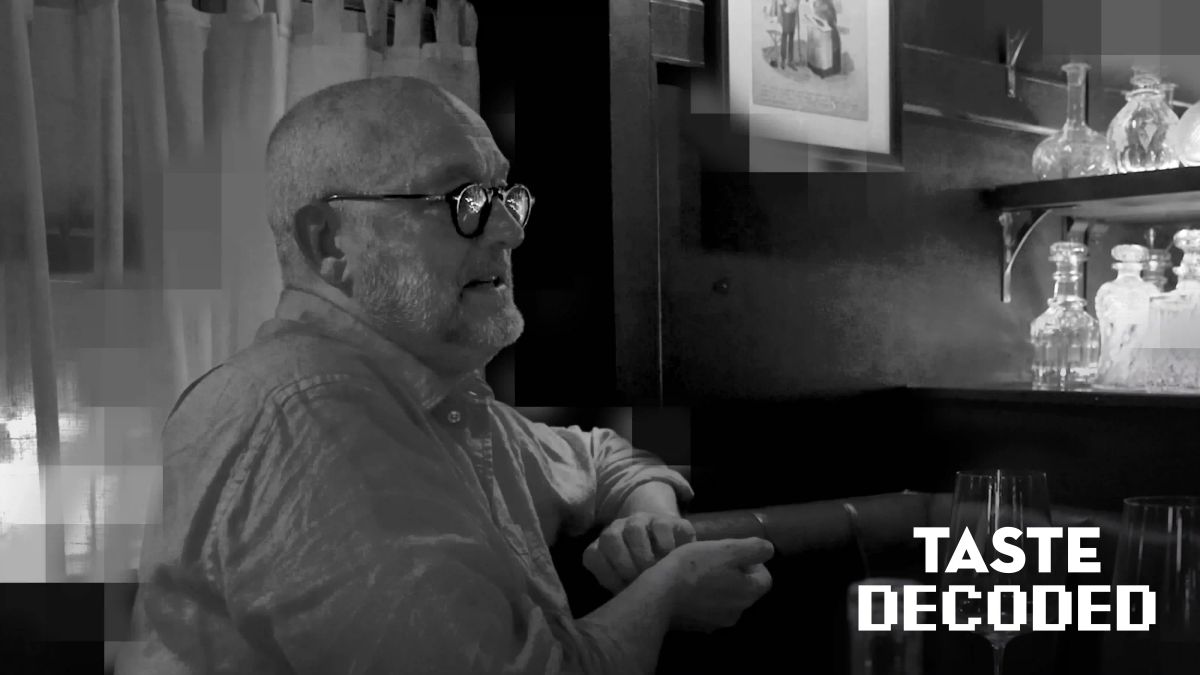
Tim Hayward did not go to university. He went to art college, trained as a photographer and filmmaker, fell in love with a waitress at a TexMex restaurant off Tottenham Court Road, worked as a bouncer, blagged his way into television, zigzagged through six advertising agencies, became a stay at home dad, and ended up as the restaurant columnist for the Financial Times.
There was no plan. Just a fast talking bullshitter, as he puts it, moving through industries that rewarded exactly that.
But beneath the chaos is a consistent thread. Hayward is not really a writer. He is a communicator. And the distinction matters more than you might think.
This is a conversation about food and restaurants. But it is also about how we learn to taste anything. Wine included.
THE CLIVE JAMES METHOD
When Hayward decided to teach himself food writing, he did not read restaurant critics. He read Pauline Kael. Hunter Thompson. And above all, Clive James.
"Clive James was utterly honest about being an outsider. He had an enormous intellect but wore it lightly. And he did that fantastic thing of crediting popular culture with proper thought."
James wrote essays about television that treated the medium with the same seriousness others reserved for literature. He made low culture high without ever making it pretentious. And crucially, he wrote about how to write.
"His biography and essays are the only things I read at that time that talked about journalistic structure. How you go about writing. Nobody else was public about it."
Hayward still uses techniques he learned from James. Including a structure James claimed would let him file a good story by morning even if he came home too drunk to see.
"You cannot make people creative. But you can share the way it is done."
It is the same principle Jon King of Gang of Four describes when he talks about unlearning taste. You cannot teach creativity directly. But you can share the grammar. The constraints. The method that makes creativity possible.
WRITING WITHOUT WRITING
Most people assume good writing is about vocabulary and punctuation. Hayward disagrees.
"You have got subs who will stop you saying anything stupid or spelling things wrong. They have got all that covered. What you have got to do is have an absolutely airtight argument. A structure. A point that goes through it."
He does not sit down to write until the piece is already complete in his head. A thousand words takes 45 minutes. But the real work happens long before.
"If my writing day is Thursday, you are coming for dinner on Wednesday. Because I will run it past you and see where you laugh and where you do not."
He rehearses arguments out loud. Tests them on friends. Refines the structure until it is bulletproof. Only then does he type.
"I finish two days before deadline. Sleep on it. Do not touch it. Walk away. Then I go back for one last pass before it goes in."
The actual writing, in other words, is the smallest part of the process.
COMMUNICATOR, NOT STYLIST
Hayward draws a distinction between writers who sculpt sentences and writers who transmit ideas.
"Will Self is a brilliant writer. But he has got that slightly Oxbridge problem. He is a writer rather than a communicator. He is about words and crafting the perfect sentence."
Hayward sees himself differently.
"I have got the argument down pat before I sit down. If you have got the communication right, how you write it is a secondary issue."
He points to Kate Hawkings, the wine writer, as someone who exemplifies this principle.
"I saw her at a food festival hold a room of 200 wine freaks. It was astonishing. Her commitment and focus. If you have got the thing right in your head, the quality of how you say it is sort of immaterial."
The comparison to music is apt. The Marseillaise works not because of the words but because of the feeling. Sound, words and meaning are one thing. Whereas God Save the King is just a series of words set to music.
"You are not writing. You are not performing. You are transmitting an idea from your head to somebody else's. Everything else is finesse."
It is the same insight that underpins how taste actually works. Perception is not passive reception. It is active construction. What you experience depends on what you bring to the moment.
THE DEMOCRACY OF THE DINER
Hayward has a chip on his shoulder. But it is a specific one.
"I do not think any place should define itself by how uncomfortable it can make most people. And therefore you do not feel uncomfortable because you are rich enough to pay them not to be nasty to you. It seems fundamentally flawed."
His ideal is the American diner. Democratic. Unpretentious. A place for authentic experience.
"They were about supplying the needs of a local audience. Making people feel comfortable. Those places are always good."
The British equivalent, he argues, is the gastropub. Good wine. Reasonable food. Friendly service. Children and dogs allowed.
"What we did not have here is little zincs with check tablecloths and pastis on tap. So our gastropubs are our bistros. Our trattorias."
He cites Hawksmoor as an example of the principle executed at scale. You can sit at the counter with a book, order a steak and an old fashioned, and feel completely at ease. Good quality, disarmingly accessible.
"There are at least twelve things that matter in a restaurant. And none of them are the food."
This is the context effect in action. Setting shapes experience. The room, the service, the company, the lighting. Change the frame and you change what you taste.
THE BIG MAC AS PLATONIC IDEAL
Hayward makes a provocative claim. The Big Mac is the most perfect food ever devised.
"A billion people have eaten it and not rejected it. You start looking into the technology of what is in it and how it has evolved over time. It is beautiful."
The thin patties maximise the Maillard reaction. The gluey cheese keeps moisture between the layers. The middle bun lets both patties bleed into the bread. The sauce ties everything together. Even the bun is engineered to be soft enough not to distract.
"It is remarkable. This is the most perfect food. Not because it is gourmet. Because it is evolved to be the perfect deliverable."
One end of the spectrum is the steak trying to be fine dining. The other is the fast food that does not spill on your tie while driving. Both are valid. But only one has been optimised by billions of data points.
"You cannot argue that a Big Mac is the same as a gourmet burger. One is trying to be a steak. One is trying to be a fast food that does not spill on your tie when you are driving. Those are two ends of the same spectrum. But one of them is evolved to be the perfect deliverable."
Watch Tim expand on this in Ourglass Tapes | Talking Taste with Tim Hayward | Part 2.
WINE BY THE GLASS
Over a glass of oxidative Jura and 24-month aged cheese at Noble Rot, Hayward reflects on the future of wine. The salinity of the cheese, the granular salt crystals, the nuttiness of the wine. Everything in dialogue.
He quotes Kate Hawkings, the wine writer.
"You have got to think about how the next generation are going to be drinking. By the glass. For adventure and excitement. None of the stuff granddad knows is of any value outside dinners with six mates who can afford the expensive stuff."
The English tradition is to buy wine for drinking in ten or twenty years with people who may not even be there. The American and Asian tradition is to ask: what am I drinking today? What am I sharing with my friends right now?
"The privilege is being able to move from one foot to the other. Enjoying both depending on the situation. That is someone who really gets food and wine. Picking the right tool for the right moment."
This is the argument Rory Sutherland makes about the wine sweet spot. Value is not about price. It is about fit. The right wine for the right moment at the right price.
Watch the full conversation in Ourglass Tapes | Talking Taste with Tim Hayward | Part 3.
THE END OF CRITICISM
Hayward resisted becoming a restaurant critic. Even when the FT offered him the role, he said no.
"Every time you say you write about food, people say it must be great, all those free meals. I did not want to be a critic. I owned a restaurant. I did not think I should write criticism the way a lot of people wrote it."
COVID changed things further. People lost their taste for giving restaurants a kicking.
"Although we loved writing it and people always loved our nasty pieces best, you just cannot do it anymore. It does not feel appropriate. It does not seem right."
He calls himself a columnist now. Half the time his column is triggered by a restaurant experience. He does some dish by dish analysis. But it is always framed positively.
"I spike stories and pay for myself if I cannot be nice. I have got a certain style for being enthusiastic. And that is sort of it."
THE CHATGPT TEST
Hayward recently tested ChatGPT. He asked it to write a restaurant review in his style.
"There is enough of me out there to do it. And it came back. And it was shit."
The AI produced perfect TripAdvisor prose. Generic adjectives. No argument. No point of view.
"As long as I am writing better than that and AI is writing as well as TripAdvisor, we are fine. We can be friends."
The real threat to criticism is not artificial intelligence. It is the flattening of taste into consensus. The algorithm that surfaces what everyone already agrees on. The review that tells you nothing except that other people liked it.
Hayward's method is the opposite. An argument, rehearsed until airtight. A point of view, tested on friends. Words that transmit an idea rather than decorate a page.
TO TASTE IS TO THINK
My father taught art for decades. His first job with new students was never to fill them with technique. It was to empty them out.
"You have to unlearn everything you think you know before you can learn," he would tell them.
Tim Hayward arrived at food writing the same way. No university. No formal training. Just art college, a series of unlikely jobs, and the realisation that communication is not about the words. It is about the argument underneath.
Picasso said it took him years to paint like Raphael but a lifetime to paint like a child. Hayward spent years learning how to write. But the real skill was learning what to say before he said it.
The next time you read a restaurant review, do not ask whether you agree with it. Ask what the argument is. If there is no argument, there is no criticism. Just decoration.
And the next time you pick up a glass, do not ask whether you like it. Ask what it is doing. That is where taste begins.
MORE FROM TASTE DECODED
How Taste Works: The Science of Flavour and Memory
The Wine Sweet Spot with Rory Sutherland
(Un)learn Taste with Gang of Four's Jon King
Context Effect: How Setting Shapes What You Taste
ABOUT THE AUTHORS
Tim Hayward is a British food writer, broadcaster and restaurateur. He is proprietor (with his wife, Alison Wright) of Fitzbillies, a historic Cambridge bakery and café founded in 1920. He trained at Bournemouth and Poole College of Art and Design, worked in marketing and advertising, then taught himself food writing through Clive James, Pauline Kael and Hunter Thompson. His books include Fitzbillies: Stories and Recipes from a 100-Year-Old Cambridge Bakery.
Benedict Johnson is the founder of Ourglass, a London-based taste platform dedicated to helping people become confident wine lovers. He writes on everything to do with wine, and curates the Taste Decoded series, which brings together sommeliers, communicators, academics and creatives to decode what great actually tastes like.