
WHAT TO DRINK INSTEAD OF MERLOT
Five wines similar to Merlot, and a tasting game to find your favourite.
THE SHORT ANSWER
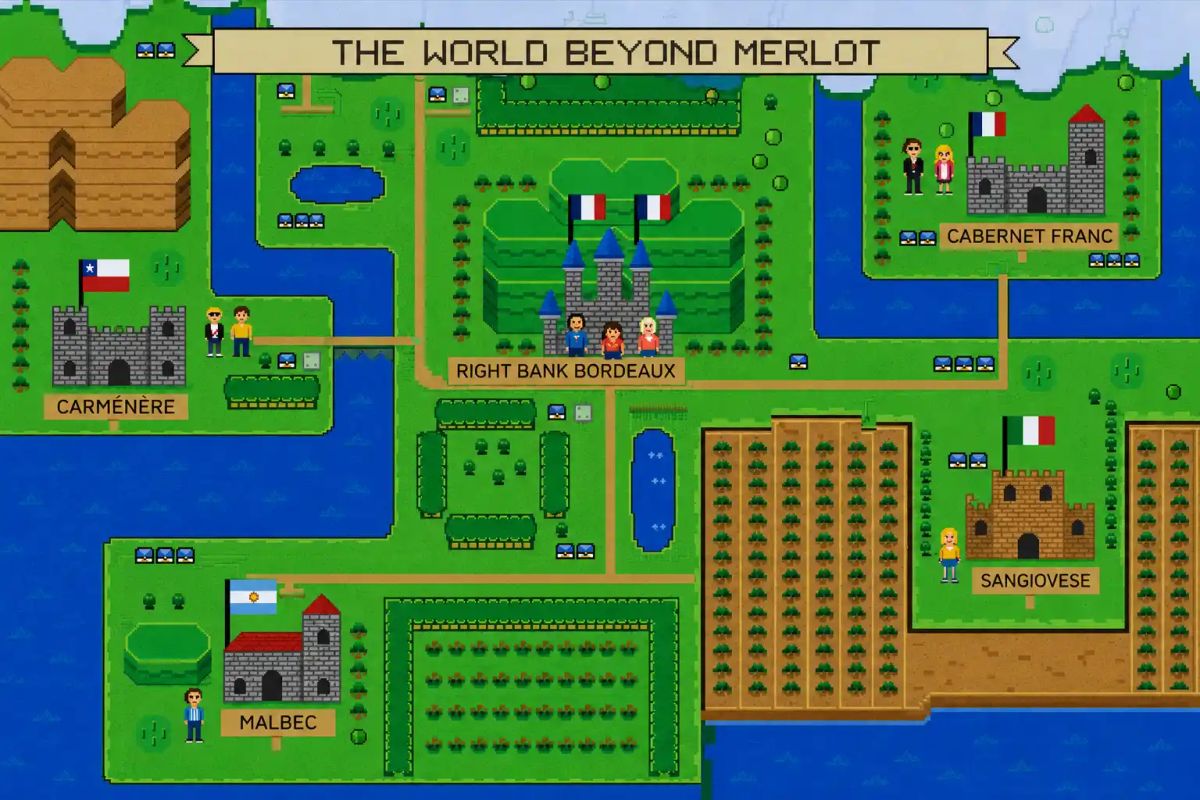
If you like Merlot, try these five wines: Carménère from Chile for the plush, herb-edged red that is genuinely Merlot's lost Bordeaux cousin, Right Bank Bordeaux from Saint-Émilion and Pomerol for Merlot taken as seriously as it has ever been taken, Malbec from Mendoza for the same soft, dark-fruited generosity by a slightly riper route, Cabernet Franc from the Loire for the leaner, leafier, more structured version of the same idea, and Sangiovese from Tuscany for the savoury, food-shaped answer that trades plush for grip.
Five wines to try if you like Merlot:
- Carménère (Central Valley, Chile): plush, dark, herbal, soft (£8 to £18)
- Right Bank Bordeaux (Saint-Émilion, Pomerol): Merlot, elevated (£15 to £40+)
- Malbec (Mendoza, Argentina): velvety, dark fruit, easy (£9 to £22)
- Cabernet Franc (Loire, France): leaner, leafy, structured (£10 to £22)
- Sangiovese (Tuscany, Italy): savoury, sour cherry, grip (£9 to £20)
THE MAP

| Carménère | Right Bank Bordeaux | Malbec | Cabernet Franc | Sangiovese | |
|---|---|---|---|---|---|
| Body | Medium to full | Medium to full | Full | Medium | Medium |
| Acidity | Medium | Medium | Medium | Medium to high | High |
| Tannin | Soft | Medium to firm | Soft to medium | Medium, grippy | Firm |
| Closest match to Merlot | The texture | The grape itself | The plushness | The structure | The food role |
| Price band | £8 to £18 | £15 to £40+ | £9 to £22 | £10 to £22 | £9 to £20 |
| Best occasion | Midweek, roast | Occasion, cellar | Steak, crowd | Cheese, charcuterie | The table |
QUICK LEGEND
If you like Merlot soft, dark and easy: go Carménère or Malbec.
If you want Merlot done properly: go Right Bank Bordeaux.
If you like a bit more spine and a green-herb edge: go Cabernet Franc.
If what you actually want is a red built for food: go Sangiovese.
If you secretly like Merlot for its quiet reliability, you are allowed to keep drinking it. Nobody is watching.
WHAT CONNECTS THESE WINES
Merlot is the most quietly betrayed grape in wine.
One line in one film did the damage. A character in Sideways announced he was not drinking any Merlot, the audience laughed, and a generation of drinkers decided agreement was the sophisticated position. The irony, well worn now but still true, is that one of the most expensive wines in the world, Château Pétrus, is almost entirely Merlot. The grape did not get worse in 2004. Its reputation did.
What Merlot actually offers is approachability without apology. Soft tannin, dark plum and black cherry, a rounded mid-palate, a finish that does not demand anything of you. It is the red you can open without a plan. That is not a weakness. It is the reason it is planted almost everywhere.
The problem is that "almost everywhere" produced an ocean of cheap, hollow Merlot, and the hollow version is the one most people picture. The grape is fine. The floor was low.
These five wines keep what Merlot does well and fix what the cheap stuff lost. More texture, more origin, more structure, more savour. None of them needs you to forgive anything.
Serve at 16 to 18 degrees Celsius. Too warm and the soft fruit turns flat.
THE FIVE WINES
1. Carménère, the Lost Bordeaux Grape
Carménère is the closest thing Merlot has to a long-lost sibling.
It was a Bordeaux grape, planted alongside Merlot for centuries, then almost wiped out after phylloxera and quietly forgotten. For decades the Carménère growing in Chile was mislabelled as Merlot, because nobody had told the vines they were different. Once Chile worked out what it actually had, Carménère became the country's signature red.
The family resemblance is obvious. Deep colour, soft tannin, plush dark fruit, the same low-effort drinkability. What Carménère adds is a savoury, green note, bell pepper, dried herb, sometimes soy, that gives the wine an edge Merlot rarely has. The good bottles balance the herb against ripe fruit. The cheap ones can tip too far into the vegetal.
This is the switch for the Merlot drinker who wants the same comfort with a little more to talk about.
What you will recognise: soft tannin, dark plum, easy approachability. What changes: more savoury and herbal, a green-pepper top note, a touch more body. Look for: Chilean Carménère, particularly from the warmer Colchagua and Maipo valleys. Budget: £8 to £18.
2. Right Bank Bordeaux, the Origin Restored
The most honest answer to "what should I drink instead of Merlot" is better Merlot.
On the Right Bank of Bordeaux, in Saint-Émilion and Pomerol, Merlot is not the cheap option. It is the main grape in some of the most coveted wines in the world. Same variety, completely different ceiling. Plum and black cherry deepen into truffle, tobacco, graphite and dried flowers, with a structure that the supermarket version simply does not have.
You do not need to spend Pétrus money. Satellite appellations such as Lalande-de-Pomerol and the Côtes de Bordeaux deliver a serious amount of the experience for a fraction of the outlay, and they age in a way cheap Merlot cannot.
This is the move for the Merlot drinker who has only ever met the grape at its worst and assumed that was all it had.
What you will recognise: plum, soft-edged tannin, roundness. What changes: far more depth, savoury complexity, real structure, the capacity to improve in bottle. Look for: Saint-Émilion, Pomerol, Lalande-de-Pomerol, and the Côtes de Bordeaux for value. Budget: £15 to £40 and well beyond.
3. Malbec, the Plush One
Malbec and Merlot solve the same problem from slightly different angles.
Both give you a dark, soft, generous red that works without ceremony. Malbec leans riper and more velvety, with violet and dark cherry where Merlot gives plum and a more savoury edge. The tannins are soft, the mid-palate full, the appeal immediate. For a lot of Merlot drinkers it is the cleanest one-to-one swap on this list.
Mendoza is the centre. One tier above entry level the wines gain freshness and definition, particularly from the higher-altitude sites of Luján de Cuyo and the Valle de Uco.
What you will recognise: dark fruit, soft tannin, crowd-pleasing ease. What changes: riper and more velvety, more violet and cherry, slightly fuller. Look for: Mendoza Malbec, particularly Luján de Cuyo or Valle de Uco. We go deeper in our Malbec alternatives guide. Budget: £9 to £22.
4. Cabernet Franc, the Structured Cousin
Cabernet Franc is the parent grape of both Merlot's blending partner and, genetically, of Cabernet Sauvignon. On the Right Bank it is the third voice in the blend. On its own, in the Loire, it becomes something Merlot drinkers should know.
Red cherry, raspberry, graphite, and a leafy, pencil-shaving note that is the grape's signature. Lighter in body than Merlot, more obviously structured, with a freshness that makes it one of the best food reds in France. Chinon, Bourgueil and Saumur-Champigny are the names. Cooler vintages bring out the green edge; warmer ones bring out the fruit.
This is for the Merlot drinker who likes the fruit but has started to want a bit more spine underneath it.
What you will recognise: red and dark fruit, drinkability, a soft heart. What changes: leaner, fresher, more structured, a distinctive leaf-and-graphite edge. Look for: Chinon, Bourgueil and Saumur-Champigny from the Loire. Budget: £10 to £22.
5. Sangiovese, the Savoury One
Sangiovese is the answer for the Merlot drinker who has quietly realised they only really enjoy the wine with food.
This is Tuscany's grape, the spine of Chianti and Brunello. Sour cherry, dried herb, tomato leaf, leather, and a firm, savoury grip that Merlot deliberately avoids. It is not plush. It is built around acidity and structure, which is exactly why it makes ordinary food taste better and why Italians rarely drink it without a plate in front of them.
The shift from Merlot to Sangiovese is the biggest jump on this list, and the most rewarding for anyone who has started to find soft reds a little boring.
What you will recognise: dark cherry fruit, an everyday red role, dependable structure. What changes: far more savoury and herbal, higher acidity, firmer tannin, built for the table. Look for: Chianti Classico and Rosso di Montalcino to start; the full picture is in our upcoming Chianti alternatives guide. Budget: £9 to £20.
A NOTE ON MERLOT VERSUS CABERNET SAUVIGNON
This is the comparison everyone reaches for, so make it cleanly.
Merlot is the softer of the two. Rounder tannin, riper plum and black cherry, lower acidity, a gentler finish. It is ready sooner and asks for less. Cabernet Sauvignon is firmer and more structured: blackcurrant rather than plum, higher tannin, a savoury cedar and graphite edge, and the kind of grip that wants either food or time. In a classic Bordeaux blend the two are paired precisely because they cover each other's gaps. Merlot fills the middle and softens the edges. Cabernet supplies the frame.
If you like Merlot and want to stay close, Carménère and Malbec are the safe moves. If the Cabernet half is what you actually respond to, the structured cousins, Cabernet Franc and Right Bank Bordeaux, are the better direction. Tasting a varietal Merlot and a varietal Cabernet side by side, from the same producer if you can, settles the question faster than any tasting note.
THE TASTING GAME
What You Need
Five bottles, one of each wine above. Four to five red wine glasses per person. A pen and the rating table below. One person who has confidently said "I do not drink Merlot" at least once and cannot fully explain why.
Optional but recommended: add a cheap supermarket Merlot and a varietal Cabernet Sauvignon as reference points. The gap between the cheap Merlot and the Right Bank bottle is the entire argument.
The Rating Table
| Characteristic | What you are looking for |
|---|---|
| Dark fruit | Plum, black cherry, blackberry |
| Tannin | 1 = soft and round, 5 = firm and grippy |
| Savoury edge | Herb, leather, tobacco, graphite |
| Freshness | How much the wine makes you want the next sip |
| Food pull | How urgently it asks for something to eat |
Ourglass Benchmarks
| Characteristic | Merlot | Carménère | Right Bank | Malbec | Cab Franc | Sangiovese |
|---|---|---|---|---|---|---|
| Dark fruit | 4 | 4 | 4 | 5 | 3 | 3 |
| Tannin | 2 | 2 | 4 | 3 | 4 | 5 |
| Savoury edge | 2 | 4 | 5 | 2 | 4 | 5 |
| Freshness | 2 | 3 | 4 | 3 | 4 | 5 |
| Food pull | 2 | 3 | 4 | 3 | 4 | 5 |
The revealing column is Food pull. Cheap Merlot scores low because its whole appeal is requiring nothing. The exercise is to find how much structure and savour you can add before the wine stops being relaxing and starts being interesting, and to notice where on that line you actually want to live.
If you would rather have that line found for you, bottle by bottle, that is what Ourglass is for. Start here.
WHAT YOUR SCORES REVEAL ABOUT YOUR PALATE
Low tannin, high dark fruit, low food pull? You like Merlot for exactly what it is. Carménère or Malbec, and no apology required. Next: Chilean Carménère reserva, Valle de Uco Malbec.
Liked the depth more than the softness? You are a Right Bank drinker. Next: Lalande-de-Pomerol, Castillon Côtes de Bordeaux, aged Saint-Émilion.
Drawn to the green-and-graphite edge? Cabernet Franc is your grape. Next: Chinon, Saumur-Champigny, Loire reds in general.
High food pull, high freshness? You were never really a Merlot drinker. Sangiovese is home. Next: Chianti Classico, then our upcoming Chianti guide.
Not sure? Take the palate route through Taste Decoded, or use our guide to developing your palate.
YOUR SHOPPING LIST
| Carménère | Right Bank Bordeaux | Malbec | Cabernet Franc | Sangiovese | |
|---|---|---|---|---|---|
| Region | Central Valley, Chile | Saint-Émilion / Pomerol, France | Mendoza, Argentina | Loire, France | Tuscany, Italy |
| Budget | £8 to £18 | £15 to £40+ | £9 to £22 | £10 to £22 | £9 to £20 |
| Start with | Colchagua or Maipo Carménère | Lalande-de-Pomerol or Côtes de Bordeaux | Luján de Cuyo or Valle de Uco | Chinon or Saumur-Champigny | Chianti Classico or Rosso di Montalcino |
Carménère, Malbec and Chianti are easy to find in any major UK supermarket. Loire Cabernet Franc and good-value Right Bank Bordeaux are the two most likely to need a proper wine merchant, which is also where they are most rewarding.
GO DEEPER
What to drink instead of Malbec. The closest neighbour to this one.
A guide to the wines of Bordeaux. Where Merlot is taken most seriously.
A brief guide to the wine regions of France. The wider map.
The definitive guide to wine grape varieties. Every grape on this list, in context.
If you like that wine, try this. Fourteen more of these jumps.
How to develop your wine palate. The long game.
FREQUENTLY ASKED QUESTIONS
What does Merlot taste like?
Soft, rounded and approachable: ripe plum and black cherry, a smooth mid-palate, gentle tannin and a low-acid, undemanding finish. Better Merlot, particularly from the Right Bank of Bordeaux, adds truffle, tobacco and graphite over a real structure.
What is the difference between Merlot and Cabernet Sauvignon?
Merlot is softer, rounder and riper, with plum fruit, gentle tannin and lower acidity. Cabernet Sauvignon is firmer and more structured, with blackcurrant fruit, higher tannin and a savoury cedar edge. They are blended together in Bordeaux because each covers the other's weakness.
If I like Merlot, what else will I like?
Carménère from Chile for the same plush texture with a savoury edge. Right Bank Bordeaux for Merlot at its best. Malbec from Mendoza for a riper, velvety version. Cabernet Franc from the Loire for more structure. Sangiovese from Tuscany for the food-driven answer.
Is Merlot a good wine?
Yes. The grape produces some of the world's most expensive wines on the Right Bank of Bordeaux. Its reputation suffered from a film joke and from an oversupply of cheap, hollow examples. Bought one tier above the bottom, Merlot is reliably good.
Why did people stop drinking Merlot?
Largely culture rather than taste. A dismissive line in the 2004 film Sideways made disliking Merlot a fashionable position, at the same time as a glut of cheap, characterless Merlot confirmed the prejudice. The serious versions never went anywhere.
Is Carménère similar to Merlot?
Closely. It was historically grown alongside Merlot in Bordeaux and was mistaken for it in Chile for years. It shares the soft tannin and dark fruit, and adds a savoury, green-pepper and herb character of its own.
What food pairs with Merlot and its alternatives?
Softer styles such as Merlot, Carménère and Malbec suit roast chicken, sausages, mild cheese and midweek cooking. The structured options, Cabernet Franc, Right Bank Bordeaux and especially Sangiovese, come alive with richer dishes, charcuterie and anything tomato-based.
Which Merlot alternative should a beginner try first?
Chilean Carménère. It is inexpensive, widely stocked in UK supermarkets, soft and immediately likeable, and it offers a little more interest than entry-level Merlot for the same money.