
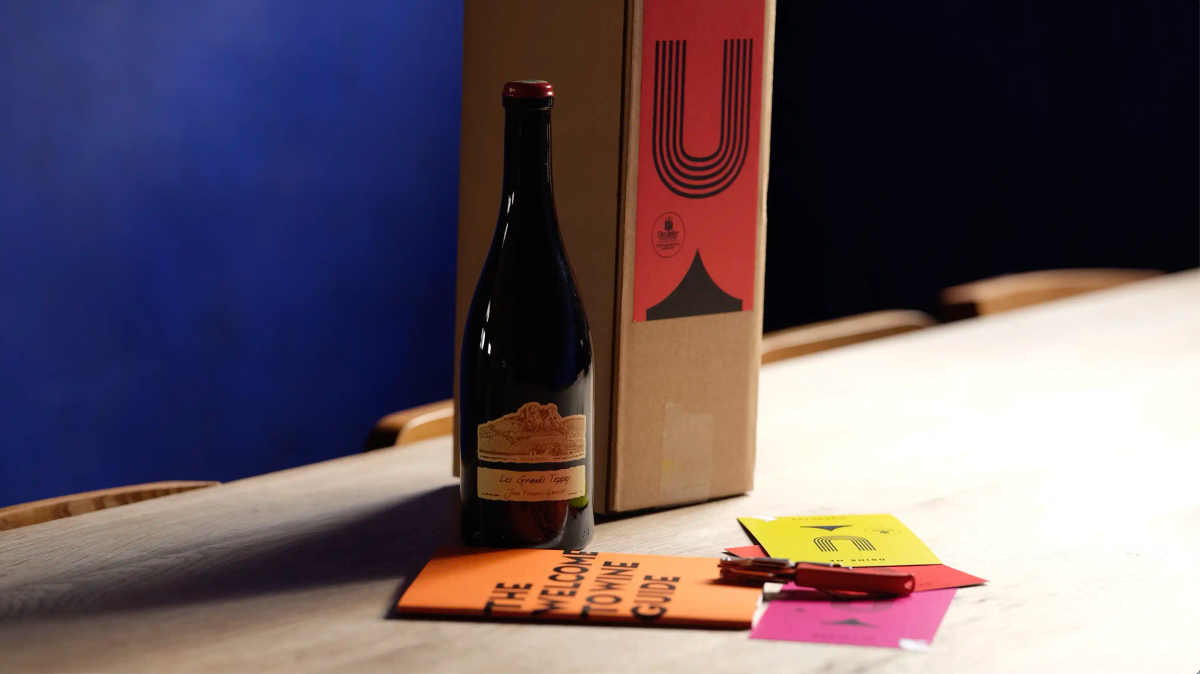
WHAT'S IN AN OURGLASS BOX
Real wines from producers worth knowing, structured tasting notes, food pairings, and the context that makes every bottle worth remembering.
THE SHORT ANSWER
An Ourglass box contains wines chosen to teach you something specific, plus the material that makes the lesson stick: printed tasting and pairing notes, short video guides, and producer context. It is a wine subscription designed to develop your taste, not just fill your rack. You end up choosing wine with more confidence in shops, restaurants, and at other people's dinner tables. Tiers and pricing are on our subscriptions page.
WHAT ARRIVES AT YOUR DOOR
A heavy, cleanly packed box. Bottles nested in protective inserts, each one individually sleeved. Printed notes on thick stock, not flimsy leaflets. The weight tells you something before you open it. These are producers you will not find stacked three shelves high in a chain store. Pick up one of the bottles and you will notice the labels first: names you do not recognise, from producers you will not stumble across in Tesco. That unfamiliarity is the point. It is how you stop drinking the same three wines forever.
THE WINES INSIDE
Every bottle is chosen to teach you something specific about a grape, a region, or a style. Here are three wines from a recent box.
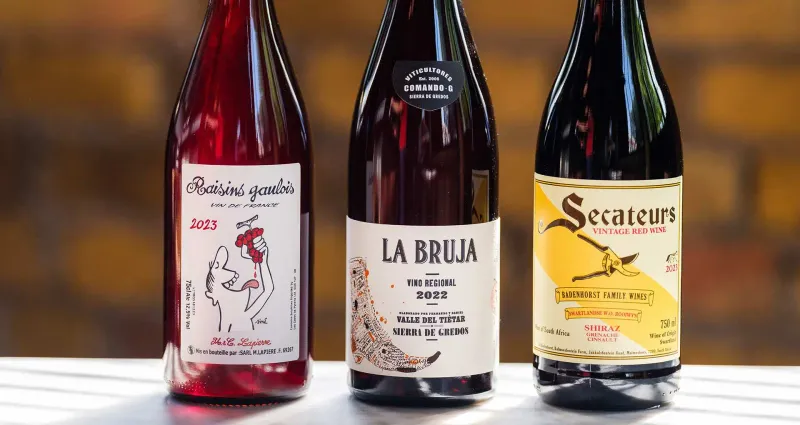
Lapierre Raisins Gaulois '22 Gamay, Vin de France. The Lapierre family are key figures in the French natural wine movement. Marcel was known as the Godfather of Gamay. Organic and biodynamic vineyards, hand-harvested, no herbicides or pesticides. Expect pure redcurrant, vegetal notes, and freshness. The kind of wine that teaches you what minimal intervention actually tastes like, and why Gamay is not the joke people think it is. Pair with pâté, tortilla crisps with salsa, or a bright tomato and watermelon gazpacho.
Comando G La Bruja de Rozas '19 Garnacha, Sierra de Gredos, Spain. Fernando García and Daniel Gómez Jiménez-Landi, the self-styled "crazy enologists," make concentrated, finesseful Garnacha from 80-year-old vines on a single small plot. Expect fresh raspberry and light earthy freshness. Nothing like the heavy, jammy Garnacha you might expect. One glass and you understand why Sierra de Gredos is one of the most exciting regions in Spain right now. Pair with spinach, strawberry and goat cheese salad, vegetarian tagine, or a Spanish cured meat board.
Badenhorst Secateurs '20 Cinsault Blend, Swartland, South Africa. Adi Badenhorst makes uncompromising yet accessible wines from the Swartland. Perfect for the park, the beach, or the barbecue. Expect berry fruits, pepper, and light freshness. A bottle that shows what South Africa does best when it stops overthinking. Pair with escargot, or match with the bolder flavours of stews and roasts.
And from another custom gift subscription:
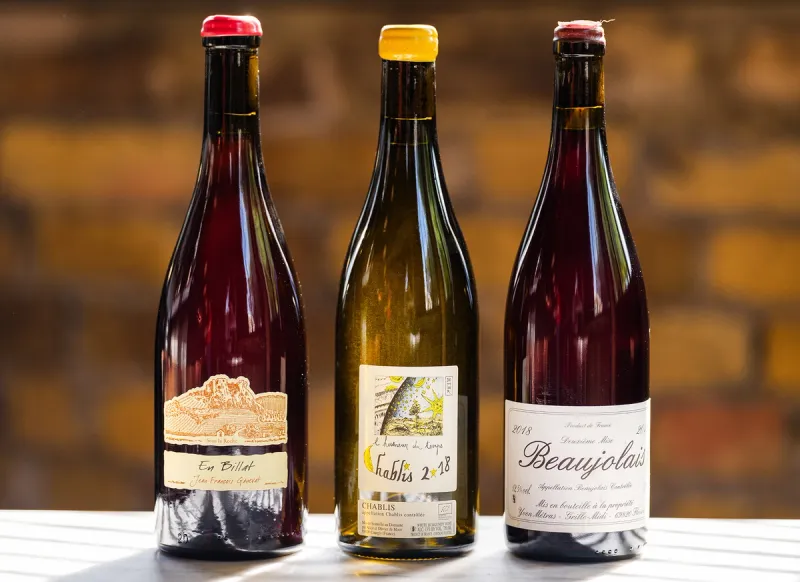
Jean-François Ganevat En Billat '18 Poulsard, Jura, France. Anne and Jean-François Ganevat reclaimed traditional biodynamic techniques without compromising the perfected quality of their sought-after wines. Rolling high-altitude Juran hilltops, schist soil, and low-yield vineyards produce wines of distinct place. Expect textured cherry, berry, and forest notes. Pair with grilled aubergine, a clam and summer vegetable salad, or a hot and fragrant bowl of Sichuan beef soup.
De Moor Chablis L'Humeur du Temps '19 Chardonnay, Chablis, France. Innovative winemaking couple Alice and Olivier De Moor both studied at the Dijon enological school. Their coveted organic Chablis is aged in oak barrels in an old cellar under Olivier's grandparents' home. Expect cool minerality, apple, and citrus notes. Pair with buttery freshly baked bread, simple fish dishes like grilled oysters, or braised fennel.
Yvon Métras Beaujolais '17 Gamay, Beaujolais, France. This cult producer is feted as the best Beaujolais has to offer. Yvon makes pure, natural yet serious Gamay with native yeasts and little or no sulphur from small-yield, century-old vines. Expect red berries, gaminess, and soft, light freshness. With air, any initial barnyard character dissipates to leave very pure, light juice. Pair with steak frites, rustic garlicky sausages, or butternut squash roasted with orange and honey.
Over time, these bottles stop being interesting novelties and start becoming reference points in your own taste memory.
These are not random selections. Each one connects to our library of 90+ articles and region deep dives covering every major grape, every major region, and every major style.
WHAT COMES WITH THE WINE
Every box includes printed tasting notes, food pairing recommendations, and producer context. But "tasting notes" undersells what you actually get.
HOW THE NOTES ARE STRUCTURED
Each wine comes with four things: producer story, winemaking context, flavour expectation, and a specific food pairing.
The producer story tells you who made the wine and why they matter. Not a paragraph of marketing. A few lines that give you the reference point: "The Brajkovich family have been making wine in New Zealand since 1944" or "Apostolos Thymiopoulos has reshaped the landscape surrounding Xinomavro viticulture, bringing the ancient Greek varietal into the modern age of winemaking."
The winemaking context tells you what happened to the grapes: how they were grown, how they were fermented, what makes this bottle different from the same grape made elsewhere. Wild yeast fermentation, volcanic soil, ungrafted century-old vines, second fermentation in cuvée close. You do not need to memorise any of it. But when you taste the wine, the context changes what you notice.
The flavour expectation is written in plain English. Not scores out of a hundred. Not abstract poetry. Just what to expect in the glass: "juicy cherries and strawberries, primrose and lavender, and a litany of baking spices" or "pear, citrus and honeysuckle with a creamy effervescence and a crisp end." Enough to give you a framework. Not so much that it tells you what to think.
Food pairings are specific. Not "pairs well with white meat." Instead: herb-crusted roast chicken, spicy Thai green papaya salad, boeuf bourguignon, or buffalo mozzarella with olives and crostini. Dishes you can actually cook or order.
Short video guides give you the producer's story, the vintage context, and the regional background in under five minutes. You watch them while you drink. That is the point.
WHY THIS WORKS
The whole system compounds. The first box gives you a vocabulary. The third box gives you comparisons.
By the sixth box you are noticing things unprompted, choosing wines in shops with actual criteria, holding your own at a dinner table without bluffing, and explaining why to someone else without reaching for adjectives you do not believe.
You do not study wine. You practise on real bottles, with a method you can reuse anywhere. The wine is the vehicle. The judgment is what you keep.
For the science behind why this approach works, our Taste Decoded series with Rory Sutherland and Professor Charles Spence explains how context, expectation, and experience shape the way you perceive flavour.
THE TIERS
If you are unsure, start with The First Time. Move up a tier the moment it feels easy.
The First Time. 3 bottles, £50 per month. Tasting notes, pairings, and a welcome guide. If you want to stop feeling like you are guessing, this is where you start.
The Next Level. 4 small-producer bottles, £90 per month. Detailed notes, food pairings, and video guides. If you are bored of your defaults and want range with structure, this is the step up.
The Producers. 4 critic-acclaimed bottles, £120 per month. Producer profiles and wines that set the benchmark for their region, with vintage context so you understand why. If you want proper context and not random variety, this is where you go.
| Tier | Bottles | Monthly Price | Perfect For | Includes |
|---|---|---|---|---|
| The First Time | 3 | £50 | Crowd Pleasers | Tasting & pairing notes, welcome guide, eco packaging, cancel or pause anytime |
| The Next Level | 4 | £90 | Explorers | Everything in First Time plus priority member support |
| The Producers | 4 | £120 | Cultists | Everything in Next Level plus first access limited wines |
| The Traveller | 6 | £180 | Terroirists | Everything in Producers plus masterclass video library |
| The Master | 8 | £270 | Rares | Everything in Traveller plus personal wines concierge |
| Northern Star | 4+ | £500 | Collectors | Everything in Master plus private tasting events and exclusive winery trips |
If you want to understand what makes a good wine club before choosing, that is worth reading first. If you are weighing up whether a wine subscription is worth it at all, we wrote that one too.
THE GUARANTEE
Every wine in every box is chosen by our curation team and matched to your taste profile. If a wine does not work for you, we want to know. Tell us, and we will replace it on the next box or refund the bottle. We curate by hand, taste every wine before it goes into a box, and stand behind every selection.
WHAT MEMBERS SAY
Terry Pigott, member since the start: "Being less clued in about wine, having someone else choose different regions, varieties, and flavours, and it always being good, is a game changer for me. It gives me something to talk about with more knowledgeable friends. They're always impressed with the Ourglass wines I bring. I now feel I'm finally in on the whole wine thing."
Tom S.: "It feels like Christmas every time the box turns up, so that's pretty cool. Our friends and neighbours now think of us as 'wine people' which is hilarious given our actual knowledge, but we go along with it. Someone even said the other day: 'is this an Ourglass wine?'"
Kelly GS: "I thought I had a good sense of what I like, but Ourglass has introduced me to bottles I wouldn't have chosen and really enjoyed. I cancelled our Wine Society subscription after a few months of Ourglass boxes. It's miles better."
HOW IT GETS TO YOU
Boxes are dispatched from our temperature-controlled warehouse near Heathrow. UK delivery is via DPD or Parcelforce, with tracking emailed at dispatch. Most boxes arrive within 2 to 4 working days. We do not ship outside the UK at present. Wines are packed in recyclable moulded pulp inserts within sturdy cardboard outers. Glass breakage is rare. When it happens, we resolve it within 24 hours. Email nick@ourglass.wine with a photo and we will replace or refund without quibble.
WHERE TO START
Pick a tier, choose monthly or bi-monthly, and pause or cancel whenever you like.
GO DEEPER
Is a Wine Subscription Worth It?
What to Drink Instead of Sauvignon Blanc
What to Drink Instead of Malbec
Wine Grape Varieties: The Definitive Guide
FAQ
What if I do not like a wine in my box? If it is simply not for you, we replace it or credit you. No questions. If it is just unfamiliar, the notes and pairings usually show you why it was chosen.
How is Ourglass different from other wine subscriptions? Most subscriptions optimise for logistics. We optimise for learning. Every wine is chosen to teach you something about a grape, a region, or a style. The notes, videos, and pairings are structured to build your palate systematically. What makes a good wine club explains the difference in detail.
Can I choose red only, white only, or mixed? Yes. Every tier is available as mixed, red, or white.
Do I have to commit to a minimum number of months? No. Cancel or pause any time. No lock-in.
What if I already know a lot about wine? The higher tiers (Producers, Traveller, Master) are designed for experienced drinkers. The wines are benchmarks, not introductions. The education layer adds context even experienced tasters rarely get: producer philosophy, vintage specifics, and regional framing that connects each bottle to the bigger picture.
Is this cheaper than buying these wines individually? We are not trying to be the cheapest source of wine. We are the most structured way to improve your taste. The price reflects the producers, the material, and the system behind it.