
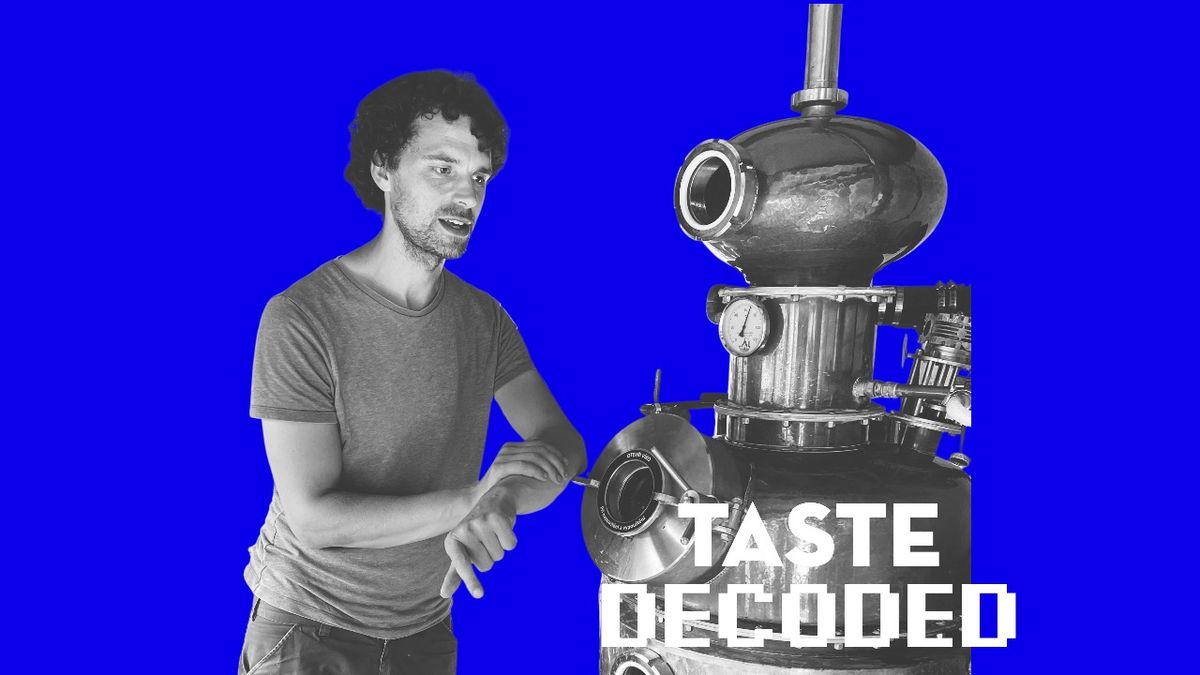
There is a greenhouse in Cirencester that does not grow tomatoes.
It squats quietly beside a childhood home of Cotswold stone and timber, more suggestive of geraniums and seed trays than spiritual revelation. Inside it, Barney Wilczak has constructed one of the most exacting distilleries in Britain, perhaps Europe. Two copper stills gleam where sweet peas once climbed. Outside, roe deer slip through hedgerows at dusk, as if conscious of the fact that they too are part of this story.
Capreolus. The Latin name of the roe deer. Graceful, transient, natural. A fitting name for a distillery devoted not to volume, nor indulgence, but preservation. To the idea that fruit, at its perfect moment, deserves to be remembered at its best.
Watch our conversation with Barney Wilczak, or read on.
THE MOMENT OF TRUTH
Wilczak works only with local fruit, gathered from small orchards within reach of the Cotswolds. Not because the word local plays well on labels, but because anything else would violate the ethos. Fruit must not be taken when convenient, but when it is truly expressive. When sugar, acid and aroma sit at their narrow point of balance. When the fruit is no longer agricultural produce but an event.
That timing is everything. The moment of harvest is chosen by instinct, weather, skin tension, seed colour and scent. The practical difficulty of this would deter most businesses. For Capreolus, it defines their work.
This is the same principle that underpins how taste actually works. Perception is not passive. It is constructed through attention, context and expectation. What you experience depends on what you bring to the moment.
A SINGULAR VISION
Wilczak took a decade to become satisfied with his own distillation. Even now, satisfaction arrives briefly. He is not interested in control, but guidance. The distillery does not impose flavour. It reveals it.
Every fruit is hand graded and cleaned. Rare pears, quince, damsons, raspberries. Sometimes stems, stones and pips are left in what he calls their noble form for depth and structure.
Wild fermentation follows. No cultured yeasts. No shortcuts. A sequence of native yeasts found on the fruit begin their work, each contributing character from orchard, season and soil. The spirit landscape is written long before the still is even warm.
THE DISCIPLINE OF DISTILLATION
The first distillation yields low wines of modest strength. These are combined and distilled again for the final spirit run. This is where experience matters. Flavours emerge in bands as molecules reach their boiling points. The heads are rejected. So too the tails. They are never recycled. Commercial recovery is of no interest here.
At peak concentration, the essence of up to three thousand kilograms of fruit can sit within a still that could be ruined by a single careless decision. Twenty seconds of error. A year lost.
Copper is chosen for function, not nostalgia. It binds undesirable compounds and conducts heat consistently. The still is heated slowly, wrapped in water to avoid scorching, allowing flavours to rise in sequence rather than haste.
This is distillation with care.
It echoes what Jon King describes as the discipline of subtraction. Knowing what to leave out. Rejecting the heads and tails. Refusing to recycle. Clarity emerges when you know what to subtract.
WHAT CAPREOLUS TASTES LIKE
These are not spirits that imitate or represent. They express essence.
Raspberry Eau de Vie carries not only sweetness, but the green whisper of stem and the granular memory of seed. Damson shows spice and almond alongside dark flesh. Perry pear offers a creamy, tannic echo that feels strangely inevitable. There is gravity and lightness in the same breath.
The Cotswold Eau de Vie, a blend of raspberry, quince and orchard fruit, finishes with crystalline clarity and near-weightless precision. Serve it neat and lightly chilled. With figs, soft cheese, or nothing at all. It demands attention, not accompaniment.
Each bottle is one harvest. One location. One exact moment.
Volume will remain small. This is not scarcity as strategy. It is consequence. The finite nature is not an inconvenience. It is the point.
A DISAPPEARING RELATIONSHIP WITH FRUIT
Capreolus preserves something more than flavour. It conveys essence, even memory.
An essence of fruit before modern abundance rendered ripeness irrelevant. Before orchards were reduced to items on a spreadsheet and varieties flattened for transport resilience. These spirits refuse the idea that fruit is merely sweet. They settle on season, lineage, timelessness.
Not nostalgia. Continuity.
Drink them to remind yourself what fruit tastes like. Of what purity tastes like.
Drink them to understand restraint.
This is the argument Rory Sutherland makes about the wine sweet spot. Value is not about price or volume. It is about attention, care and fit. The right thing at the right moment, chosen with intention.
Capreolus does not shout. It distils fruit to its essence.
'Capreolus is an exercise in reverence: by drawing our egos in and focusing on recording the plant, we amplify (through sheer concentration) seemingly impossible complexity and elegance, place, plant and heritage. Aeons of evolution dwarfs our own ability to create.'
Barney Wilczak, Distiller, Capreolus Distillery
FREQUENTLY ASKED QUESTIONS
What is Capreolus Distillery?
Capreolus Distillery is an artisanal English distillery based in Cirencester, producing eaux de vie from locally sourced fruit harvested at peak ripeness and distilled using wild fermentation and copper pot stills.
Who is Barney Wilczak?
Barney Wilczak is the founder and distiller of Capreolus Distillery. A former photographer, he applies the discipline of capturing fleeting moments to the art of fruit distillation.
What makes Capreolus eaux de vie different?
Each Capreolus spirit is made from a single harvest of local fruit, distilled at the moment of peak balance, with no recycled heads or tails and no artificial flavour manipulation.
How should you drink Capreolus eau de vie?
Serve neat and lightly chilled. Capreolus eaux de vie pair well with figs, soft cheese, or nothing at all. They demand attention, not accompaniment.
Where is Capreolus Distillery based?
Capreolus Distillery is based in Cirencester in the Cotswolds, working exclusively with fruit from local orchards.
MORE FROM TASTE DECODED
How Taste Works: The Science of Flavour and Memory
The Wine Sweet Spot with Rory Sutherland
(Un)learn Taste with Gang of Four's Jon King
Tim Hayward: The Art of Not Writing
ABOUT THE AUTHORS
Benedict Johnson is the founder of Ourglass, a London-based taste platform dedicated to helping people become confident wine lovers. He writes on everything to do with wine, and curates the Taste Decoded series, which brings together sommeliers, communicators, academics and creatives to decode what great actually tastes like.
Barney Wilczak is the founder and distiller of Capreolus Distillery. A former photographer, he spent a decade refining his approach to fruit distillation before releasing his first eaux de vie. His work has been recognised as among the finest in Europe, applying the discipline of capturing fleeting moments to the preservation of seasonal fruit.