
WHAT TO DRINK INSTEAD OF CABERNET SAUVIGNON
Five wines similar to Cabernet Sauvignon, and a tasting game to find your favourite.
THE SHORT ANSWER
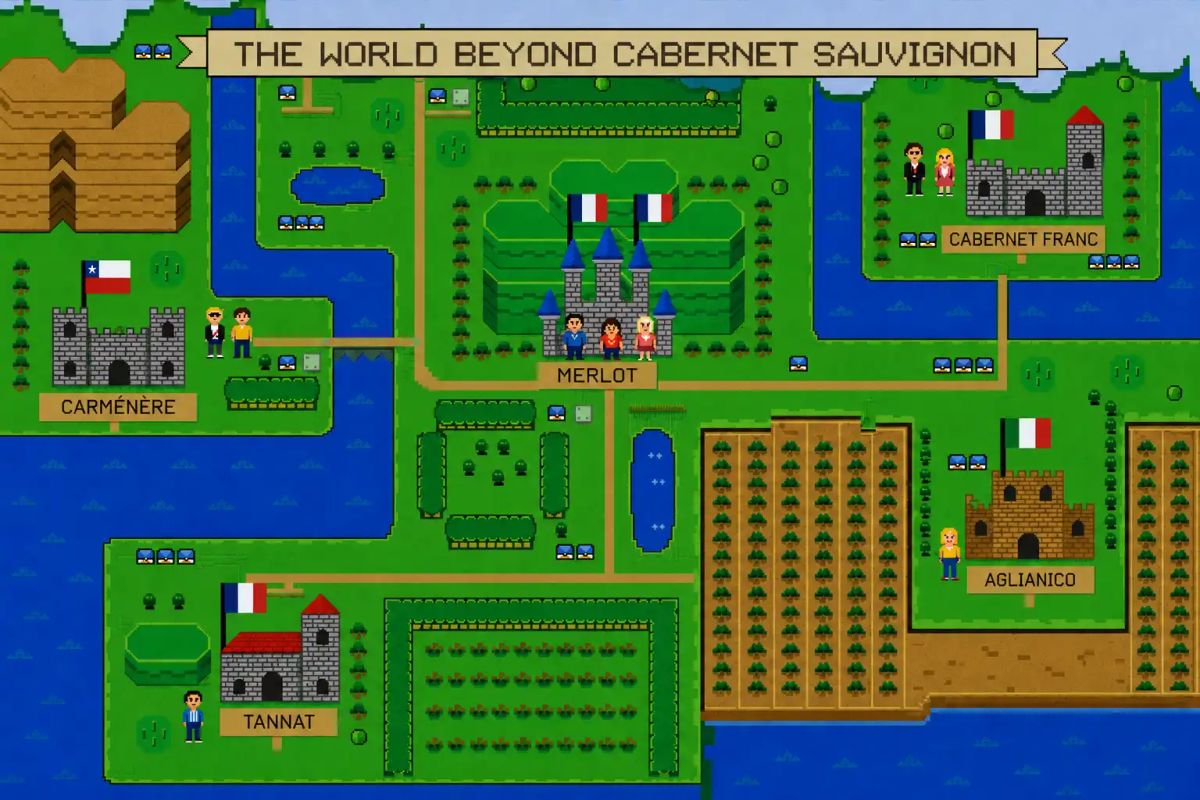
If you like Cabernet Sauvignon, try these five wines: Merlot from Pomerol for plush, velvety depth without the angular grip, Carménère from Chile for dark fruit with a smoky, savoury edge, Aglianico from southern Italy for volcanic structure and serious age-worthiness, Tannat from Madiran for unapologetic tannin and brute density, and Cabernet Franc from the Loire for cooler fruit, perfume, and pencil-shaving elegance.
What ties them together is not flavour but architecture. They all have structure. They all improve with food. They all reward a bit of patience. And they all understand that red meat and hard cheese are not side notes but part of the argument.
Five wines to try if you like Cabernet Sauvignon:
- Merlot (Pomerol, Bordeaux): plush, velvety, dark cherry and chocolate (£12 to £40)
- Carménère (Chile): dark fruit, green pepper, smoky savour (£8 to £18)
- Aglianico (Campania/Basilicata, Italy): volcanic, structured, tar and dark plum (£12 to £30)
- Tannat (Madiran, France): dense, tannic, blackberry and iron (£9 to £22)
- Cabernet Franc (Loire, France): aromatic, pencil shavings, cooler red fruit (£10 to £25)
The longer answer involves a tasting game, a scoring system, and the discovery that many Cabernet Sauvignon drinkers are not actually chasing fruit. They are chasing authority.
THE MAP
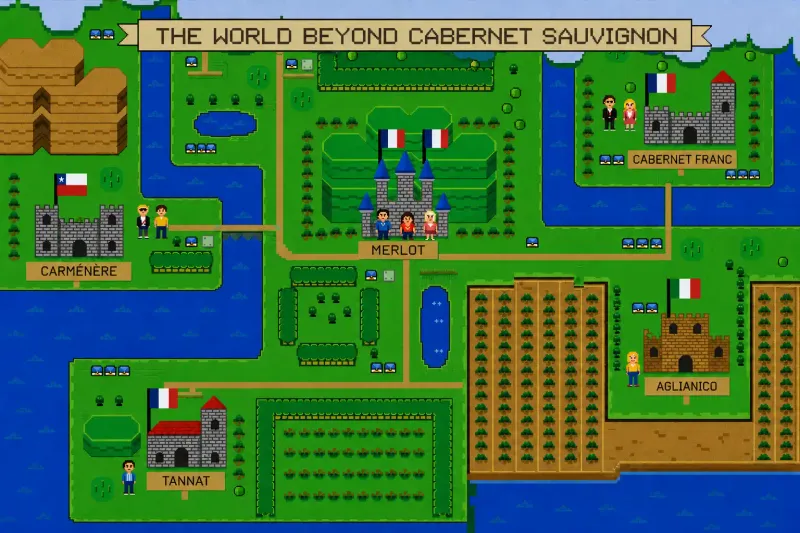
QUICK LEGEND
If you like the plush, velvety, fruit-forward side, go Merlot.
If you like the dark, savoury, slightly green-edged side, go Carménère.
If you like the structured, age-worthy, volcanic side, go Aglianico.
If you like pure tannin and power with no interest in compromise, go Tannat.
If you like aromatic lift and cooler fruit, go Cabernet Franc.
WHAT CONNECTS THESE WINES
Cabernet Sauvignon drinkers often think they want fruit. More often, they want authority.
They want a wine with posture. Something that stands up straight. Something that does not merely taste good but seems to know what it is doing. Cabernet Sauvignon is rarely casual. Even cheap Cabernet tends to arrive with a little too much confidence.
These five wines share that same architecture, but with different accents. Medium-full to full body. Dark or cool-toned fruit at the centre. Tannins that grip rather than glide. Reds that open with air, improve with food, and reward patience over instant gratification.
They share the architecture, not the address.
Serve all five at 17 to 18 degrees Celsius. Decant anything with age, and anything young that looks like it might argue with you.
THE FIVE WINES
1. MERLOT, THE PLUSH ONE
Merlot has a reputation problem. A great deal of that reputation was earned.
Too many drinkers met Merlot through warm-climate examples that were soft, vague, and forgettable. Plum without shape. Fruit without tension. The result was a generation of people talking about the grape as if softness were the same thing as lack of seriousness.
The solution is Pomerol.
On Bordeaux's right bank, where clay soils hold moisture and Merlot ripens fully without losing its line, the grape becomes something else entirely. Dark cherry, plum, cocoa, and a texture that feels like velvet rather than silk. The tannins are there, but rounded. Where Cabernet Sauvignon can feel like a firm handshake held slightly too long, Pomerol Merlot feels like a quieter confidence. Less rigid. No less serious.
The softness is deliberate. It is structure expressed differently.
You do not need to spend Pomerol money to understand the point. Castillon Côtes de Bordeaux and good right bank blends can get surprisingly close for everyday drinking. What you want is cool nights, enough ripeness, and a producer who treats Merlot as a grape capable of shape rather than just flesh.
What you will recognise: dark fruit, structure, food compatibility. What changes: softer tannins, more chocolate and plum, less cassis, more immediate pleasure. Look for: Pomerol and Saint-Émilion if you want the benchmark. Castillon Côtes de Bordeaux if you want the lesson without the invoice. Budget: £12 to £40.
2. CARMÉNÈRE, THE SAVOURY ONE
Carménère was presumed extinct for over a century. Then it turned out it had simply moved to Chile and kept quiet about it.
Originally a Bordeaux grape, it was largely wiped out in Europe after phylloxera and then rediscovered in Chilean vineyards in the 1990s, where growers had assumed it was Merlot. The confusion makes sense. Carménère has Merlot's dark fruit and medium body, but with something more feral under the surface. A green, smoky, herbal savour that either feels compelling or mildly suspicious, depending on your disposition.
When it is ripe, it works beautifully. Dark cherry, blackcurrant, green pepper, smoke, sometimes tobacco. It tastes like Cabernet Sauvignon's less polished cousin. Not rough, exactly. Just less interested in manners.
When it is underripe, it is miserable. All greenness, no charm. So the producer matters.
Good Carménère from Colchagua or Maipo is one of the smartest red-wine buys in the under-£15 category. Chile remains better than it gets credit for at this level, especially when it leans into what it actually does well rather than pretending to be Bordeaux in translation.
What you will recognise: structure, dark fruit, weight. What changes: a smoky, savoury, herbal quality, less tannin, more immediacy. Look for: Colchagua or Maipo. Budget: £8 to £18.
3. AGLIANICO, THE VOLCANIC ONE
Aglianico is what happens when structure stops being polite.
From Campania and Basilicata in southern Italy, often grown in volcanic soils, Aglianico produces wines of dark fruit, dried herbs, tar, and a mineral quality that feels less stony than metallic. Not literally iron, but something close enough that you start reaching for the word anyway.
Young Aglianico can be difficult. That is part of the appeal. The tannins are firm, the acidity is real, and the wine has no interest in seducing you early. This is not a red that wants to be liked on sight. It wants to be understood eventually.
Given time, it can be magnificent. Taurasi DOCG is the benchmark, capable of evolving for twenty years or more. Aglianico del Vulture, from Basilicata and the slopes of an extinct volcano, often makes the better entry point. Slightly fresher, slightly more aromatic, still structured enough to remind you that this is not a beginner's wine.
Cabernet drinkers who say they want to get into something more serious often mean this, whether they know it yet or not.
What you will recognise: tannic structure, dark fruit, the requirement for food. What changes: volcanic mineral character, tar, dried herbs, greater severity in youth, deeper reward in age. Look for: Aglianico del Vulture to start. Taurasi DOCG when you want the full sermon. Budget: £12 to £30.
4. TANNAT, THE POWERFUL ONE
Tannat does not apologise, which is one reason people either love it or avoid eye contact.
From Madiran in south-west France, and now widely planted in Uruguay, it is among the most tannic grapes in regular commercial production. Not metaphorically tannic. Properly tannic. The sort of wine that can make a young Cabernet feel almost cooperative by comparison.
But there is more to it than just grip. Good Tannat has tremendous dark fruit density. Blackberry, damson, black cherry, a little iron, sometimes something almost bloody in the best sense of the word. It is dense rather than heavy, assertive rather than clumsy. The tannins do not just grip. They coat. Fully. Thoroughly. As if the wine has decided it is not leaving until you serve it something with hooves.
This is where food stops being optional.
Madiran has improved enormously over the years, partly through better viticulture and partly because the region more or less invented micro-oxygenation as a way of civilising the grape. Uruguay tends to offer a rounder, riper version, often easier on first acquaintance.
If Cabernet Sauvignon is your benchmark for serious red, Tannat is the one that asks whether you meant it.
What you will recognise: weight, tannin, dark fruit, food affinity. What changes: more density, more tannin, less diplomacy. Look for: Madiran AOC for the stern version. Uruguay for the warmer, riper one. Budget: £9 to £22.
5. CABERNET FRANC, THE AROMATIC ONE
Cabernet Franc is one of Cabernet Sauvignon's parents, and in the Loire it behaves like one of those older relatives who is clearly from the same family but had a much more interesting life.
From Chinon, Bourgueil, and Saumur-Champigny, Cabernet Franc becomes cooler, finer, and more aromatic than Cabernet Sauvignon. Red cherry rather than cassis. Violet rather than dark chocolate. Pencil shavings, leafiness, dried herbs, and a kind of fragrant clarity that gives the wine lift without making it feel insubstantial.
This is the key difference. Cabernet Sauvignon tends to speak through fruit and structure. Cabernet Franc often speaks through perfume.
The body is lighter, the tannins finer, and the whole thing feels less monumental, but not less intelligent. If Cabernet Sauvignon wears a suit, Loire Cabernet Franc wears something older and better cut, then says something faintly devastating over lunch.
For drinkers who love Cabernet's shape but want more nuance and less force, this is often the revelation.
What you will recognise: structure, berry fruit, dry finish, tannic backbone. What changes: more perfume, cooler fruit, lighter body, a more expressive nose. Look for: Chinon, Bourgueil, Saumur-Champigny. Budget: £10 to £25.
THE TASTING GAME
WHAT YOU NEED
Five bottles, one of each wine above. Four to five glasses per person. A pen and the rating table below. Friends who think Cabernet Sauvignon is the default setting for serious red wine.
Optional but recommended: bring your usual Cabernet Sauvignon as a sixth bottle for direct comparison.
THE RATING TABLE
Rate each wine from 1 to 5:
| Characteristic | What you are looking for |
|---|---|
| Dark fruit intensity | Blackcurrant, blackberry, plum, damson, cassis |
| Tannin weight | How firmly the wine grips your gums and dries the inside of your cheeks |
| Savoury and mineral | Earth, smoke, herbs, graphite, iron, tar |
| Aromatic complexity | How much the wine gives you before the first sip |
| Length | How long the finish lasts after you swallow |
HOW TO PLAY
Step 1: Pour blind. Label the wines A, B, C, D, E.
Step 2: Taste and score. Each person rates every wine across the five characteristics.
Step 3: Compare scores. The disagreements matter more than the agreements.
Step 4: Reveal the wines. Compare with the Ourglass benchmarks below.
Step 5: Taste again now that expectation has arrived. Notice what changes.
OURGLASS BENCHMARKS
| Cab Sav | Merlot | Carménère | Aglianico | Tannat | Cab Franc | |
|---|---|---|---|---|---|---|
| Dark fruit | 4 | 4 | 4 | 5 | 5 | 3 |
| Tannin weight | 4 | 2 | 3 | 5 | 5 | 3 |
| Savoury/mineral | 3 | 2 | 4 | 5 | 4 | 3 |
| Aromatic complexity | 3 | 3 | 3 | 4 | 3 | 3 |
| Length | 4 | 3 | 3 | 5 | 4 | 3 |
THE FIVE QUESTIONS
Between rounds, pour one wine blind and ask:
- Old world or new world?
- Would you decant this?
- What would you eat with it?
- More or less tannic than Cabernet Sauvignon?
- Is this Wine A or Wine B?
Question 3 is usually the most revealing. Tannat says steak before most people can explain why. Cabernet Franc says charcuterie. Aglianico says lamb, or occasionally nothing at all, as if it expects the lamb to arrive on its own.
Those instinctive answers are your palate talking, not your memory.
If you want to shortcut this process, that is exactly what Ourglass does: wines chosen to stretch your range, with tasting notes that explain what you are drinking and why it matters. Start here.
WHAT YOUR SCORES REVEAL ABOUT YOUR PALATE
High dark fruit, high tannin, high length? You like power and structure. Aglianico and Tannat are your territory. Next: Barolo, Sagrantino from Umbria, Priorat. Your palate wants wines that push back.
High dark fruit, lower tannin? You like the fruit of Cabernet without the grip. Merlot from Pomerol is your answer. Next: Malbec from Mendoza, Montepulciano from Abruzzo.
High aromatic complexity, moderate tannin? You want structure with perfume. Cabernet Franc is your grape. Next: Blaufränkisch, Sangiovese, aged Rioja.
High savoury and mineral, high tannin? You want wines that taste of somewhere specific. Aglianico is the start. Next: Etna Rosso, Xinomavro.
YOUR SHOPPING LIST
| Merlot | Carménère | Aglianico | Tannat | Cab Franc | ||
|---|---|---|---|---|---|---|
| Region | Pomerol/Right Bank | Colchagua, Chile | Campania/Basilicata | Madiran, France | Loire Valley | |
| Budget | £12–40 | £8–18 | £12–30 | £9–22 | £10–25 | |
| Start with | Castillon | Côtes de Bordeaux | Maipo or Colchagua | Aglianico del Vulture | Madiran AOC | Chinon or Bourgueil |
| Aromatic complexity | 3 | 3 | 3 | 4 | 3 | 3 |
| Length | 4 | 3 | 3 | 5 | 4 | 3 |
GO DEEPER
What to drink instead of Prosecco. The sparkling version.
What to drink instead of Sauvignon Blanc. The more aromatic crisp white version.
What to drink instead of Chardonnay. The full-bodied white version.
What to drink instead of Pinot Grigio. The non-obvious version.
What to drink instead of Pinot Noir. The lighter red version of this game.
What to drink instead of Shiraz/Syrah. The teeth staining version.
What to drink instead of Malbec. The other half of this conversation.
What to drink instead of Cabernet Sauvignon. The structured red version.
What to drink instead of Rioja. The oak-aged red version.
What to drink instead of Rose. The pink version.
How to develop your wine palate.
Is a wine subscription worth it?
FREQUENTLY ASKED QUESTIONS
If I like Cabernet Sauvignon, what else will I like? Merlot from Pomerol for plush depth, Carménère for smoky savour, Aglianico for volcanic structure, Tannat for brute tannic power, and Cabernet Franc for aromatic lift. They all share structure and backbone, but express it differently.
What wine is most like Cabernet Sauvignon? Merlot from Bordeaux's right bank is probably the closest structurally. Cabernet Franc is the closest genetically and shares the backbone with more perfume and less force.
Is Carménère similar to Cabernet Sauvignon? Yes in weight and dark fruit. No in mood. Carménère has a herbal, smoky savour and softer tannins, making it more immediately approachable when ripe.
What is Aglianico? A southern Italian red grape from Campania and Basilicata known for tannin, dark fruit, volcanic minerality, and serious age-worthiness. One of Italy's great structured reds.
What is Tannat? A red grape from Madiran, also widely planted in Uruguay. Extremely tannic, densely fruited, and dramatically better with food than without it.
What is Cabernet Franc? One of Cabernet Sauvignon's parent grapes. In the Loire it makes cooler, more aromatic reds with red cherry, violet, leafiness, and fine tannins.