
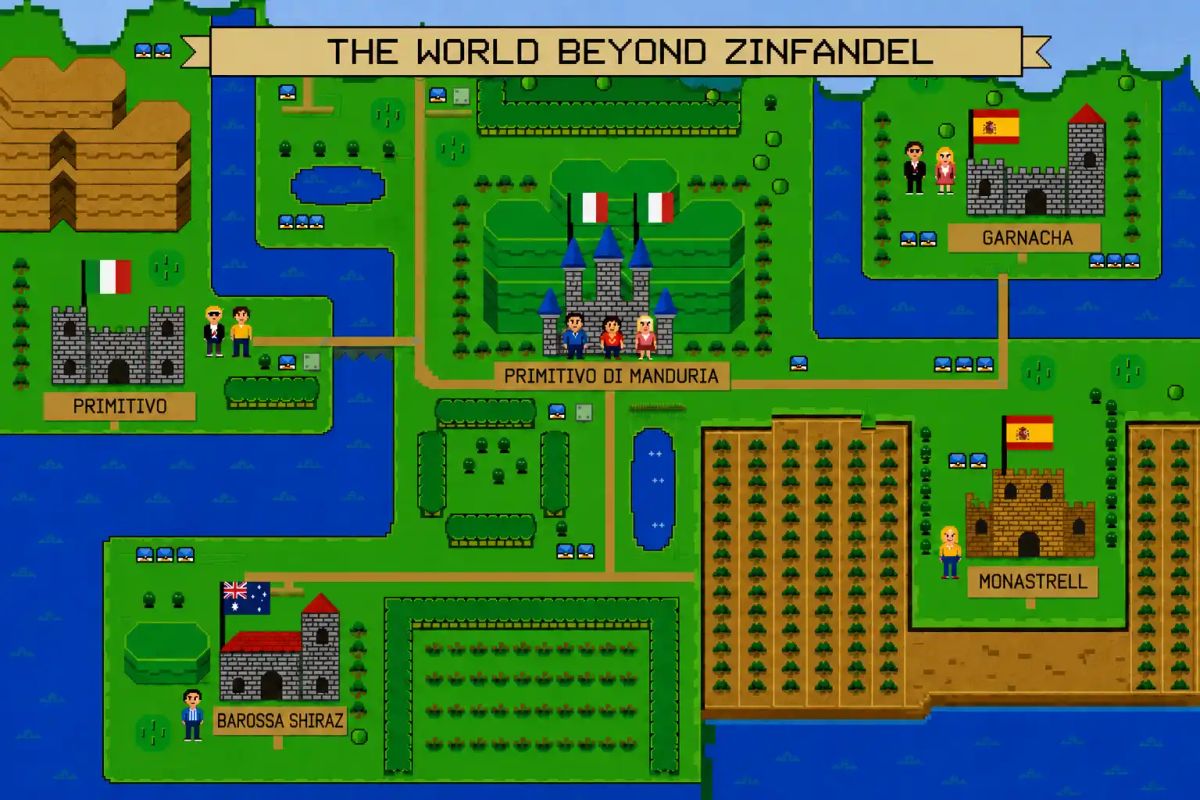
WHAT TO DRINK INSTEAD OF ZINFANDEL
Five wines similar to Zinfandel, and a tasting game to find your favourite.
THE SHORT ANSWER
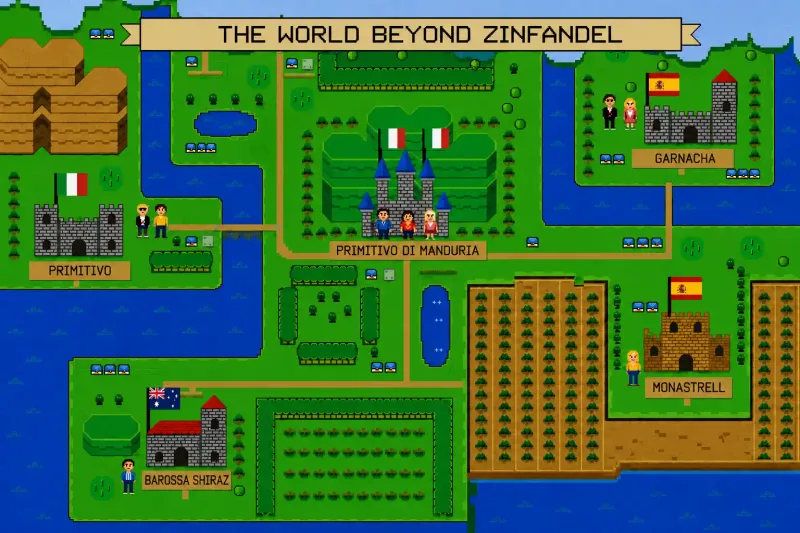
If you like Zinfandel, try these five wines: Primitivo, which is genetically the very same grape grown in southern Italy, Primitivo di Manduria for that grape taken to its richest, ripest extreme, Garnacha for Spain's warm and brambly answer, Monastrell for a darker, denser, more savoury take on sun-baked red, and Barossa Shiraz for the Australian blockbuster that hits the same big, jammy spot.
Five wines to try if you like Zinfandel:
- Primitivo (Puglia, Italy): the same grape, honestly (£9 to £18)
- Primitivo di Manduria (Puglia, Italy): riper, denser, sweeter-edged (£12 to £25)
- Garnacha (Spain): warm, brambly, generous (£8 to £20)
- Monastrell (Jumilla, Spain): dark, dense, savoury (£8 to £18)
- Barossa Shiraz (South Australia): the jammy blockbuster (£15 to £35)
THE MAP
| Primitivo | Primitivo di Manduria | Garnacha | Monastrell | Barossa Shiraz | |
|---|---|---|---|---|---|
| Body | Full | Full | Medium to full | Full | Full |
| Alcohol | High | Very high | High | High | Very high |
| Fruit (jamminess) | High | Very high | High | Medium to high | Very high |
| Closest match to Zinfandel | The same grape | The ripe extreme | The Spanish cousin | The savoury one | The blockbuster |
| Price band | £9 to £18 | £12 to £25 | £8 to £20 | £8 to £18 | £15 to £35 |
| Best occasion | Midweek, pizza | The big roast | Easy weeknight | Stew, grill | The barbecue |
QUICK LEGEND
If you want literally the same grape from a different country: go Primitivo.
If you want Zinfandel's ripeness turned all the way up: go Primitivo di Manduria.
If you want the warm, brambly Spanish version for less money: go Garnacha.
If you want more savour and grip alongside the fruit: go Monastrell.
If you want the full new-world blockbuster experience: go Barossa Shiraz.
WHAT CONNECTS THESE WINES
Zinfandel is California's signature red, and it is built for pleasure rather than restraint.
At its best it gives you a great wave of ripe black and red fruit: blackberry jam, brambly raspberry, black cherry, often with a sweet baking-spice lift and a warming hit of alcohol that can sail past fifteen per cent. There is usually a touch of black pepper and dried herb behind the fruit. It is bold, generous and sunny, the opposite of a tense, mineral, hold-back wine. It is the bottle you open when you want the wine to be the life of the party, not the quiet guest in the corner.
That generosity is the thread through all five alternatives. Every one is a warm-climate red built on ripe fruit, high alcohol and an open, welcoming character. They differ in how much savour, grip and pepper they layer over the fruit, but none of them is asking you to think hard. They are asking you to pour another glass.
A note on sweetness before we start. If your idea of Zinfandel is the pale pink, semi-sweet White Zinfandel, that is a different drink entirely, made from the same grape but in a blush style. This guide is about red Zinfandel, the serious version, and its alternatives are all dry reds.
Serve these slightly cooler than room temperature, around 16 to 18 degrees Celsius, which keeps the alcohol in check and the fruit fresh.
THE FIVE WINES
1. Primitivo, the Same Grape
The first answer to Zinfandel is the genuine surprise: it is the very same grape.
DNA testing settled it years ago. Zinfandel, Italy's Primitivo and Croatia's Tribidrag are one and the same variety, just grown under different names in different places. Primitivo is the southern Italian version, planted across the sun-drenched heel of Italy in Puglia. It gives ripe black cherry, blackberry, fig and a warm, slightly rustic spice, with softer tannins and a friendly, food-ready feel. It is usually cheaper than Californian Zinfandel and, to many palates, just as satisfying. If you want to understand Zinfandel, the most direct route is to taste its Italian twin side by side.
This is the move for the Zinfandel drinker who wants the same pleasure at a kinder price.
What you will recognise: ripe dark fruit, warmth, a generous open character. What changes: a little more rustic and savoury, usually softer and cheaper, with a Mediterranean rather than Californian accent. Look for: Primitivo from Puglia, with Salento on the label for the heartland. Budget: £9 to £18.
2. Primitivo di Manduria, the Ripe Extreme
If standard Primitivo is the twin, Primitivo di Manduria is the twin after a long summer with no shade.
Manduria is a specific zone near the Ionian coast of Puglia, with its own protected denomination, where the grape reaches its ripest, most concentrated form. These wines are dense, dark and powerful, full of blackberry compote, dried fig, chocolate and sweet spice, often with alcohol comfortably above fifteen per cent. There is even a legally sweet version, Primitivo di Manduria Dolce Naturale, for those who want the fruit to tip fully into dessert. For the dry style, this is Zinfandel-style hedonism at its most unapologetic.
This is for the drinker who finds ordinary reds too lean and wants maximum ripeness and depth.
What you will recognise: a great wave of ripe fruit, sweet spice, warming alcohol. What changes: more concentration, more density and a darker, almost liqueur-like depth than basic Primitivo. Look for: Primitivo di Manduria DOC for the dry style, and the Dolce Naturale if you want it sweet. Budget: £12 to £25.
3. Garnacha, the Spanish Cousin
Garnacha is Spain's great warm-climate red, and it scratches the Zinfandel itch from across the Mediterranean.
Known as Grenache in France and widely planted across Spain, Garnacha gives ripe strawberry and raspberry, bramble, a hint of white pepper and sweet dried herb, all wrapped in soft tannin and high alcohol. From old bush vines in regions such as Calatayud, Campo de Borja and Aragón it can be astonishingly good value, delivering generous, sun-baked fruit at supermarket prices. It is a touch redder-fruited and more perfumed than Zinfandel, but the warmth, the ripeness and the easy open character are exactly the same.
This is for the Zinfandel lover who wants the same generosity with a lighter, more lifted feel.
What you will recognise: ripe red and black fruit, warmth, soft and welcoming tannin. What changes: more red-fruited and perfumed, often even better value, with a Spanish rather than Californian sunshine. Look for: old-vine Garnacha from Calatayud, Campo de Borja or the southern Rhône, where it leads the blend. Budget: £8 to £20.
4. Monastrell, the Savoury One
Monastrell is what you reach for when you love Zinfandel's power but want more grip and savour underneath the fruit.
Spain's dark horse, grown in the baking south-east around Jumilla, Yecla and Alicante, Monastrell is the same grape the French call Mourvèdre. It gives blackberry, black plum and dried fig, but layers them over earth, leather, dried herb and a firmer, more savoury tannin than anything else on this list. The sun gives it ripeness and high alcohol; the grape gives it structure. The result is a big red that still has a serious, food-demanding backbone, especially with grilled meat and rich stews.
This is for the drinker who wants the ripeness of Zinfandel but misses a bit of savoury grip and structure.
What you will recognise: dark ripe fruit, warmth, real density. What changes: more savoury, earthy and grippy, with firmer tannin and a meatier character. Look for: Monastrell from Jumilla and Yecla, both reliably excellent value. Budget: £8 to £18.
5. Barossa Shiraz, the Blockbuster
If you want to push Zinfandel's generosity to its absolute maximum, go to the Barossa.
In this hot South Australian valley, Shiraz reaches a scale few wines anywhere can match: dense blackberry and black plum, chocolate, sweet vanilla from oak, a lick of liquorice and a warming, opulent finish. These are unashamed blockbusters, big and rich and built to impress, exactly the mood Zinfandel drinkers chase. There is grilled-meat savour underneath, but the headline is pure, ripe, full-throttle fruit. Of everything here, it most directly delivers the wow factor of a top Californian Zinfandel.
This is for the drinker who wants the boldest, richest glass on the table.
What you will recognise: a huge wave of ripe dark fruit, sweet spice, warming power. What changes: even more density and oak-driven richness, with the unmistakable plush style of warm-climate Australian Shiraz. Look for: Barossa Valley Shiraz, with McLaren Vale as a close cousin. Budget: £15 to £35.
A NOTE ON ZINFANDEL VERSUS PRIMITIVO
It is worth saying this plainly, because it surprises almost everyone: Zinfandel and Primitivo are the same grape.
For years they were thought to be separate varieties. Then DNA profiling traced both back to an old Croatian grape called Tribidrag, also recorded as Crljenak Kaštelanski. Primitivo travelled to Italy, Zinfandel travelled to California, and each became the local star under its own name. So a Puglian Primitivo and a Californian Zinfandel are, biologically, identical twins raised in different homes.
That does not make them taste the same. Climate, soil and winemaking all leave their mark. Californian Zinfandel tends to be a little more polished and oak-influenced, sometimes with brighter brambly fruit. Italian Primitivo tends to be more rustic, savoury and friendly, and usually cheaper. Tasting the two together is one of the most enjoyable lessons in wine, a clear demonstration that where a grape grows matters as much as which grape it is.
THE TASTING GAME
What You Need
Five bottles, one of each wine above. Four to five red wine glasses per person. A pen and the rating table below. Bold, savoury food on the table: barbecue, burgers, grilled sausages, anything that can stand up to big fruit and high alcohol. One person who only ever buys Californian Zinfandel and is sure nothing else compares.
Optional but recommended: add a true Californian Zinfandel as the reference point everything else is measured against.
The Rating Table
| Characteristic | What you are looking for |
|---|---|
| Ripeness of fruit | How jammy and sweet the fruit smells and tastes |
| Body and weight | How big and full the wine feels in the mouth |
| Warmth (alcohol) | The warming sensation on the finish |
| Savoury grip | Pepper, earth, herb and tannin behind the fruit |
| Drinkability | How easily you want a second glass |
Ourglass Benchmarks
| Characteristic | Zinfandel | Primitivo | Manduria | Garnacha | Monastrell | Barossa Shiraz |
|---|---|---|---|---|---|---|
| Ripeness of fruit | 5 | 4 | 5 | 4 | 4 | 5 |
| Body and weight | 5 | 4 | 5 | 4 | 5 | 5 |
| Warmth (alcohol) | 5 | 4 | 5 | 4 | 4 | 5 |
| Savoury grip | 3 | 3 | 3 | 3 | 5 | 3 |
| Drinkability | 4 | 5 | 3 | 5 | 4 | 4 |
The decisive row is savoury grip. Ripe fruit and warmth are the easy part, shared by every wine here. The real question is how much savour, pepper and tannin you want sitting underneath that fruit. If the answer is plenty, Monastrell is your wine. If the answer is none, you want pure brambly hedonism, and Garnacha or Barossa Shiraz will make you happiest.
If you would rather have wines chosen for the way they actually behave at the table than the way they read on a shelf, that is what Ourglass is for. Start here.
WHAT YOUR SCORES REVEAL ABOUT YOUR PALATE
Loved the same-grape pleasure of Primitivo? You are a Zinfandel purist who values honesty and value. Next: more Puglian Primitivo, and a Zinfandel-versus-Primitivo tasting.
Wanted the ripeness pushed to the limit? Primitivo di Manduria is your wine. Next: Manduria Dolce Naturale, and other high-alcohol southern Italian reds.
Drawn to the perfumed warmth of Garnacha? You like red fruit and lift. Next: old-vine Spanish Garnacha and southern Rhône blends.
Preferred the savoury grip of Monastrell? You want structure with your sunshine. Next: Jumilla Monastrell, Bandol, and our guide to what to drink instead of Shiraz or Syrah.
Fell for the Barossa blockbuster? You chase scale and richness. Next: McLaren Vale Shiraz, and the bigger reds in what to drink instead of Malbec.
Want something with more grip and less fruit entirely? Cross to the high-tannin end of the red world with what to drink instead of Nebbiolo.
YOUR SHOPPING LIST
| Primitivo | Primitivo di Manduria | Garnacha | Monastrell | Barossa Shiraz | |
|---|---|---|---|---|---|
| Region | Puglia, Italy | Puglia, Italy | Spain or southern Rhône | Jumilla, Spain | South Australia |
| Budget | £9 to £18 | £12 to £25 | £8 to £20 | £8 to £18 | £15 to £35 |
| Start with | Salento Primitivo | Primitivo di Manduria DOC | Old-vine Calatayud Garnacha | Jumilla Monastrell | Barossa Valley Shiraz |
Primitivo, Garnacha and Barossa Shiraz are easy to find in any UK supermarket. Monastrell from Jumilla is widely stocked and one of the best-value reds on the shelf. Primitivo di Manduria sits a tier up, usually with the better Italian sections or an independent merchant.
GO DEEPER
What to drink instead of Shiraz or Syrah. The closest sibling conversation in the red world.
What to drink instead of Malbec. Another bold, fruit-forward crowd-pleaser.
What to drink instead of Nebbiolo. The opposite pole of red wine, all grip and structure.
A guide to the wine regions of the USA. Where Zinfandel found its home in California.
The complete guide to Australian wine regions. The Barossa and beyond.
If you like that wine, try this. The full map of alternatives.
FREQUENTLY ASKED QUESTIONS
What does Zinfandel taste like?
Ripe and jammy: blackberry, bramble, black cherry and raspberry, with sweet baking spice, a hint of black pepper and a warming hit of alcohol that often passes fifteen per cent. Red Zinfandel is bold, generous and sunny, built for pleasure rather than restraint.
Is Zinfandel the same as Primitivo?
Yes. DNA testing confirmed that Zinfandel, Italy's Primitivo and Croatia's Tribidrag are the same grape, grown under different names. Californian Zinfandel tends to be more polished, Italian Primitivo more rustic and usually cheaper, but biologically they are identical.
If I like Zinfandel, what else will I like?
Primitivo for the same grape, Primitivo di Manduria for its ripest extreme, Garnacha for a warm perfumed Spanish cousin, Monastrell for more savoury grip, and Barossa Shiraz for the full new-world blockbuster.
What is the difference between red Zinfandel and White Zinfandel?
Red Zinfandel is a serious dry red wine. White Zinfandel is a pale, semi-sweet blush wine made from the same grape in a completely different style. This guide is about red Zinfandel and dry red alternatives.
Is Garnacha a good alternative to Zinfandel?
Yes, especially if you want the same warmth and ripe fruit for less money. Garnacha is a touch more red-fruited and perfumed, with soft tannin and high alcohol. Old-vine examples from Calatayud and Campo de Borja are excellent value.
What food pairs with Zinfandel and its alternatives?
Bold, savoury, slightly smoky food: barbecue, burgers, grilled sausages, pulled pork, and rich tomato-based dishes. The ripe fruit and high alcohol suit char, fat and spice, which is why these wines are barbecue favourites.
Which is the most powerful wine on this list?
Primitivo di Manduria and Barossa Shiraz are the heavyweights, both dense and high in alcohol. Monastrell is nearly as big but more savoury. Standard Primitivo and Garnacha are the most approachable and easiest to drink.
Which Zinfandel alternative should a beginner try first?
Primitivo from Puglia. It is widely available, inexpensive and friendly, and tasting it reveals that it is the same grape as Zinfandel. Garnacha is an equally easy and rewarding second step.