
Amelia Singer is a wine broadcaster, educator, and founder of Amelia's Wine. A Trinity College Dublin graduate with a WSET Wine Diploma, she has spent fifteen years working across wineries, retailers, importers, and startups on three continents before becoming a presenter on The Wine Show (broadcast internationally), former wine correspondent on Jamie Oliver's Drinks Tube, and wine writer for Waitrose Food Magazine. Winner of the 2019 IWSC/WSET Future 50 Award for innovative drinks industry talent and Ourglass Wine Advisor, she writes and presents on wine culture for the Ourglass Taste Decoded series and Film Tasting video programme.
Before the television cameras, before the podcast, before the magazine column, Amelia Singer hosted a wine-centric supper club in London. A long table. Wine. Food. People who had not been told what they were supposed to think about either.
No tasting notes. No scores. No vocabulary test at the door. The supper club operated on a single assumption: that wine, placed alongside food in a room where nobody needed to perform expertise, would earn its own attention. The discovery, repeated across dozens of evenings, was that most people have opinions about wine but have never been in a room where those opinions were treated as legitimate.
The wine industry's default mode is gatekeeping. Sometimes a sommelier who assumes the customer does not know what they want. Sometimes a label in a language the buyer does not speak. Sometimes a twenty-page wine list that rewards prior knowledge and punishes curiosity. Singer's entire career has been built on a counter-claim: the opinion is already there. The palate is already developing. What most people lack is not ability but permission.
'I only mention wines I like. I want to sleep at night.'
Amelia Singer explains why the gatekeeping infrastructure of wine culture excludes the people most ready to enjoy it, and why choosing wine with intent matters more than knowing wine with expertise.
THREE CONTINENTS BEFORE THE CAMERA
Singer studied at Trinity College, Dublin. She completed the WSET Wine Diploma, the Level 4 qualification that sits below the Master of Wine and above the vast majority of wine professionals. Not a certificate of enthusiasm. A technical credential requiring demonstrated knowledge of viticulture, vinification, and global wine regions, assessed through blind tasting and written examination.
But the credential is not where the authority comes from. Before any camera appearance, Singer worked in wineries across Europe, the United States, and South America. Retailers selling wine for Tuesday dinner. Importers navigating the gap between what a producer makes and what a market wants. Fine wine merchants. Startups reimagining how wine is discovered.
She has stood at every point in the chain between vine and glass. When she recommends a wine, the recommendation carries supply-chain literacy, not just flavour preference. She knows the difference between a wine priced at twelve pounds because that is what it is worth and a wine priced at twelve pounds because the margin would not survive at ten.
When she recommends a wine, the recommendation carries supply-chain literacy, not just flavour preference.
The supper club was the first public expression of what this experience produced: wine knowledge, to be useful, must be communicated without the structures that make most people feel excluded.
WINE ON TELEVISION WITHOUT THE PERFORMANCE
The Wine Show, broadcast internationally across three series, works because it refuses to treat wine as a subject requiring explanation. The format embeds wine in stories about travel, food, and curiosity. Presenters Matthew Goode and Matthew Rhys are actors, not sommeliers. Singer brings expertise without making expertise the point.
Jamie Oliver's Drinks Tube, before the channel wound down, operated the same principle at YouTube scale. Singer, as Oliver's 'Wine Woman,' communicated wine to millions who had come for food content. No vocabulary test. No assumption the viewer needed a taxonomy before enjoying a glass. Here is something interesting. Taste it with me. Notice what happens.
Waitrose Food Magazine gave her a column aimed at readers who buy wine alongside groceries. The California Wine Institute appointed her UK Ambassador. In 2018, she was shortlisted for the IWSC Wine Communicator of the Year. In 2019, she won the IWSC/WSET Future 50 Award, a joint recognition by the International Wine and Spirit Competition and the Wine and Spirit Education Trust of innovative talent across the global drinks industry.
The thread across all these platforms is not reach. It is the refusal to separate wine from the life it belongs in. Singer's method is to meet wine where it already is rather than ask people to meet wine where the industry has placed it.
THE CORNFLAKES PRINCIPLE
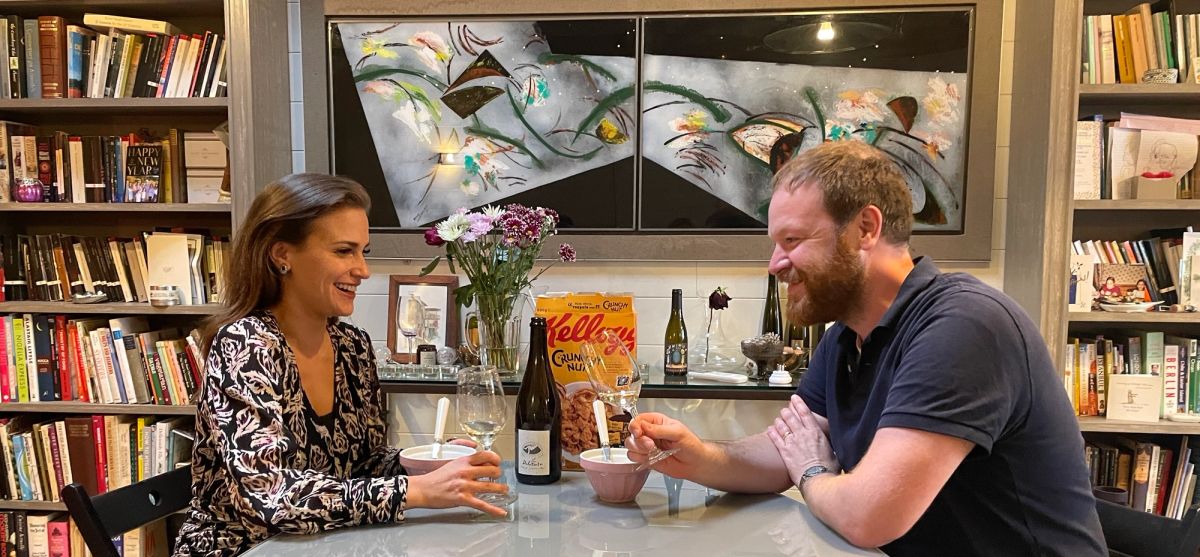
In the Ourglass Film Tasting series, Singer pairs wine with Crunchy Nut Cornflakes. Champagne alongside a bowl of cereal. The kind of combination a conventional wine educator would not attempt.
'Yes, we're going there,' she says.
The pairing works. Sugar, salt, and crunch interact with acidity and fruit in ways that are genuinely engaging. Professor Charles Spence's research at Oxford has demonstrated the neuroscience: the brain constructs flavour from all available sensory inputs, and unexpected combinations generate more neural activity than predictable ones.
But the purpose is not to prove that cereal and wine are a great combination. It is to establish a principle: there is no inappropriate context for paying attention to what you are drinking. If Crunchy Nut Cornflakes and Champagne count, then Tuesday dinner counts. A takeaway counts. A film on the sofa counts.
If Crunchy Nut Cornflakes and Champagne count, then Tuesday dinner counts. A takeaway counts. A film on the sofa counts.
The Film Tasting series (seven parts, the most extensive contributor content on the Ourglass site) applies this across Loire Valley whites, old vine Chenin Blanc from South Africa, grower Champagnes paired with whatever Singer and Benedict Johnson happen to be eating. The format is deliberately informal. The wines are interesting not because they are expensive but because they reward the kind of attention Singer's whole career has been designed to make possible.
'What stood out with Ourglass was how you link wine to music, art, the zeitgeist. I thought, these are the kind of people I'd actually want to drink with.'
That last sentence is the democratisation thesis in practice. The criterion is human, not professional.
CHOOSING WITH INTENT
The Cornflakes principle says context does not matter. But attention does. And if attention is the thing that makes wine worth drinking, the question becomes: how do people learn to pay it?
In the Ourglass piece on the premiumisation paradox, Singer observes that people now 'choose wine with intent, not just grab whatever is nearest.' Choosing with intent is her alternative to choosing with expertise.
The wine industry's traditional answer to 'how do I choose wine?' is 'learn more.' Learn the regions, the grapes, the vintage charts. For most people, this is a barrier dressed as a solution. Choosing with intent requires something different: paying attention to what you are drinking and noticing what you like, without needing to name it. Asking 'do I want something light or something rich tonight?' rather than 'should I drink Burgundy or Barolo?'
The generational data supports this shift. Younger drinkers enter through discovery rather than inheritance. Sixty-seven per cent of Gen Z drinkers consciously limit their consumption. They are not drinking less because they are uninterested. They are choosing with intent: fewer glasses, more attention per glass.
Singer's podcast, Ameliarate Through Wine (launched Autumn 2023), is built around this. Each episode pairs wine with a guest from outside the wine industry: a filmmaker, a musician, a writer. The wine is the medium. The conversation is the point. The context is what makes it taste.
THE ADVISOR WHO DRINKS WHAT SHE RECOMMENDS
Singer's Ourglass role is Wine Advisor. Not ambassador. Not spokesperson. She works alongside the brand, selecting wines that meet her own standards.
'There are so many wine clubs out there. But I only mention wines I like.'
The people Singer advises are at the beginning of their wine journeys. The supper club guests who showed up without tasting notes. The Drinks Tube viewers who came for Jamie Oliver and stayed for the wine. The Film Tasting audience who thought: maybe I am allowed to have opinions about this.
Singer's presence in the Taste Decoded series, alongside Rory Sutherland on the psychology of value, Charles Spence on the neuroscience of perception, and Tim Hayward on the craft of paying attention, provides the most practically accessible entry point. Sutherland explains why wine pricing works the way it does. Spence explains why context changes what you taste. Hayward explains why argument matters more than vocabulary. Singer explains why none of that matters if you are not willing to pick up the glass, try something, and trust what you find. Her role is activation: translating the science, economics, and craft into the act of opening a bottle and paying attention.
The supper club no longer exists. The format has evolved into television, a podcast, a seven-part film series, and a wine advisory role that connects fifteen years of supply-chain education to the question of what to put in your glass this month.
But the principle from that first evening in London has not changed. Put wine where people already are. Remove the performance. Trust that attention follows.
Crunchy Nut Cornflakes and Champagne. It works because she tried it. Because the question was not 'is this appropriate?' but 'is this interesting?' Because the only credential required was curiosity, and the only test was whether it made her want to try something else.
That is what taste confidence looks like when it stops performing and starts paying attention. Not knowing what to drink. Noticing what you are drinking. And trusting, finally, that your own attention is enough.
MORE FROM TASTE DECODED
- Film Tasting: Wine and Food with Amelia Singer, Part 1
- Film Tasting: Wine and Food with Amelia Singer, Part 2
- The Premiumisation Paradox: Why Drinking Less Wine Means Drinking Better
- How Taste Works: The Science of Wine Flavour and Memory
- The Context Effect: How Setting, Company, and Mood Change Wine Taste
- Watch the Taste Decoded series
ABOUT THE AUTHOR
Benedict Johnson is the founder of Ourglass, a London-based taste platform dedicated to helping people become confident wine lovers. He writes on the psychology of taste, the economics of wine, and the culture of drinking, and curates the Taste Decoded series, which brings together sommeliers, communicators, academics, and creatives to decode what great actually tastes like.