
A MATTER OF TASTE
Reviewed by Jancis Robinson MW and Dr William Kelley.
THE SHORT VERSION
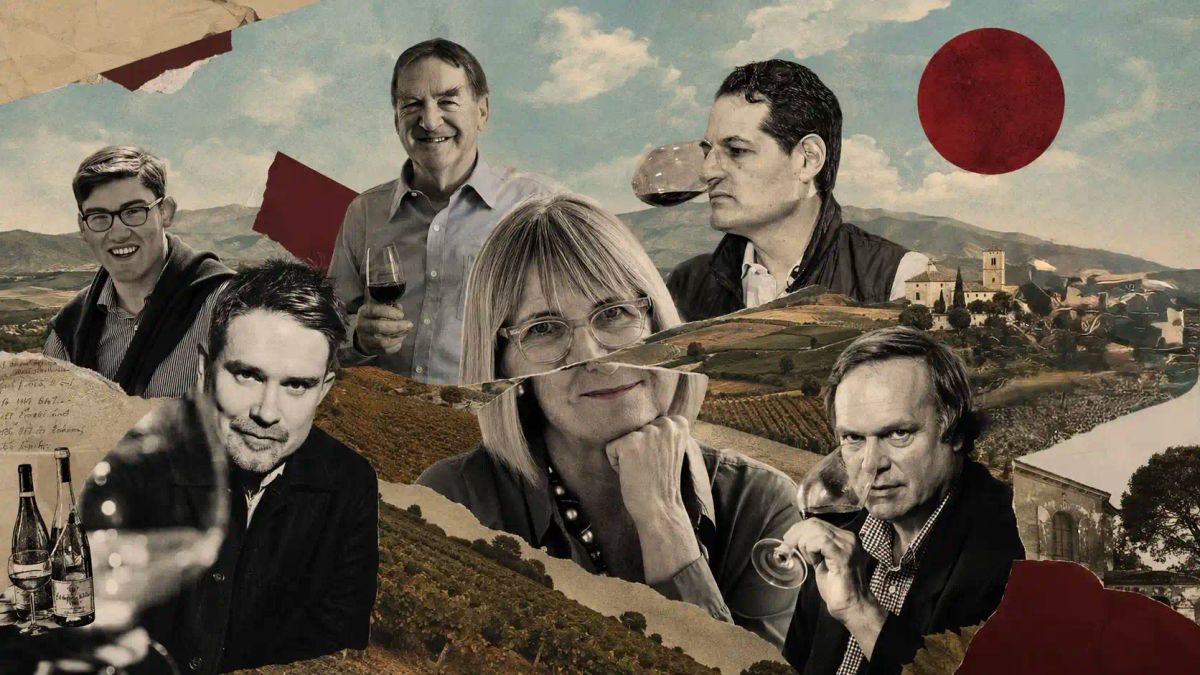
Eight critics. Eight answers to the same question: what is wine for? For Robert Parker, it is pleasure. For Jancis Robinson, balance, purity and precision. Hugh Johnson, story. Michael Broadbent, evidence.. Steven Spurrier, context. Antonio Galloni, time. William Kelley, truth. And for Dan Keeling, experience. The divergence is not an error in wine criticism. It's the whole point. Understanding where they diverge is how you begin to understand what works best for you.
FOREWORD: AMELIA SINGER
Why follow a wine critic rather than rely on a crowdsourced platform like Vivino? I think of it as the difference between Rotten Tomatoes and following a single critical voice: Roger Ebert or Peter Bradshaw rather than IMDb.
They both have their uses, and their biases. A crowd-sourced opinion like Vivino offers a large, mixed group of viewers in the format of short reviews, aimed at enjoyment and value, focused on how one would enjoy the wine. A single critic offers a defined point of view. That perspective may be shaped by craft, technical precision, context or broader thematic value. It will be a full review with argument and evidence.
Both have limits. A crowd-sourced audience view can be skewed by film campaigns and demographic biases, whilst a single critic's taste is inextricable from their own personal tastes or niche interests.
Ben's article fully explores the intricacies of wine critic reviews, highlighting single critics' differences of approach whilst also revealing what one can learn from each. One critic won't appeal to all and that is the point. The key is to find who you can most relate to, as this then allows you to engage with your subject of interest in greater depth and with greater confidence.
There is a time and place for both review models. If I am out and about and don't have the time to access or read a full article by Jancis Robinson or Dan Keeling, Vivino can be a super helpful tool for a general overview. If I am spending more than I usually would on a bottle of wine, or I love a certain producer or region, then I relish learning the in depth information and gaining assurance when it comes to making that purchase or savouring that glass.
I am curious to see which wine critic most resonates with your perspective around the wine in your glass.
Amelia Singer is a broadcaster, wine educator, and one of the inaugural IWSC and WSET Future 50 Awards 2019
WHAT IS WINE FOR?
It is, in every sense, a matter of taste.
Not in a casual sense, where everyone has their own preference and all preferences are taken as valid. In a specific, technical sense: the question of what makes a wine good is inseparable from the question of what you believe wine is there for. And the people who have thought hardest about it for a living arrive from genuinely incompatible takes.
Robert Parker believed wine is for pleasure, immediate and unapologetic. Jancis Robinson, it seems to me, favours purity, precision and balance; the discipline of noticing what is actually there. Hugh Johnson believes it is for meaning, for the accumulated weight of place and history. Dan Keeling believes it is for experience, for the moment created, there and then. These are not just different preferences. They are different philosophies, and those philosophies inform every aspect of how each critic prepares, tastes, scores and writes.
Learn to read a critic's method and you learn what they believe. Understand what they believe and it holds up a mirror to your own.
That's the aim here. Not that any critic is right, but that each one has a means of paying attention that is available to you to try on for size. Knowing the questions they ask is the first step to knowing which questions you will ask.
Wine criticism makes this legible because wine is uniquely resistant to objective measurement. You can quantify alcohol, acidity, phenolic content. You cannot quantify whether a wine moves you, whether it tastes like where it came from, whether it will be better in ten years than it is today. The critics who have spent careers translating those qualities into scores and sentences first had to decide what matters. Those choices reveal more about taste than any score.
THE CRITICS' COMPASS
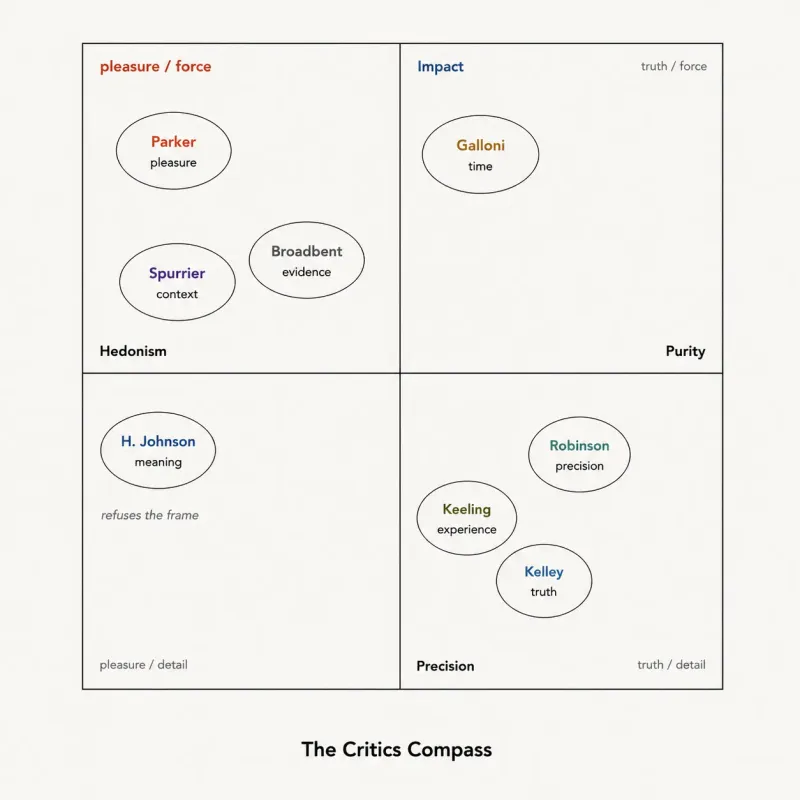
Wine critics disagree because they are answering different questions. Those questions tend to cluster around two axes. Place them together and you get a working map of modern wine criticism.
It is not a scientific taxonomy. It shows the questions critics pour into the glass.
AXIS ONE: HEDONISM VS PURITY
At the hedonist end: the wine exists to give pleasure. Quality is what makes you want another glass, immediately and by instinct. At the purity end: the wine exists to express something true, a place, a grape, the particular conditions of a specific year. Quality is precision of expression. Pleasure matters, but it is not the point.
Parker gravitates toward hedonism. Robinson towards balance, purity and precision. Most serious critics occupy positions between the two, shifting depending on region, vintage and whatever is in front of them.
AXIS TWO: IMPACT VS PRECISION
At the impact end: quality announces itself, like a town crier on market day. A great wine has impact, presence, even force. At the precision end: quality reveals itself over time, in detail that emerges with sustained attention rather than force.
These are gravitational pulls, not fixed positions. They shape every assessment a critic makes, acknowledged or not.
What follows are eight different ways of viewing the same glass.
THE OLD GUARD: STORY, EVIDENCE AND CONTEXT
HUGH JOHNSON: THE STORYTELLER
Hugh Johnson does not taste wine so much as read it. For Johnson, a wine is not primarily a sensory object. It is an artefact of culture, one that encodes the history of a place, the decisions of a family, the weather of a year, and the slow accumulation of meaning that turns a vineyard into a proper noun. His writing, across more than sixty years, has always been less about describing flavour than about locating a wine in a web of significance.
Johnson's most influential work, The World Atlas of Wine, co-authored with Jancis Robinson from the fifth edition onward, is structured not around tasting notes but around geography, history, and the idea that understanding where a wine comes from is inseparable from understanding what it is. His Pocket Wine Book, updated annually since 1977, offers compressed judgements, but the compression assumes a reader who already cares about provenance.
For Johnson, the best wines are the ones that carry the most meaning. A great Burgundy is not great because of its balance or concentration. It is great because it tastes like a specific hillside in a specific year, and because that hillside has been making wines worth remembering for centuries. This is a deeply European sensibility, and it shapes everything Johnson values.
Johnson's Method
Johnson does not follow a formal tasting protocol. He has never used a scoring system. His method is contextual: he drinks wine as part of life, with food, with conversation, with attention to what the wine represents as much as what it tastes like. His notes, recorded in a cellar diary he has maintained for decades, are as likely to record who was at the table as what was in the glass. He tastes with the bottle visible, because for Johnson the label is not a bias to be eliminated but information to be integrated.
What Johnson Teaches Your Palate
Johnson develops contextual awareness. If you follow his approach, you learn to ask: where does this come from? What is it trying to be? What tradition does it belong to, and how does it track within that tradition? This is the opposite of blind tasting. It is tasting with all information, and using that information to deepen your experience rather than to confirm a score.
MICHAEL BROADBENT: THE SURVEYOR
Michael Broadbent may have tasted more old wine than any single person in history (François Audouze might have somethjing to say about that). As head of Christie's wine department from 1966 until his retirement in 1992, and senior consultant thereafter until 2009, he assessed, catalogued and auctioned wines dating back to the eighteenth century. His tasting notes, collected across seven decades in a series of handwritten notebooks, form the most comprehensive record of how fine wine ages that exists anywhere.
Broadbent's approach was architectural. He treated a wine the way a surveyor views a building: systematically, from the outside in. Colour first, then nose, then palate, then finish, each stage recorded in precise, functional language. His vocabulary was deliberately restrained. Where other critics reached for metaphor, Broadbent was measured. A wine had weight, structure, length, depth. It was or was not sound. It was or was not drinking well.
How Broadbent Tastes
Broadbent tended to taste in the morning, when the palate is sharpest, and followed a typical two-stage sequence: nose first, at length, often returning to the glass several times before tasting. His notes were always written during the tasting, and not reconstructed afterwards. He used a five-star system rather than points, arguing that numerical precision implied a false accuracy. His stars indicated broad quality bands, not fine distinctions.
What Broadbent Develops in Your Palate
Broadbent wields analytical rigour. If you follow his method, you learn to separate a wine into its components and assess each one before forming an overall judgement. You learn to record what you find, not what you feel. You learn that provenance and storage matter alongside winemaking. Above all, you learn that a wine's current state is a point on a trajectory, and that judging it without considering where it has been and where it is going is incomplete.
STEVEN SPURRIER: THE COMPARATIST
Steven Spurrier is best known for organising the 1976 Judgement of Paris, the blind tasting in which Californian wines beat their French counterparts and reorganised the world's assumptions about where great wine could come from. But that event, dramatic as it was, was simply the most visible expression of Spurrier's lifelong method: put wines side by side, remove the labels, and enjoy what happens.
Spurrier believed that wine quality is most visible in comparison. A wine tasted alone is an impression. The same wine tasted alongside its peers becomes an argument. His entire approach, from the Académie du Vin he established in Paris in 1973 to his later work at Decanter, was built around the idea that blind comparative tasting is the closest thing wine has to an objective method.
Spurrier's Approach
Spurrier organised tastings in flights of comparable wines: same region, same vintage, same price bracket. The comparison was the method. He used classical European benchmarks as the measuring stick, but he was willing to be surprised by what the comparison revealed. The Judgement of Paris wasn't designed to show up France. It was designed to weigh an assumption, and the assumption lost.
What It Trains You to Notice
Spurrier develops the habit of comparison. If you follow his method, you learn to ask: compared to what? You stop evaluating wines in isolation and start placing them in context. You learn that expectations shape perception, and that removing expectations, through blind tasting, reveals things that labels and reputations obscure. This is perhaps the single most useful habit any wine drinker can develop.
THE SCHISM: PLEASURE VS PRECISION
ROBERT PARKER JR: THE HEDONIST
Robert Parker changed wine more than any critic before or since. From the founding of The Wine Advocate in 1978 until his retirement in 2019, his 100-point scale and his unshakeable confidence in his own palate reshaped how wine was made, marketed, and priced across the world. Parker's fundamental belief was simple: wine is for drinking, and the best wines are the ones that give the most pleasure.
That belief had consequences. Parker's palate favoured concentration, extraction, ripeness, and length. He was drawn to wines that announced themselves, that filled the mouth, that delivered an immediate, almost physical impact. His highest scores went to wines that combined power with complexity, with power always to the fore. A wine that was elegant but restrained would score. A wine that was powerful and complex would score higher.
This preference, expressed through scores that moved markets, incentivised a generation of winemakers to make wines Parker would love. The result was what critics called the "Parkerisation" of wine: riper, darker, more extracted wines across every major region. Whether this was a good or bad thing depends entirely on what you think wine is for.
How Parker Tastes
Parker tasted in a room, alone, with the wines at cellar temperature. He swirled a fair bit, aerating the wine to release its aroma. He tasted in flights but not blind, arguing that knowing the producer and vintage was necessary context. His notes focused on sensory impact: the depth of colour, the intensity of aroma, the weight and length of the palate. He measured finish in seconds.
I really think probably the only difference between a 96-, 97-, 98-, 99-, and 100-point wine is really the emotion of the moment.
That admission, from a man whose single-point distinctions moved millions of dollars in wine prices, reveals the tension at the heart of hedonistic criticism: the system demands precision, but the experience measured resists it.
What Parker Develops in Your Palate
Parker develops hedonic attention. If you follow his approach, you learn to ask: does this give me pleasure? Not does it represent its region, not is it technically flawless, but does it make me want more? That question, stripped of all artifice, is the foundation of every honest wine experience. Parker's contribution was to insist that it was also the foundation of quality.
JANCIS ROBINSON MW: THE ANALYST
Jancis Robinson is one of the most methodical wine critics in print today. A Master of Wine since 1984, the first person outside the wine trade to hold the qualification, she has built a body of work that treats wine as a subject requiring the same rigour as any other field of serious enquiry. The Oxford Companion to Wine, which she edits with Julia Harding MW, is the definitive reference. Her website, JancisRobinson.com, is one of the most comprehensive independent tasting databases in the world.
Robinson's approach is defined by balance. Not just in the wines she values, where balance is the governing virtue, but in her method: she seeks to minimise bias, maximise consistency, and produce assessments that are useful precisely because they are disciplined. She tastes with a single glass type. She records every tasting note. She publishes her methods.
I know so well how subjective the whole business of wine appreciation is and, perhaps more importantly, how much the same wine can change from bottle to bottle and week to week, if not day to day.
How Robinson Tastes
Robinson uses a 20-point scale, which she has defended consistently against the 100-point system on the grounds that it is more honest about the limits of human discrimination. Her published quality bands run from 12 ("Faulty or unbalanced") through to 20 ("Truly exceptional"), with length, how long the flavour persists after swallowing, treated as one of the most reliable indicators of quality.
She tastes nose-first, spending significant time on aroma before the wine touches her palate. She evaluates holistically: a wine must work as a whole, not just in its parts. She is wary of wines that impress on first taste but fatigue on the second glass, and she is openly sceptical of wines engineered for impact at the expense of drinkability.
Like many Brits, I find this system difficult to cope with, having no cultural reference for it. So I limp along with points and half-points out of 20.
That humility is characteristic. Robinson's authority comes not from certainty but from transparency: she shows her working, acknowledges her limitations, and lets the consistency of her method speak for itself.
What Robinson Develops in Your Palate
Robinson develops structural awareness. If you follow her approach, you learn to assess a wine's architecture: is the acidity in the right place? Do the tannins support or overwhelm the fruit? Does the finish persist? These are not abstract questions. They are the difference between a wine that is pleasant to drink and a wine that is genuinely good. Robinson's framework gives you the vocabulary to explain the difference.
THE 2003 PAVIE DIVIDE
The 2003 Château Pavie is a flashpoint in modern criticism. Not because of what is in the bottle, but because of a clash of philosophies.
Robert Parker gave the 2003 Pavie 100 points, calling it one of the greatest wines he had ever tasted: monumental, concentrated, a wine of extraordinary richness and power. Jancis Robinson gave it 12 out of 20, calling it ridiculous, more reminiscent of a late-harvest Zinfandel than a red Bordeaux, a wine that had abandoned any pretence of balance in pursuit of impact.
They were both right, in their ways. Parker was evaluating the wine against his criteria: intensity, concentration, hedonic impact. By those measures, the 2003 Pavie is exceptional. Robinson was evaluating the wine against hers: typicity, balance, classical proportion. By those measures, the 2003 Pavie is a failure. The wine did not change between their glasses but the question changed.
Years later, Parker and Robinson met by chance in a Bordeaux hotel breakfast room. Parker said simply: "That Pavie thing. I overreacted." The Pavie episode is not a scandal. It is a case study in the limits of any single framework for evaluating something as complex as wine.
THE MODERNISTS: TIME, SCIENCE AND EXPERIENCE
ANTONIO GALLONI: THE PATIENT ONE
Antonio Galloni founded Vinous in 2013 after leaving Robert Parker's Wine Advocate, and his departure marked a philosophical shift as much as a professional one. Where Parker valued immediate impact, Galloni values trajectory. His highest praise goes not to wines that overwhelm on first taste but to wines that reveal themselves with time, wines with tension, energy, and the kind of internal complexity that rewards patience.
Galloni's Process
Galloni tastes at the wineries, non-blind, often over multiple visits. For key wines, he returns to the same bottle across several hours, tracking how the wine evolves. He is interested in what the wine will become as much as what it is, and his notes frequently project forward: this will need five years, this has twenty years ahead of it. His 100-point scale weighs both current quality and future trajectory.
The Habit Galloni Builds
Galloni develops patience. If you follow his approach, you learn to resist the first impression. You learn to wait, to return to the glass, to ask whether the wine is showing you everything or holding something back. This is the hardest habit to develop because it requires you to distrust your own initial reaction, to develop your critical faculties, but it is also the habit that most reliably separates casual drinking from serious tasting.
WILLIAM KELLEY: THE SCIENTIST
William Kelley joined Robert Parker's Wine Advocate in 2017 and now serves as Editor in Chief, covering Burgundy, Bordeaux and Champagne. He immediately distinguished himself with a level of technical depth unusual even by the standards of professional criticism. Kelley's background in history, with an Oxford doctorate, and his obsessive interest in geology, viticulture and winemaking science give his reviews a distinctive character: they are as interested in why a wine tastes the way it does as in how it tastes. Crucially, this is not theoretical curiosity. Now in his tenth vintage making wine across California and Burgundy, Kelley brings a practitioner's eye to his analytical lens, informed by the actual decisions of fermentation and the actual feel of vineyard soil under his boots.
For Kelley, the truth of a wine is in its origins. His reviews frequently reference soil types, elevation, vine age, pruning methods and fermentation choices, not as decoration but as explanation. When Kelley praises a wine for its "mineral tension" or "chalky precision," he is not using metaphor. He is expounding on the relationship between what is in the glass and what is in the ground.
How Kelley Tastes
Kelley tastes at the wineries, often over extended visits that include walking the vineyards. He takes handwritten notes and evaluates structure first, fruit second. His reviews are unusually long and detailed, frequently running to several paragraphs for a single wine. He limits himself to a maximum of fifty wines a day, fewer than most professional critics, arguing that attention degrades with volume.
His 100-point scores are tightly clustered, with most wines falling in the upper 80s and lower 90s. The narrow range reflects his conviction that fine distinctions within a quality band matter more than the distance between good and great.
What Kelley Develops in Your Palate
Kelley develops curiosity about origins. If you follow his approach, you learn to ask: why does this taste the way it does? You learn to connect flavour to place, technique to texture, vintage to character. This is an intellectually demanding form of tasting, and it is also the most rewarding for anyone who wants to understand wine rather than simply consume it.
DAN KEELING: THE COUNTER-CULTURALIST
Dan Keeling co-founded Noble Rot magazine in 2013 with Mark Andrew MW, and in doing so created one of the most influential wine publications of recent times. Noble Rot treats wine not as a specialist subject but as a cultural one, placing it alongside music, food, literature and art. Keeling's own writing reflects this: his tasting notes are prose pieces, atmospheric and personal, more interested in what a wine does in a moment than in how it measures against a scale.
Keeling does not rate wines in the conventional sense. He does not use a formal tasting approach. He does not claim objectivity. He pays attention to the experience a wine creates, in context, with food, with people, in a specific place and time, and to write about that experience with the requisite skill that the reader can almost taste along.
Keeling's Method
Keeling tastes in context: at the table, with food, in conversation. He is suspicious of formal tasting environments, arguing that they strip wine of the very thing that makes it interesting. His reviews appear in Noble Rot magazine and are structured as narrative rather than assessment. A wine is not scored but situated: this is what it was like to drink this wine, in this place, at this moment.
What Keeling Restores
Keeling restores trust in experience. If you follow his approach, you learn to value your own response to a wine above any score or expert opinion. You learn that the circumstances of drinking matter as well as the contents of the bottle. You learn that wine is, finally, about pleasure and meaning in the moment, and that the moment is to be enjoyed unabashedly. This is the most liberating and the most demanding form of attention: it requires you to be present.
THE LIMITS OF THE FRAMEWORK
Any framework that places critics on axes simplifies what is, in practice, a far more fluid reality (forgive the pun). Parker did not only value impact. Robinson does not only value structure. Johnson writes about pleasure with as much conviction as he writes about history. Every critic moves, sometimes within a single review, between the poles this framework describes.
The compass is useful not for accuracy but for legibility. It gives you a way to see the differences between critical approaches that might otherwise blur into a general sense that some critics like different things. They do, but the differences are systematic, and understanding the system holds up a mirror to your own evolving method.
It also has a blind spot: it does not account for the critics who reject the framework entirely. Johnson, in particular, would likely resist being placed on any axis. His work is defined by its refusal to systematise. Including him in a map of critical positions is a useful contradiction, a reminder that every map has edges, and the most interesting territory is often just beyond them.
TIM HAYWARD: WHAT IS CRITICISM FOR?
The interesting thing about critics is not whether they're right or wrong. It is what they're trying to do.
Some critics write to produce a review – the 800-word filed piece is the end result, and possibly a sense of mild entertainment in a reader who won't actually experience the thing themselves. Dan Keeling is at his best when he can evince vicarious pleasure. The gonzo move: immerse in the end experience and retell.
For me, the next and more controversial step is to rank reviewers on how deeply they achieve vicariousness. Call it vicariety. Vicareity. The word doesn't quite exist yet. It should.
It all gets terribly meta once you start asking what a review is for and therefore how well it lands.
Marina O'Loughlin wants you to feel how deeply she loved her dinner. Jay Rayner wants you to enjoy reading his article. (Interestingly, neither cares whether you go to the restaurant.)
I think of both Jancis Robinson and Robert Parker as wanting to affect purchase decisions on a market-wide front. Dan Keeling, in spite of owning a wine business, still writes with so much enthusiasm it soundsm like he doesn't much care what you buy or where. His books are sold as helping change the way people buy and drink wine, but they're great to the extent that they successfully communicate his own joy.
The final dirty secret in all the critics (given that nobody really writes for the money anymore) is validation as motivation. It's very important to most critics to believe their opinion is widely influential. A restaurant critic like Giles Coren has to believe his review will change the actual footfall at a place he reviews... even though he secretly knows it won't.
Some critics write as if they're changing broad opinion with their words. AA Gill did it. And Meades. Coren does it, and Rayner, and Jancis. Even though they may not be shifting the needle anywhere near as much in the present media ecology.
This is where the restaurant critics are hitting a wall right now. Those who continue to write in the 'magisterial' register are causing people to look at the rest of the spread... and they'll start to question the relevance more and more. The enthusiast geek or the quietly non-judgemental academic will triumph. Bombast sinks.
So the question becomes: how many critics have the ambition to write a good piece? How many to be seen and acknowledged as an expert? And how many to transmit pleasure? Recognition or communion?
THE COMPARISON TABLE
| Critic | What wine is for | Key ritual | Scoring | Rewards | Develops in you | |
|---|---|---|---|---|---|---|
| Hugh Johnson | Meaning and place | Contextual drinking bottle-line method no fixed protocol | None | Historical resonance typicity story | Contextual awareness | |
| Michael Broadbent | Evidence and structure | Morning two-stage nosing colour/nose/palate/aftertaste sequence contemporaneous notes | Five stars | Architecture provenance ageability | Analytical rigour | |
| Steven Spurrier | Relative quality in context | Blind comparative like-with-like flights classical European benchmark | Variable | Balance within peer group typicity | The habit of comparison | |
| Robert Parker Jr | Immediate pleasure | Dedicated room aggressive swirling finish expressed in seconds | 100 points | Concentration impact hedonism | Hedonic attention | |
| Jancis Robinson MW | Precision and balance | Universal glass nose-first holistic balance assessment length as primary quality marker | 20 points | Balance classical expression typicity | Structural awareness | |
| Antonio Galloni | Evolution over time | At wineries non-blind multiple tastings for key wines | 100 points | Tension ageability completeness | Patience | |
| William Kelley | Truth of origin | Winery visits handwritten notes structure-first evaluation maximum 50 wines a day | 100 points | Accuracy of expression genuine complexity | Curiosity about origins | |
| Dan Keeling | Experience and meaning | Contextual with food and people prose only no scores | None | Expressiveness cultural resonance | Trust in experience |
WHAT THIS MEANS FOR YOU
You are already somewhere on this map.
If you instinctively reach for wines that are rich, ripe and generous, you are closer to Parker. If you prefer wines that are taut, precise and typical, you are closer to Robinson. If you care most about where a wine comes from and what it represents, you are closer to Johnson. If you find yourself more interested in how a wine changes over the course of an evening than in its first impression, you are closer to Galloni. If you want to understand why a wine tastes the way it does at a geological and viticultural level, you are closer to Kelley. If the best wines in your memory are inseparable from circumstances in which they were enjoyed, you are closer to Keeling.
No position here is wrong. But each one leads to a different kind of palate, a different set of criteria, and a different experience of the same glass.
Johnson's question: what does this wine mean? Where does it come from and what is it trying to be? Parker's question: does this give pleasure, immediately, without qualification? Robinson's question: is everything in balance and true to expectation? Galloni's question: what will this become? Is there energy underneath the first impression? Keeling's question: what is this wine for in this moment? Kelley's question: why does this taste the way it does?
The critics disagree because they weight these questions differently. You will too, differently from all of them. The point is not to resolve the argument. The point is to reflect and enjoy the process.
THE PALATE DEVELOPMENT LADDER
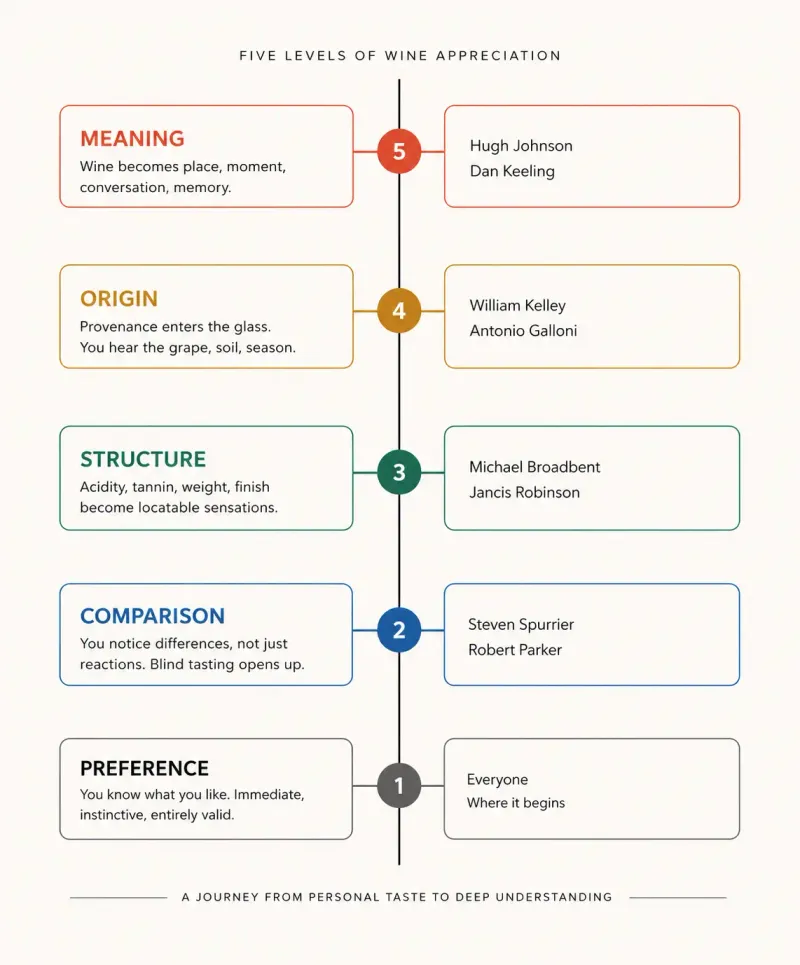
The critics in this piece operate at different stages of attention, and those stages map, loosely, onto a progression that any wine drinker can recognise in their own experience. This is not a hierarchy of sophistication. It is a description of how palates tend to develop when given the opportunity.
Stage 1: Preference. You know what you like and what you do not. The judgement is immediate, instinctive, entirely valid. This is where everyone begins, and there is nothing wrong with staying here.
Stage 2: Comparison. You start noticing differences between wines rather than simply reacting to them. Blind tasting becomes interesting here. Spurrier built a career on the gap between what you expect and what you actually find.
Stage 3: Structure. The components of a wine become legible. Acidity, tannin, weight, finish, not as vocabulary but as sensations you can locate and name. Broadbent lived at this stage. The vocabulary follows the sensation; it does not precede it.
Stage 4: Origin. You begin to hear the wine's provenance in the glass. Why it tastes the way it does, the grape, the soil, the season, the decisions made in the cellar, becomes part of what you experience. Kelley's approach belongs here, and so does Galloni's patience.
Stage 5: Meaning. Wine stops being primarily a beverage and becomes something else: a place, a moment, a conversation, a memory. Johnson arrived here decades ago and never left. Keeling built a whole publication around it.
Most people stay at stage one. Others like Robinson operate across all of the above. There is nothing wrong in either case. But each stage is not a departure from pleasure. It is cumulative. The wine does not change. You do, along with what you bring to it.
The critics in this piece spent decades building means of framing attention. None arrived at the same framework. None would claim to have settled the question.
This is no failure of expertise. It is expertise. Learning more often highlights how much there is to know.
AFTERWORD: RORY SUTHERLAND
Everything I am about to say assumes you have read Ben’s piece, which argues in part that we should find a critic or critics we trust and let them do some of the cognitive heavy lifting. He is right.
But the interesting thing about critics is not whether they are right or wrong. It is that, once read, they become part of the wine.
A 95-point score from Robert Parker does not simply describe a Bordeaux. It changes how that Bordeaux tastes if you read it before drinking. A 17.5 from Jancis Robinson produces a different effect. A paragraph from Dan Keeling does something else again.
The critic is not a measurement device. The critic is a meaning generator. And that meaning is part of what you experience in the glass.
This unsettles people who want wine to be objective. It should not. It is simply how perception works.
We know that expectation alters taste. The same wine is rated differently when people are told it scored highly than when they are told it did not.
The liquid does not arrive in your mouth alone. It arrives wrapped in everything you know.
You are not a spectrometer. You are a person.
Which makes the question about critics more useful than most people think.
The question is not: “Is this critic telling me the truth about the wine?”
The question is: “Does this critic’s way of seeing enhance my experience of it?”
A good critic expands your attention. They help you notice structure, origin, trajectory. They give you more to perceive.
A bad critic does the opposite. They narrow your attention and even make you distrust your own palate.
Ben’s ladder makes this practical.
At the beginning, you do not need a critic. You like what you like.
At the top, you do not need a critic either. You have built your own frame.
Critics do their work in the middle.
They are scaffolding. A shortcut, but necessary.
Choose a critic the way you choose a guide in a foreign country.
Not because they are right.
Because they help you see things differently.
CONTRIBUTORS
Benedict Johnson is the founder of Ourglass, a London-based wine subscription dedicated to helping people understand what they love and why. He curates the Taste Decoded series.
Amelia Singer is a broadcaster, wine educator, and named to the inaugural IWSC and WSET Future 50 list in 2019.
Rory Sutherland is Vice Chairman of Ogilvy, a columnist for The Spectator, and author of Alchemy: The Surprising Power of Ideas That Don't Make Sense. He wrote the afterword to this piece.
Tim Hayward is a food writer, broadcaster, and restaurant columnist for the FT Weekend Magazine. He is the author of Loaves and Fishes, Knife: The Cult, Craft and Culture of the Cook's Knife, and DIY Cook. He contributed the section "What Is Criticism For?" to this piece.
The accounts of Jancis Robinson MW and Dr William Kelley in this piece were reviewed by both critics for accuracy ahead of publication.