

UNGRAFTED – WHAT JONATAN GARCIA LIMA FOUND IN THE VINES ABOVE OROTAVA
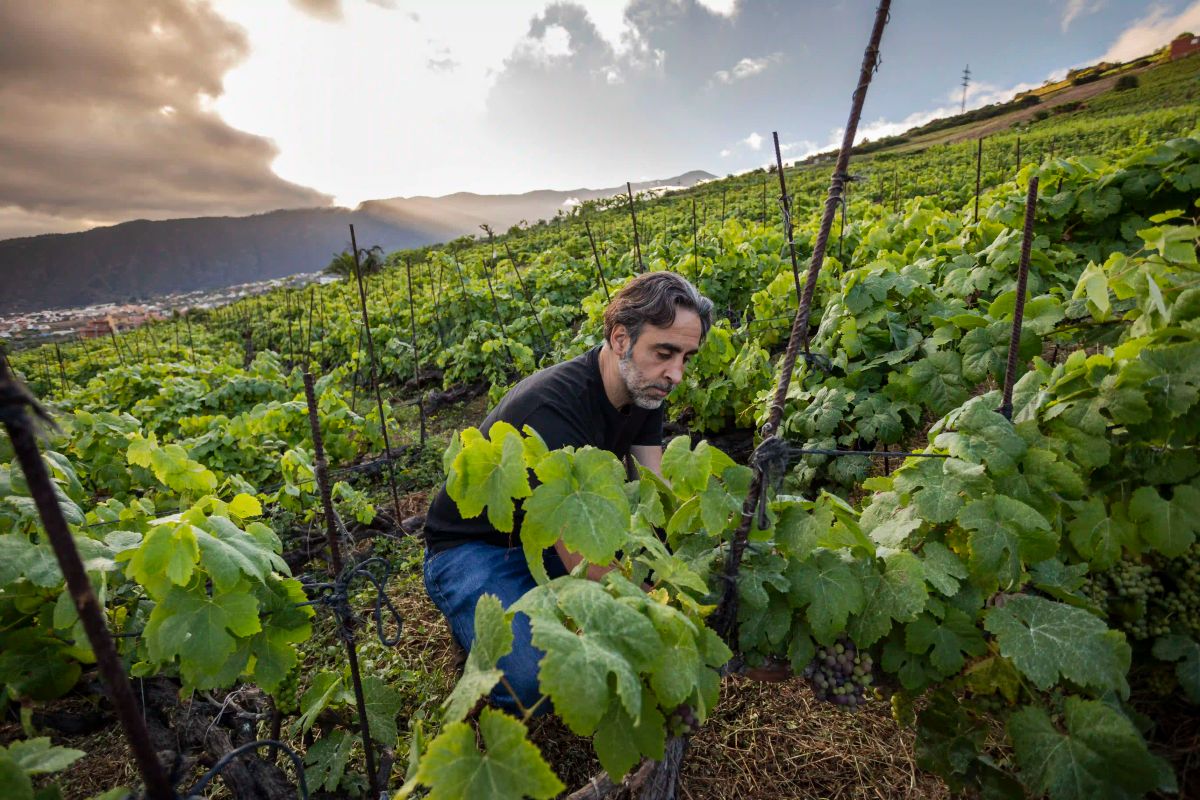
Jonatan García Lima is the winemaker behind Suertes del Marqués, working with ungrafted vines between 90 and 250 years old in the Valle de la Orotava, Tenerife.
This is not an article about volcanic wine.
It is about what remains when you strip the usual stuff back.
BEFORE THE IDEA
The vineyards came first. Jonatan’s father bought the first plots in 1986 because he liked the land. Not because he had a philosophy. Not because he was building a wine project. The vines were already there. The work was practical. The ambition came later.
"I did not start with a philosophy," Jonatan says. "I found it in the vineyards."
Many modern wine projects begin with an idea and then look for land to express it. This one didn’t. The land was there and the thinking followed.
That reversal is the story.
THE WRONG LATITUDE
Fine wine is supposed to happen between 30 and 50 degrees latitude.
Tenerife sits at 28 degrees north. Level with the Sahara so on paper, it shouldn’t work.
In practice it works, because altitude pulls temperatures down, Atlantic winds moderate the extremes, and the north of the island sits under cloud cover for much of the year. The climate is not Mediterranean. It is maritime. Closer to a long spring than a hot summer.
Rules rarely account for places like this.
WHAT PHYLLOXERA MISSED
Between the 1860s and 1890s, phylloxera rewrote European wine. Vines were pulled out and regions were rebuilt on American rootstock. The genetic continuity of European vineyards was broken and reassembledfrom the ground up.
The Canary Islands were largely untouched.
These vines are not old in the way Burgundy's oldest vines are old. They are not restored. They are continuous. Ungrafted. In some cases approaching 250 years.
This does not constitute a romantic detail – it changes how the plant behaves.
"Most of our vineyards are between 90 and 250 years old," Jonatan says. "But it is difficult to know exactly. People did not record these things. The wine business was more professional in the seventeenth and eighteenth centuries than the nineteenth and twentieth. After the merchants left the islands, people made wine to drink, not to sell. They did not see any reason to register what they had planted. So we ask the previous owners who are over eighty, who planted, whose grandfather planted. We build the picture from memory."
There is no clean lineage. Only continuity.
Own-rooted vines are not engineered for resilience. They respond directly to the site. They produce less and balance differently.
"The age of the vines makes the wines more balanced," he says. "With young vines you can have good yields, but not always the right balance between ripeness and acidity. A grafted vine at fifty years old does not produce a good yield. An ungrafted vine does."
Most of European wine is a solution to a problem. These vines are what the problem didn't reach.
Around seventy per cent of the valley is between eighty and one hundred years old.
THE BRAID
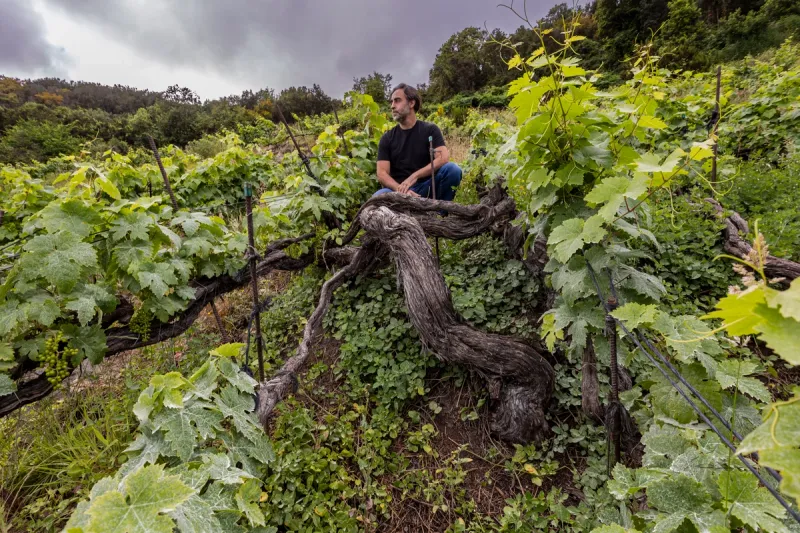
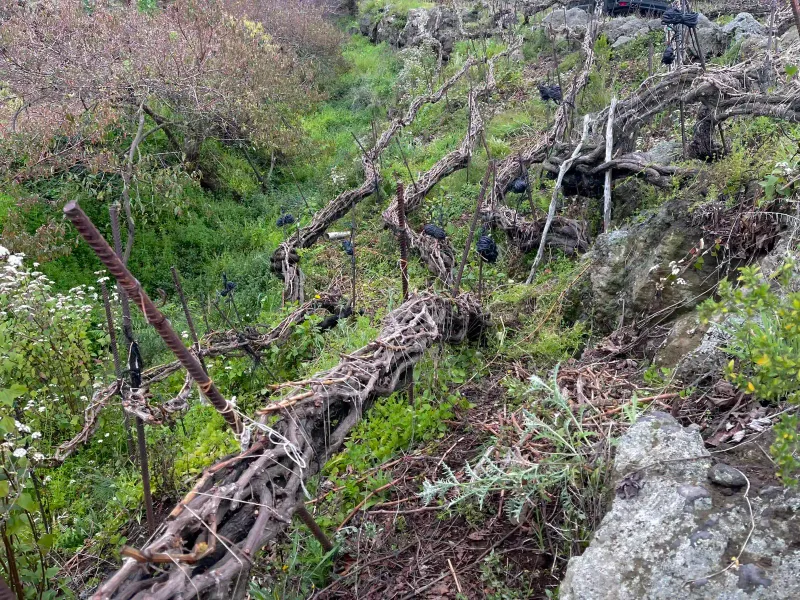
The defining image of the valley is not the volcano – it's the braid.
Cordón trenzado. Vines woven into long strands along the ground, lifted and laid by hand.
It did not evolve to make better wine. It evolved because the land was shared with potatoes. The vines could be lifted. The crops could grow underneath. It was a solution to a practical problem.
The potatoes are gone but the system remains.
"It is heritage," Jonatan says. "Not just for us. For the world of wine. Every year we lose hectares of vines in the appellation. We have to protect it."
There is no efficiency case. The system is slower. It cannot be mechanised. It requires more labour than almost any modern training method.
"If you compare with other systems, there is no benefit. It is the opposite. A lot of extra work. We cannot plough with machines. But it is something we must protect."
And still he is doing both. Jonatan García Lima is planting new vineyards in cordón trenzado and converting trellised vines back to it, to protect the system. Not because it is easier but because he believes it is right.
Most of modern viticulture moves towards efficiency. This deliberately moves away from it.
FINDING HIS OWN STYLE
There was no clean start point.
He was running the family business. The vineyards were there, but they were not yet a fully formed wine project. The work of shaping them into one took time.
He learned in the vineyards. He learned alongside Roberto Santana and Luis Seabra. He learned by watching how the wines changed from year to year.
"I work very differently from Roberto," he says. "With Luis I am closer, but even there we are different now compared to ten years ago."
Style was not imported. It emerged through travel, tasting, and watching how the wines responded year on year. Burgundy and the Rhône became reference points but not templates – whole bunch fermentation, lower extraction, neutral vessels, used because they suited the work, not because they signalled an alliance.
"I never did a harvest in Burgundy," he says. "This is my winemaking style."
THE WINES
The work resolves in the glass. Three wines, carrying the logic through from ancient parcels to finished bottles.
7 Fuentes. Seven parcels in the Valle de la Orotava blended into one wine. Listán Negro and Tintilla from the slopes of Teide. The entry point, but not so you know it. Red and black berries, pepper, a juicy freshness that stays on the right side of restraint. Pure rather than simple.
Trenzado. The white wine that carries the philosophy most cleanly. Listán Blanco from ungrafted vines over a hundred years old, trained in the goblet style on sea-facing cliffs. Citrus, minerality, smoke. Listán Blanco is neutral in the way Chardonnay is neutral, which is to say, it stays out of the way. What you taste is the site.
Las Suertes. Listán Negro from a single parcel, fermented on skins for twenty-five to thirty-six days. Longer than the grape usually asks for, but the maceration is what makes it specific. Fresh red fruits, florals, spice. The colour stays light. The wine does not.
The wines are both expressive and precise.
WHY BURGUNDY COMES UP
The comparison is inevitable, but also incomplete.
Burgundy is famed for taking site seriously enough to map it at parcel level. Valle de la Orotava does the same, for different reasons.
"When people compare, and sometimes we do too, it is because Burgundy is focused on terroir," Jonatan says. "Here we have many soils, elevations, orientations. We work many different wines in the cellar from the same wine."
The parallel goes further than geography. Listán Blanco behaves the way Chardonnay behaves in one specific respect: it is aromatically neutral. Neither grape imposes itself. Both allow place to show. In a region that takes parcel-level variation as a starting point, a neutral grape is not a limitation but an opportunity.
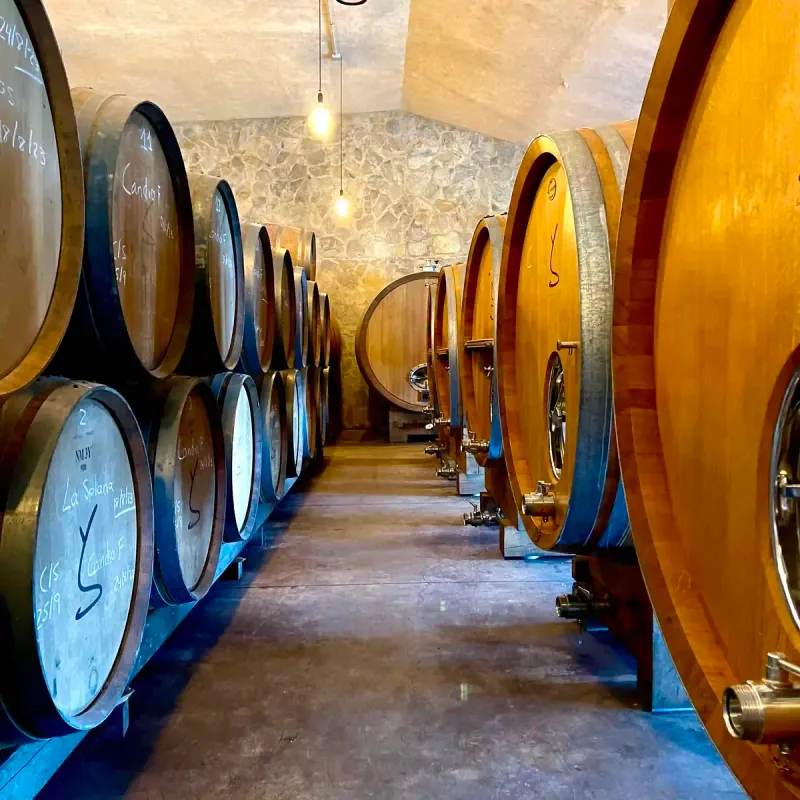
Oak is used carefully. Whole bunch fermentation appears where it makes sense. Extraction is restrained. Red grapes whose personality is not to give a lot of colour are worked without forcing them to.
But the comparison stops at structure. It is not a stylistic claim.
"I never did a harvest in Burgundy, so I do not know how they really work. This is my winemaking style."
What Suertes del Marqués shares with Burgundy is a means for paying attention. What it does not share is the vocabulary, the grapes, the weather, the history. Those are its own.
THE GRAPES NOBODY WRITES ABOUT
Listán Negro. Listán Blanco. Vijariego Negro. Baboso Negro. Castellana Negra. Malvasía Rosada.
These grapes do not appear in most wine education, which says more about the education than the grapes.
They persist because they work here. They carry centuries of adaptation without modern intervention. They express something introduced varieties cannot.
Obscurity is not a measure of importance but a measure of attention.
THE TREND PROBLEM
Volcanic wine is now a category. It was not always.
"I do not want Suertes del Marqués to be a trend," Jonatan says. "I want it to be a classic cellar. For that we need many vintages of consistent quality. We are working on it."
That is a long-term ambition. It requires patience. It requires resisting the shortcuts to which trends incline.
When a region becomes fashionable, what sells is the shorthand. Volcanic. Mineral. Saline. The words travel faster than the work behind them.
"When the trend finishes, the market cleans itself. Only the cellars doing serious work in the vineyards and the cellar remain."
That is not marketing but learning the lessons of the past.
Put the name first. Not volcanic. Not the Canaries.
A LOCAL PLACE, A DISTANT AUDIENCE
Around ninety per cent of the wines are exported. Forty markets. Seventy distributors.
Most of the bottles leave.
The local market is improving, but slowly.
"Local people are starting to appreciate the wines. The quality is much better than twenty years ago. Tourism has also improved. The quality of hospitality has grown with the quality of the wines."
But the economics are clear. The work cannot be mechanised. The costs cannot be absorbed locally at scale.
So the wines travel, the place stays where it is and the inefficiency is paid for elsewhere by someone who wants the result enough.
THE COUNTERPOINT
The project only works because the market exists.
The same trend that risks flattening the category also creates the demand that sustains it. That tension does not resolve. It sits underneath everything.
There is another pressure beneath it, and it matters more.
"Tacoronte's recent phylloxera presence frightened me. I always thought the risk was there. Many parts of the island have soil where phylloxera could live. It may have been there for twenty years already, kept in check because the vines were treated and the population could not grow outside. We are seeing it now because the vineyards were abandoned. Nobody treated them. Nobody looked in the roots. If it reaches Valle de la Orotava, it would be the end of viticulture here, and the end of cordón trenzado. A grafted vine cannot carry a training system like this. I am optimistic it will not happen. The government moved fast. The variability of the soils is a natural wall."
But the question is no longer hypothetical.
If phylloxera reaches Orotava, the defining condition of these vineyards changes. Grafting is not just a technical adjustment. It changes the relationship between plant and place.
Everything above this point depends on that relationship.
WHAT ENDURES
The cordón trenzado exists now without the reason that created it. He is returning to it anyway.
Not nostalgia but as belief.
The article began with a question. What it means to take something overlooked seriously. The answer is not abstract. It is training vines by hand when no one requires it. Asking eighty-year-old neighbours who planted what. Keeping varieties that no market asks for. Exporting most of what you make while building the case, slowly, for the people closest to it.
The volcano does not remember anything. The people who work above it do. For now.
FREQUENTLY ASKED QUESTIONS
Who is Jonatan García Lima?
Jonatan García Lima is the winemaker at Suertes del Marqués in the Valle de la Orotava, Tenerife. Working with ungrafted vines between 90 and 250 years old, he has developed a site-driven approach grounded in old vines, whole-bunch fermentation, restrained extraction, and the protection of traditional training systems such as cordón trenzado.
What is cordón trenzado?
Cordón trenzado is a traditional vine training system specific to Tenerife in which vines are braided into long woven strands laid along the ground. It evolved because vineyards were historically shared with potato crops. The vines could be lifted to let crops grow underneath. The system is labour-intensive and cannot be mechanised. Every year, hectares of it are lost. Jonatan García Lima is converting trellised vines back to cordón trenzado to protect it.
What makes Canary Islands wine different?
Many Canary Islands vineyards are ungrafted because phylloxera did not reach the archipelago during the nineteenth-century epidemic that rewrote European wine. Recent phylloxera presence has been confirmed in Tacoronte, but the Valle de la Orotava and most of the islands' historic vineyards remain untouched.
What is Trenzado wine?
Trenzado is the flagship white wine of Suertes del Marqués, made from Listán Blanco grown on ungrafted vines over one hundred years old in the Valle de la Orotava, Tenerife. Listán Blanco is aromatically neutral in a way comparable to Chardonnay, a quality that allows the site rather than the grape to dominate the wine. Expect citrus, minerality, and a thread of smoke.
Why does Suertes del Marqués export ninety per cent of its production?
The estate sells to forty markets through seventy distributors, which reflects both the international demand for Canarian wines and the historical structure of the local market. Local consumption is growing as quality improves on the island and tourism develops, but the audience for these wines has always been somewhere else. The tension between a deeply local place and a distant audience is a defining feature of the project.
MORE FROM TASTE DECODED
How Taste Works: The Science of Flavour and Memory
The Wine Sweet Spot with Rory Sutherland
(Un)learn Taste with Gang of Four's Jon King
Context Effect: How Setting Shapes What You Taste How to Taste Wine with Michael Sager
Watch the Taste Decoded series
ABOUT THE AUTHOR
Benedict Johnson is the founder of Ourglass, a London-based taste platform. He writes on wine, taste, and culture, and curates the Taste Decoded series.
Jonatan García Lima is the winemaker at Suertes del Marqués in the Valle de la Orotava, Tenerife. "Many Canarian cellars are forgetting the vineyards. Without vineyards there will be no wine."