
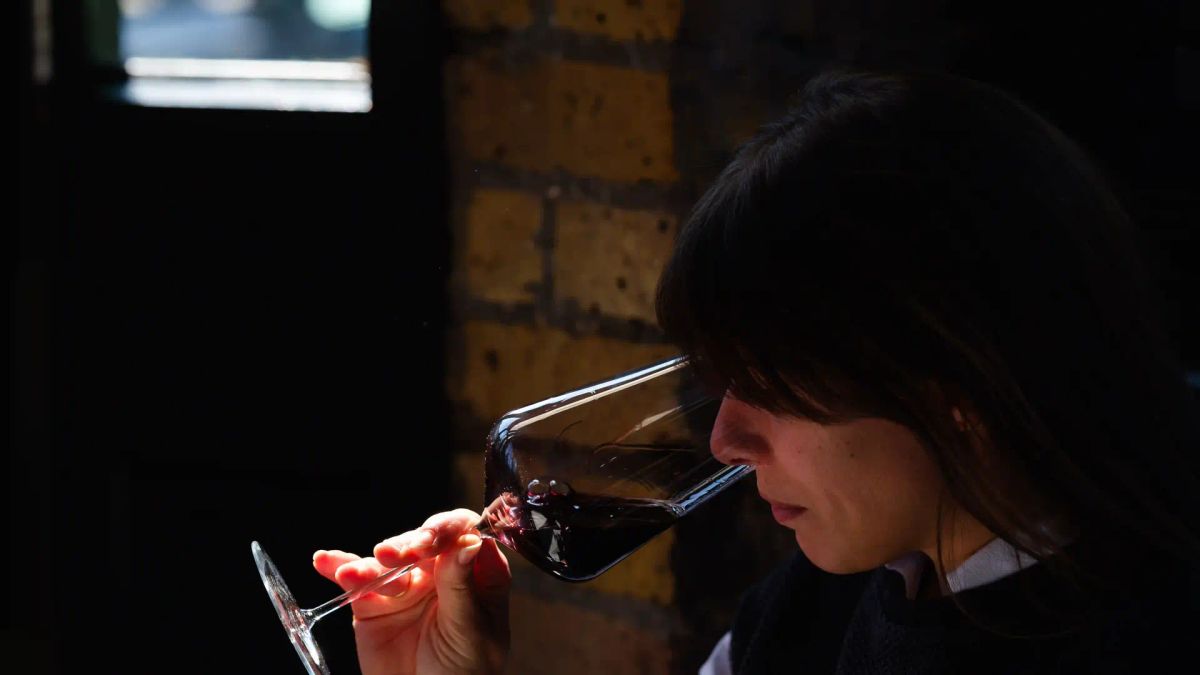
You are standing in a wine shop. There are 200 bottles in front of you. You know you do not want the cheapest. You know you do not want to overpay. You have opinions about wine. You have preferences. You have been drinking it for years.
You pick the same bottle you picked last time.
This is not a knowledge problem. You probably know more about wine than you realise. You know you prefer reds to whites, or that you like something crisp, or that Malbec usually works. The information is there.
The problem is that you do not trust it.
You do not trust your own palate enough to risk twelve quid on something unfamiliar. You do not trust your vocabulary enough to ask the shop assistant for help. You do not trust your judgment enough to order something unknown at dinner.
This gap between what you know and what you are willing to act on has a name. It is called taste confidence. And once you understand it, everything about how you choose, drink and talk about wine changes.
Taste confidence (n.): The ability to choose, taste and talk about wine without anxiety, because you trust your own palate more than labels, prices or other people's opinions. Unlike formal wine qualifications, which build confidence through accreditation, taste confidence develops through structured exposure and reflection. It is not about knowing more. It is about needing less reassurance.
THE CONFIDENCE GAP IS NOT WHAT YOU THINK
Most people assume wine anxiety comes from ignorance. They think: if I just learned the grape varieties, or memorised the regions, or understood what "tannin" actually means, I would feel confident.
This is wrong.
Wine anxiety comes from a gap between knowledge and trust. You already know what you like. You just do not believe that what you like is good enough, or correct enough, or sophisticated enough to act on publicly.
Rory Sutherland, the behavioural scientist and Vice Chairman of Ogilvy, explains the mechanism precisely: people do not only maximise utility. They maximise the feeling of having made a good decision. A single considered purchase that feels right delivers more satisfaction than several unconsidered ones. The pleasure is not just in the consumption. It is in the choosing.
This is why wine anxiety is so paralysing. The fear is not that you will drink something bad. The fear is that you will choose badly, and that someone will notice.
The result is predictable. You retreat to safety. You buy the same bottle. You defer to price tags, medals, or whatever the algorithm recommends. You never develop your own judgment because you never exercise it.
WHY ALGORITHMS CAN'T CLOSE THE GAP
Every few months, a new product promises to solve wine choice with artificial intelligence. Upload your preferences. Rate a few bottles. The algorithm will tell you what to drink next.
It sounds reasonable. It does not work. Or rather, it works at the wrong level.
A study published in the Journal of Wine Economics by Cambridge University Press tested six AI models on 141,409 expert wine reviews. The largest model, with 8 billion parameters, achieved 89.23% accuracy at classifying wine sentiment. A purpose-built interpretable model with just 2 million parameters achieved 89.20%.
The accuracy difference was 0.03 percentage points. The insight difference was vast.
The large model could classify whether a review was positive or negative. But it could not explain why. It could not show which words carried the judgment, or how "breezy" became an insult in wine while "stained" became a compliment. It could mimic the output of expert taste without making the reasoning visible.
The interpretable model could. It identified that "quick," "generic" and "simple" are the most negatively weighted words in wine criticism. Not because they describe faults. Because they describe absence: wines that arrive, pass through and leave without making you think.
For the full analysis of this research, including the complete sentiment word rankings and what they reveal about how critics actually think, read The Judgment Gap.
The implication is direct: taste is not a prediction problem. It is a transmission problem.
The goal is not to tell you what you will like. The goal is to help you understand why you like what you like, and to expand the range of things you are capable of enjoying. A recommendation engine can predict your next bottle. It cannot build the vocabulary, the framework or the perceptual confidence to choose without it next time.
As Amelia Singer, wine educator and broadcaster, observes: "People know far more about wine than ever before. The questions I receive are far more informed and relate to clear preferences and intention. This empowers people to choose wine with intent, not just grab whatever is nearest at the checkout."
The knowledge is there. The confidence to act on it is not. That is the gap. And no recommendation engine closes it.
WHAT TASTE CONFIDENCE ACTUALLY IS
Confidence does not come from knowing more. This is the mistake most people make.
You do not need to memorise appellations or vintage charts. You do not need to identify eighteen flavours in a glass of Burgundy. You do not need to know the difference between Gruner Veltliner and Gewurztraminer to enjoy either of them.
Confidence comes from having a repeatable method for paying attention.
When you know how to taste, actually taste, not just drink, you build a feedback loop. You notice what you like. You remember it. You start recognising patterns. Over time, you develop preferences that are genuinely yours, not borrowed from a critic or calculated by a model.
The method is simple: See, Swirl, Smell, Sip, Savour. Five steps. Two minutes. That is all it takes to move from passive consumption to active learning.
HOW TASTE CONFIDENCE DIFFERS FROM WINE EDUCATION
Formal wine education programmes like WSET and the Court of Master Sommeliers build confidence through accreditation. You study, you pass an exam, you earn a credential. The knowledge is structured around categories: grape varieties, regions, production methods, quality classifications. The confidence comes from knowing the system.
Taste confidence works differently.
It is built through repeated, attentive experience, not assessment. You do not need to identify eighteen aromas in a glass of Burgundy. You need to notice whether you enjoy it, and remember why. The confidence comes from the practice, not the certificate.
WSET teaches you what experts know. Taste confidence teaches you what you think.
Both are valid. They serve different purposes. If you want to work in wine, formal education is essential. If you want to enjoy wine without anxiety, taste confidence is what you are actually looking for.
The Cambridge research supports this distinction. The study found that expert wine vocabulary operates as a compressed social code. Words like "elegant," "cascading" and "stained" carry specific meaning that only becomes legible through practice. You cannot decode them from a textbook. You decode them by tasting enough wines in enough contexts that the words start to correspond to real sensory experiences.
Professor Charles Spence, head of the Crossmodal Research Laboratory at Oxford University, has demonstrated that sensory perception cannot be outsourced. His research shows that when someone describes a wine as "bright," they are drawing on cross-modal associations between visual lightness and gustatory acidity. These associations are partly innate, partly culturally trained and partly personal. An algorithm that treats "bright" as a data point misses the perceptual architecture entirely. Taste is constructed through experience, not delivered by prediction. For more on how context, colour, sound and memory shape what we taste, read How Taste Works.
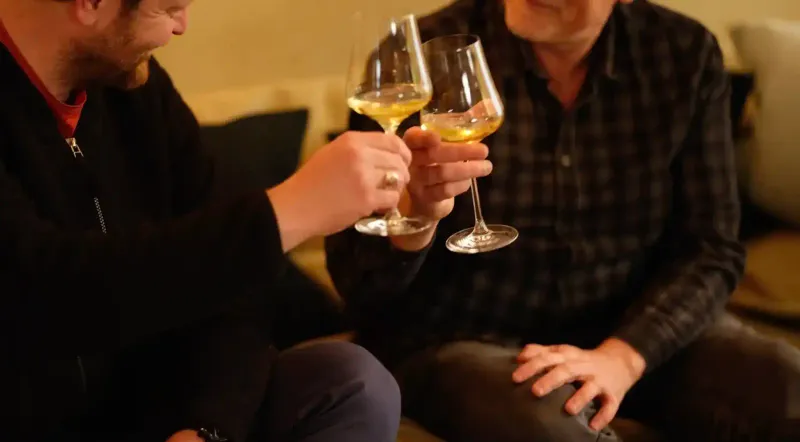
WHAT CHANGES WHEN YOU HAVE IT
Once you trust your palate, everything shifts.
Choosing becomes easier. You stop staring at wine lists hoping for divine intervention. You know what you like, you know how to spot it, and you know how to take educated risks on unfamiliar bottles. The sommelier becomes an ally, not an examiner. If you want practical help with this, read our guide on how to choose wine from a restaurant wine list.
Drinking becomes richer. The same wine reveals more when you are paying attention. You notice how it changes in the glass, how it shifts with food, how different bottles from the same grape can taste completely different. A £14 bottle can be revelatory when you are actually tasting it.
Talking becomes natural. You do not need jargon. You can describe what you are experiencing in plain language, and that is more useful than technical vocabulary. "This is fresh and citrusy, I love it" communicates more than "notes of Meyer lemon with a flinty minerality" ever will.
Anxiety disappears. The wine shop becomes interesting instead of overwhelming. Dinner parties become opportunities, not minefields. You stop worrying about choosing wrong because you have developed the skill to choose well.
As Tim Hayward puts it: "The privilege is being able to move from one foot to the other and enjoy both, depending on the situation." That freedom to move between a £12 glass of something unknown and a treasured bottle with friends, without anxiety in either direction, is what taste confidence feels like.
Taste confidence does not make you a snob. It sets you free.
HOW IT IS BUILT
Taste confidence is not acquired in a weekend course or a single tasting. It is built through guided comparison, repetition and feedback over time.
There are three layers, and they develop in sequence.
The first is a craft layer: the basic mechanics of tasting. How to smell properly. How to identify acidity versus tannin. How to distinguish between a wine that is young and a wine that is simple. This is learnable in weeks. Our guide to developing your wine palate covers the practical steps.
Kate Hawkings told Tim Hayward something he says he will hold to for the rest of his life: "You've got to think about how the next generation are going to be drinking wine. By the glass, for adventure and for excitement." That is taste confidence in practice: choosing for curiosity, not convention.
The second is a cultural layer: understanding why certain wines are valued, how regions and styles carry meaning, and how the vocabulary of quality works in practice. This is what the Cambridge study illuminated: the language of wine is not decorative. It encodes real evaluative judgments that only become legible through exposure. This develops over months. If you want to understand what makes extraordinary wine, this is the layer that matters.
The third is a personal layer: your own accumulated experience. The wines you have tasted, the preferences you have formed, the associations you carry. This is irreducibly yours, and it compounds over years.
No algorithm can build these layers for you, because each one requires your active participation. A recommendation engine can suggest the next bottle. It cannot make you pay attention while drinking it.
This is exactly what Ourglass is designed to do.
Each delivery is structured to develop your palate systematically. Wines chosen to highlight differences in style, region and grape, so you learn by comparison, not just consumption. Context that explains what makes each wine distinctive and why. Deliberate progression that builds on the last delivery, expanding your range without overwhelming you.
Think of it as a curriculum, not a subscription. The bottles are the textbook. Your palate is the student. Confidence is the graduation.
Most members notice a shift within three months. By twelve months, the wine list holds no fear.
Start building taste confidence
THE DEEPER ARGUMENT
There is a reason taste confidence matters beyond personal enjoyment.
In a world where algorithms increasingly mediate choice, from what you watch to what you read to what you eat, the ability to form and trust your own judgment is becoming rarer and more valuable. Wine is one of the few remaining consumer categories where the product genuinely rewards attention, where quality reveals itself through practice, and where personal development is part of the experience.
Taste confidence is a small act of independence. It says: I can assess this for myself. I do not need to be told what to like.
The Cambridge researchers found that the most negatively weighted word in their entire corpus of 141,409 wine reviews was "quick." Not "bad." Not "faulty." Quick. A wine that arrives, passes through and leaves without asking anything of you.
The opposite of taste confidence is not ignorance. It is passivity. And passivity is what every shortcut, every algorithm and every "AI sommelier" quietly encourages.
The alternative is attention. Repeated, deliberate, yours.
That is what taste confidence is. And it changes everything.
FREQUENTLY ASKED QUESTIONS
Is taste confidence the same as wine expertise?
No. Expertise is knowing facts about wine: regions, grapes, producers, history. Taste confidence is trusting your own experience. You can have taste confidence without expertise, and expertise without taste confidence. The goal is enjoyment, not encyclopaedic knowledge.
How long does it take to build taste confidence?
Most people notice a meaningful shift within two to three months of attentive tasting. You do not need to taste constantly. Once or twice a week with focus is enough. The key is paying attention, not just drinking.
Can anyone develop taste confidence?
Yes. Barring rare medical conditions affecting smell or taste, everyone can build a capable palate. Taste confidence is a skill like any other: practice and attention are all you need. If you are starting from zero, our beginner's guide to wine covers the foundations.
Why do I always buy the same wine?
Because choosing something unfamiliar feels risky, and the cost of a bad choice (wasted money, social embarrassment) feels higher than the reward of a good discovery. Taste confidence reduces that perceived risk by giving you a framework for making informed choices, even with wines you have never tried.
What if I have "bad" taste?
There is no such thing. Taste is personal. The point of taste confidence is not to like the "right" wines. It is to know what you like and trust that knowledge. Some people prefer bold reds. Others prefer crisp whites. Neither is wrong.
Is taste confidence the same as a WSET qualification?
No. WSET (Wine and Spirit Education Trust) builds knowledge through structured academic study and examination. Taste confidence builds through repeated, attentive experience. WSET teaches you what experts know. Taste confidence teaches you what you think. Both are valuable. They serve different purposes.
Does price indicate quality?
Sometimes, but not reliably. As we explored in The Wine Sweet Spot, the economics of wine mean that moving from £7 to £20 gets you dramatically more wine investment for a modest increase in price. But taste confidence means trusting your palate over the price tag. If you love a £10 bottle more than a £50 bottle, the £10 bottle is better for you.
Can AI recommend wine better than I can choose it myself?
AI can predict what you are statistically likely to enjoy based on past behaviour. It cannot build your capacity to choose well independently. A 2025 Cambridge study found that an 8-billion-parameter language model matched a purpose-built 2-million-parameter model on wine sentiment classification, with effectively identical accuracy, but could not explain its reasoning. Recommendation engines optimise for prediction. Taste confidence optimises for understanding. One keeps you dependent. The other sets you free.
How is Ourglass different from other wine subscriptions?
Most subscriptions focus on volume or value. Ourglass focuses on learning. Every box is designed to develop your palate, not just fill your rack. The goal is not to send you wine. It is to build your taste confidence so you can choose brilliantly on your own. For an honest comparison of how Ourglass compares to Naked Wines, Laithwaites and others, read our UK wine subscription comparison.
SUMMARY
Taste confidence is the ability to trust your own palate.
It is not expertise. It is not memorising facts. It is the quiet certainty that comes from knowing how to pay attention, and having done it enough times to trust what you notice.
A Cambridge study proved that even the most powerful AI models cannot explain why a wine is good. They can only predict that it is. The gap between prediction and understanding is where taste confidence lives.
Wine becomes easier to choose, richer to drink and more natural to talk about.
The anxiety disappears. The enjoyment compounds.
Taste confidence is built, not given. And it changes everything.
MORE FROM TASTE DECODED
How Taste Works: The Science of Flavour and Memory
The Wine Sweet Spot with Rory Sutherland
(Un)learn Taste with Gang of Four's Jon King
Context Effect: How Setting Shapes What You Taste
How to Taste Wine with Michael Sager
Watch the Taste Decoded series
ABOUT THE AUTHOR
Benedict Johnson is the founder of Ourglass, a London-based taste platform dedicated to helping people become confident wine lovers. He writes on everything to do with wine, and curates the Taste Decoded series, which brings together sommeliers, communicators, academics and creatives to decode what great actually tastes like.