
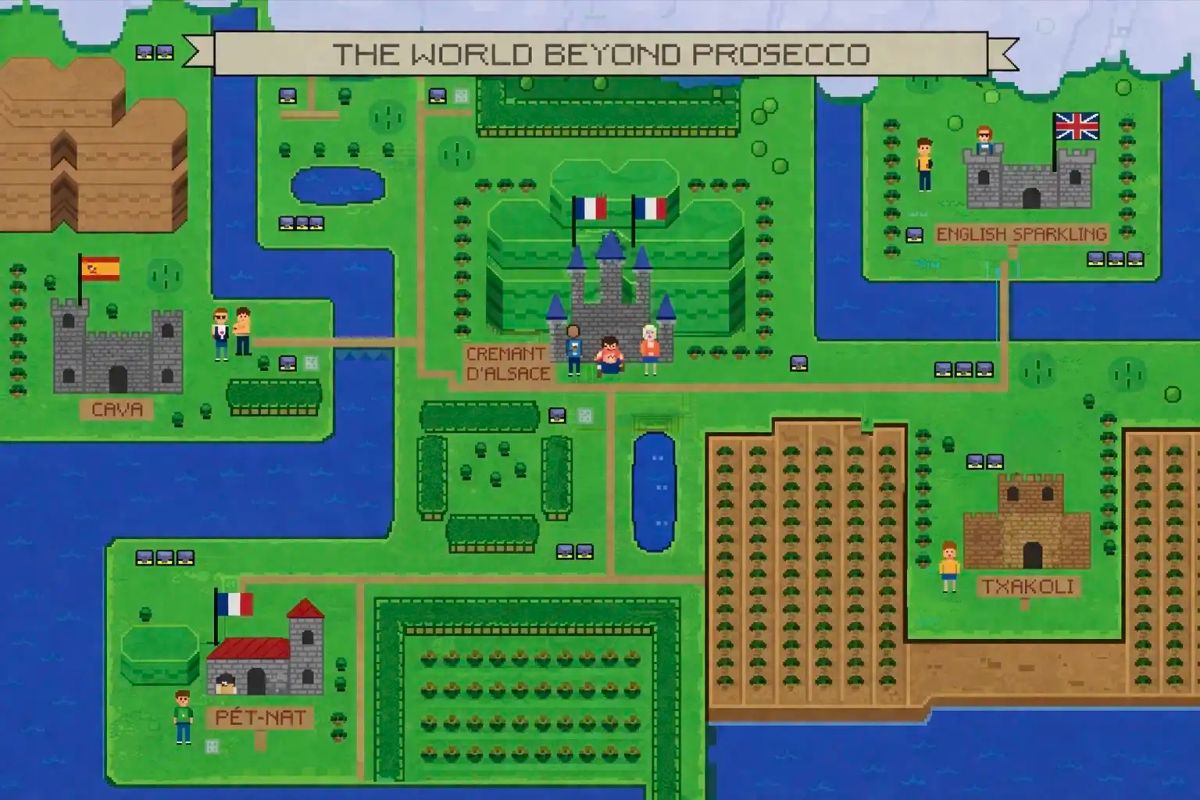
WHAT TO DRINK INSTEAD OF PROSECCO
Five wines similar to Prosecco, and a tasting game to find your favourite.
THE SHORT ANSWER
If you like Prosecco, try these five wines.
Crémant d'Alsace for biscuity, orchard-fruit freshness with a finer mousse. Cava from Spain for crisp, dry mineral character at a fraction of the price. English Sparkling Wine for chalky precision from considerably closer to home. Pét-Nat for something alive and unpredictable in the glass. Txakoli from the Basque Country for bone-dry ocean freshness that handles a summer evening at least as well as anything pink.
What they share is not style but purpose. They all answer the same question: is this a good moment to open something? And they all say yes, without requiring you to think too hard.
Five wines to try if you like Prosecco:
- Crémant d'Alsace (France): biscuity, orchard fruit, finer mousse. £10 to £18.
- Cava (Spain): crisp, dry, mineral, excellent value. £8 to £20.
- English Sparkling Wine: chalk precision, cool-climate tension. £18 to £40.
- Pét-Nat (various): cloudy, natural, alive and occasionally alarming. £12 to £25.
- Txakoli (Basque Country, Spain): bone dry, spritzy, the ocean in a glass. £10 to £20.
The longer answer is about why Prosecco has dominated the aperitif hour for a decade, and what you discover when you take one step sideways.
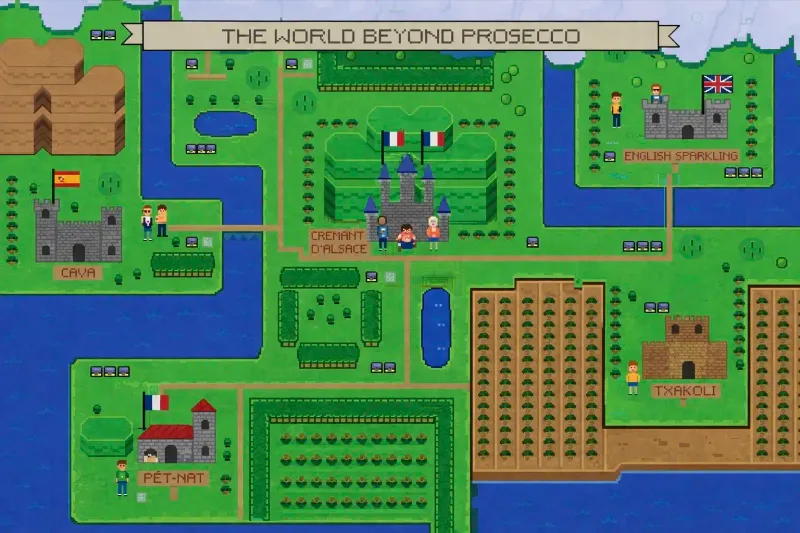
THE MAP
QUICK LEGEND
If you like Prosecco's easy, fruit-forward bubbles: go Crémant d'Alsace.
If you like the dry, crisp, value-for-money side: go Cava.
If you want more tension and precision: go English Sparkling Wine.
If you want something genuinely different and are prepared for it: go Pét-Nat.
If you want maximum freshness with no sweetness at all: go Txakoli.
WHAT CONNECTS THESE WINES
Prosecco drinkers are not really optimising for flavour. They are optimising for ease.
The category's dominance is not built on what Prosecco tastes like. It is built on what opening a bottle of Prosecco signals: low friction, high occasion, the universal human desire to mark the moment without making it a referendum on taste. Prosecco asks nothing of you. That is its great gift. It is also the ceiling.
These five wines serve the same function with more going on in the glass. Freshness that lifts. Bubbles that feel earned rather than added. Something to notice beyond the second sip.
Serve all five well chilled, 6 to 8 degrees Celsius. They will not thank you for being lazy about temperature.
THE FIVE WINES
Crémant d'Alsace, the Biscuity One
Crémant is France's collective name for traditional-method sparkling wines made outside Champagne. Alsace produces the most underrated of them.
The grape mix tends towards Pinot Blanc, with Auxerrois, Pinot Gris, and Riesling in various proportions depending on the producer. The result is a wine with a finer mousse than Prosecco, a biscuity depth that tank fermentation cannot replicate, and orchard fruit with a gentle floral lift. More complete than Prosecco. Less formal than Champagne. About half the price of either.
The mousse is the tell. Crémant bubbles are smaller, more persistent, and more integrated into the texture of the wine. The first sip of a good Crémant d'Alsace settles into the palate rather than fizzing across it. That is the difference between tank and bottle fermentation, and once you notice it you cannot un-notice it.
What you will recognise: orchard fruit, freshness, approachability. What changes: finer mousse, biscuity depth, slightly drier, more persistence. Look for: Crémant d'Alsace AOC. Wolfberger and Dopff au Moulin are reliable starting points. Budget: £10 to £18.
Cava, the Dry One
Cava is made by the same method as Champagne, from indigenous Spanish grapes, at a price point that consistently makes people underestimate it. That underestimation is your opportunity.
The grapes, primarily Macabeo, Xarel·lo, and Parellada, give Cava a character that Chardonnay-based fizz rarely replicates: green apple, lemon peel, and an earthy, slightly chalky savour that comes directly from the Xarel·lo. The bubbles are lively. The finish is clean. Nothing about it is complicated, which is not a criticism.
Cava is what happens when Champagne's method loses its pricing power. The quality stays. The ceremony goes.
Reserva Cava, at least fifteen months on the lees, and Gran Reserva, at thirty months, offer meaningful additional depth at prices that remain civilised. The category has been improving steadily for years and still does not get the credit it deserves.
What you will recognise: freshness, lightness, occasion-readiness. What changes: drier, more mineral, more savoury, traditional method complexity, significantly better value. Look for: Cava DO. Reserva for more depth. Budget: £8 to £20.
English Sparkling Wine, the Precise One
The chalk downs of southern England are the same geological formation as Champagne's Côte des Blancs. Same soil type. Cooler climate. Same grape varieties. Different latitude, which turns out to matter enormously.
England's cooler summers ripen grapes slowly. That slow ripening preserves acidity, builds tension, and produces sparkling wine with a particular kind of linear precision: green apple, lemon curd, fresh bread, and a mineral finish that tastes specifically of chalk. Not generically mineral. Actually chalk.
This is the choice for Prosecco drinkers who want to understand what sparkling wine can do when it takes the question of where it comes from seriously. It is not cheap, but the quality at the serious end is no longer in dispute.
What you will recognise: bubbles, freshness, aperitif weight. What changes: more precision, more mineral character, higher acidity, longer finish, closer to Champagne than Prosecco in intent. Look for: Sussex and Kent producers. Nyetimber, Ridgeview, Chapel Down as starting points. Budget: £18 to £40.
Pét-Nat, the Wild One
Pétillant Naturel is the oldest sparkling wine method: bottle the wine before fermentation is complete, let it finish in the bottle, leave the lees in. No disgorgement, no dosage, no filtration. The result is cloudy, slightly funky, and alive in a way that conventional sparkling wine is not.
The flavour varies so much between producers and vintages that describing it with precision is almost beside the point. Apricot and cream one glass. Green apple and something faintly barn-like the next. This is wine that has not been tidied up, and you can tell.
Prosecco drinkers who try a good Pét-Nat either find it engaging immediately or entirely alarming. Both reactions are honest. The low alcohol and slight natural sweetness from unfermented sugar make it approachable even when strange. The cloudiness is the yeast doing its job, not a sign of anything wrong.
What you will recognise: bubbles, lightness, fruit character. What changes: cloudy, wilder, less predictable, occasionally funky, more alive. Look for: Pét-Nat from Loire producers and natural wine specialists. Budget: £12 to £25.
Txakoli, the Searingly Fresh One
From the Basque Country in northern Spain. Pronounced cha-koh-lee. Not technically sparkling, but with a natural dissolved carbon dioxide that gives it the same lift as Prosecco without a single bubble being deliberately induced.
Bone dry, searingly acidic, with lemon zest, green apple, white flowers, and something oceanic that you can only describe with reference to the coast. Alcohol sits around 10 to 11 percent. The finish is clean and sharp and makes your mouth water for another sip almost before the first one has finished.
In the Basque Country it is poured from a height, the traditional method to aerate the wine and generate a brief, enthusiastic head of foam. Replicate this at home if you want to feel more theatrical than the occasion strictly requires.
This is the aperitif wine for people who find Prosecco slightly sweet. It is also, with anchovies and fried fish, one of the more precisely matched food pairings you will encounter.
What you will recognise: the spritz, the freshness, the pre-dinner function. What changes: bone dry, searingly acidic, oceanic, no added bubbles, more demanding. Look for: Getariako Txakolina DO. Budget: £10 to £20.
THE TASTING GAME
What You Need
Five bottles, one of each wine above. Four to five flutes or white wine glasses per person. A pen and the rating table below. Friends who consider Prosecco the self-evident answer to "shall we open something."
Optional but recommended: bring your usual Prosecco as a sixth bottle for direct comparison.
The Rating Table
Rate each wine from 1 to 5:
| Bubble quality: size, persistence, how the mousse integrates into the texture. |
|---|
| Fruit character: apple, pear, citrus, stone fruit, tropical. |
| Dryness: 1 = noticeably sweet, 5 = bone dry. |
| Freshness and acidity: how much the wine makes your mouth water. |
| Complexity: how much there is beyond the first sip. |
How to Play
Step 1: Pour blind. Label the wines A, B, C, D, E.
Step 2: Taste and score. Each person rates every wine across the five characteristics.
Step 3: Compare scores. Where the group disagrees on dryness tends to be where the evening gets interesting.
Step 4: Reveal the wines. Compare with the Ourglass benchmarks below.
Step 5: Order them from most to least approachable. Then notice whether the most approachable is the one you would actually want to drink again.
Ourglass Benchmarks
| Prosecco | Crémant | Cava | English | Pét-Nat | Txakoli | |
|---|---|---|---|---|---|---|
| Bubble quality | 3 | 4 | 4 | 5 | 3 | 2 |
| Fruit character | 4 | 4 | 3 | 3 | 4 | 2 |
| Dryness | 2 | 3 | 4 | 4 | 3 | 5 |
| Freshness/acidity | 3 | 3 | 4 | 5 | 3 | 5 |
| Complexity | 2 | 3 | 3 | 4 | 4 | 3 |
The Five Questions
Between rounds, pour one wine blind and ask:
- Sweet or dry?
- Old world or new world?
- What would you eat with this?
- More or less fizzy than Prosecco?
- Is this made in a tank or in a bottle?
Question 5 is where Crémant and Cava distinguish themselves for anyone paying attention. The mousse from bottle fermentation is finer and more integrated. Most people can sense it before they can name it. Once they know what they are looking for, they notice it in everything.
If you would rather not run this experiment yourself, we already have. Every Ourglass box is the outcome of exactly this kind of comparison. Start here.
WHAT YOUR SCORES REVEAL ABOUT YOUR PALATE
High fruit character and moderate dryness? You want Prosecco's easy charm with more depth. Crémant d'Alsace is the answer. Next: Vouvray Pétillant from the Loire, Blanquette de Limoux from southern France.
High dryness and high freshness? You want your sparkling wine to wake you up rather than comfort you. Txakoli is your aperitif. Cava is your everyday. English Sparkling is your occasion bottle. Next: Champagne Blanc de Blancs for the precision benchmark.
High complexity and willingness to be surprised? Pét-Nat is your territory. Next: skin-contact whites, ancestral method sparkling.
High bubble quality, high freshness, and wanting more than Prosecco? English Sparkling Wine is what you have been working towards without knowing it. Next: Champagne, Crémant de Bourgogne.
[INTERNAL LINK: https://ourglass.wine/blog/what-to-drink-instead-of-champagne]
YOUR SHOPPING LIST
Crémant d'Alsace: Alsace, France. £10 to £18. Start with Crémant d'Alsace AOC.
Cava: Catalonia, Spain. £8 to £20. Start with Cava DO Reserva.
English Sparkling Wine: Sussex or Kent. £18 to £40. Start with Nyetimber or Ridgeview.
Pét-Nat: Various. £12 to £25. Start with Loire or Jura producers.
Txakoli: Basque Country, Spain. £10 to £20. Start with Getariako Txakolina.
GO DEEPER
What to drink instead of Pinot Noir. The lighter red version of this game.
What to drink instead of Shiraz/Syrah. The teeth staining version.
What to drink instead of Sauvignon Blanc. The more aromatic crisp white version.
What to drink instead of Chardonnay. The full-bodied white version.
What to drink instead of Malbec. The other half of this conversation.
What to drink instead of Cabernet Sauvignon. The structured red version.
What to drink instead of Rioja. The oak-aged red version.
What to drink instead of Rose. The pink version.
What to drink instead of Pinot Grigio. The non-obvious version.