
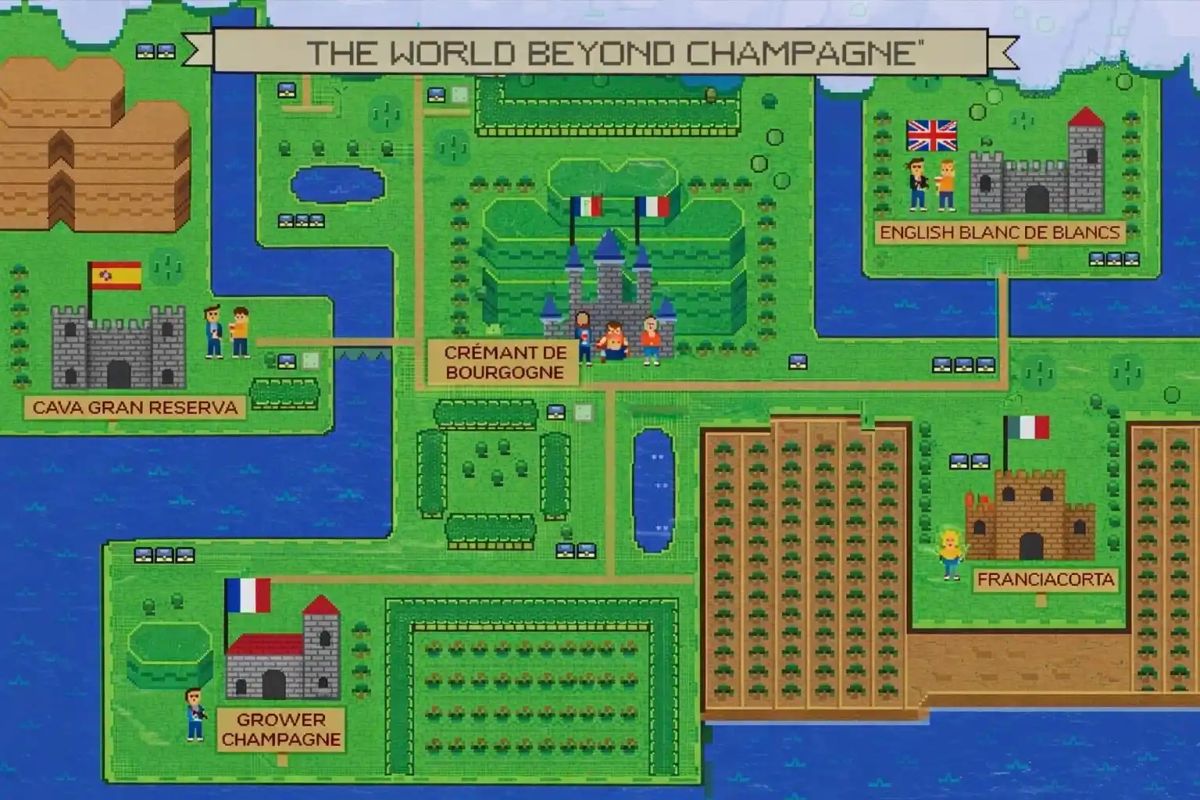
WHAT TO DRINK INSTEAD OF CHAMPAGNE
Five wines similar to Champagne, and a tasting game to find your favourite.
THE SHORT ANSWER
If you like Champagne, try these five wines: English Sparkling Wine Blanc de Blancs for cool-climate chalk precision that genuinely competes on quality, Crémant de Bourgogne for Burgundian Chardonnay character in a traditional-method bottle at a third of the price, Franciacorta from Lombardy for Italy's serious answer with more fruit and less austerity, Grower Champagne for the discovery that the category you already love has an entire dimension you have never explored, and aged Cava Gran Reserva for the proof that thirty months on the lees closes the gap between Spain and France more decisively than most people expect.
Five wines to try if you like Champagne:
- English Sparkling Wine Blanc de Blancs: chalk precision, cool-climate tension (£20 to £45)
- Crémant de Bourgogne (France): Burgundian character, traditional method (£12 to £22)
- Franciacorta (Lombardy, Italy): richer fruit, serious regulation, lower price (£15 to £35)
- Grower Champagne: the same region, more terroir, more character (£25 to £55)
- Aged Cava Gran Reserva (Spain): thirty months on lees, serious complexity (£12 to £25)
THE MAP
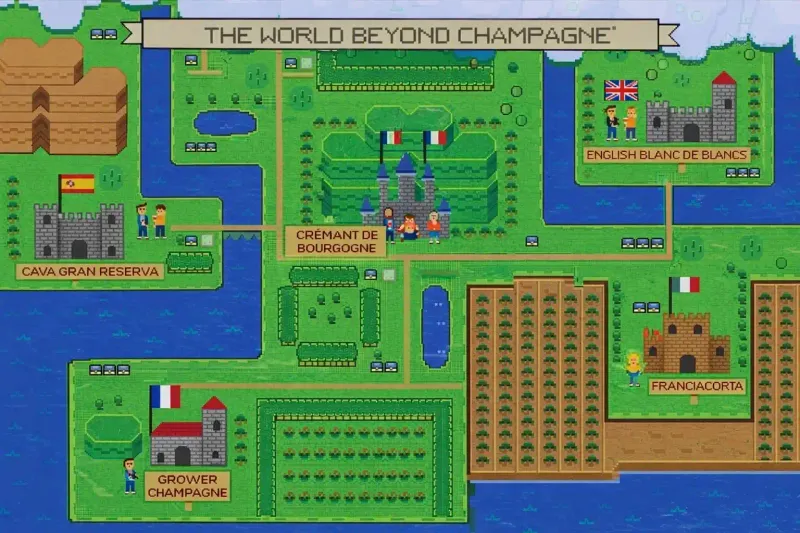
QUICK LEGEND
If you love Champagne's precision and mineral tension: go English Blanc de Blancs.
If you love the Burgundian Chardonnay character: go Crémant de Bourgogne.
If you want something richer and more generous: go Franciacorta.
If you want to stay in Champagne but find more: go Grower.
If you want traditional-method complexity at Prosecco prices: go aged Cava Gran Reserva.
WHAT CONNECTS THESE WINES
Champagne drinkers are buying certainty as much as flavour.
The big houses have spent a century building consistency, and consistency is genuinely valuable when you are paying £35 for a bottle at a restaurant and the occasion matters. The brand is doing real work. The risk is that loyalty to the brand obscures how much more the category contains.
None of these five wines replace Champagne. They extend the conversation. Traditional method, extended lees ageing, proper acidity, a finish worth waiting for. Each one adjusts something: more fruit, more mineral, more terroir, less money.
Serve all five at 7 to 9 degrees Celsius in a proper flute or tulip glass.
THE FIVE WINES
1. English Sparkling Wine Blanc de Blancs, the Precise One
The chalk downs of southern England are the same geological formation as Champagne's Côte des Blancs. Same soil, same grape, same method, cooler climate. That last variable turns out to matter enormously.
England's cooler summers ripen grapes slowly. Slow ripening preserves acidity and builds tension. The result is sparkling wine with a precise, linear quality: green apple, lemon curd, fresh bread, and a mineral finish that tastes specifically of chalk. Not generically mineral. Actually, specifically, chalk.
This is not imitation. It is parallel evolution from the same starting conditions. The best English Blanc de Blancs is a genuine peer of Champagne and costs considerably less.
What you will recognise: method, mousse, minerality, toasty depth. What changes: cooler fruit, more linear tension, slightly less brioche richness. Look for: Nyetimber Blanc de Blancs, Ridgeview Blanc de Blancs, Rathfinny. Budget: £20 to £45.
2. Crémant de Bourgogne, the Burgundian One
Burgundy makes sparkling wine. Most people do not know this, which is their loss and your discovery.
Made from Chardonnay and Pinot Noir by the traditional method, nine months minimum on the lees, the best examples sit closer to village-level Burgundy than to mainstream Champagne. Orchard fruit, cream, mineral tension, and the unmistakable sense that the wine comes from somewhere specific.
The price differential is the argument. A good Crémant de Bourgogne: £12 to £22. A comparable Champagne: £35 to £60. The gap in quality at this level does not justify the gap in price. This is not a compromise. It is a better allocation of money.
What you will recognise: traditional method, mousse, Burgundian Chardonnay character. What changes: less brioche richness, more fruit-forward, slightly less complexity at the top end, considerably less money. Look for: Crémant de Bourgogne AOC from Cave de Lugny or Louis Bouillot. Budget: £12 to £22.
3. Franciacorta, the Italian One
From Lombardy in northern Italy, where the traditional method meets Italian priorities: more fruit, more generosity, less of the austere reserve that Champagne wears as a badge of honour.
Franciacorta DOCG requires longer lees ageing than Champagne: eighteen months for non-vintage, thirty for vintage. It is one of the most rigorously regulated sparkling wine appellations in the world and remains underpriced relative to its quality.
Peach, white cherry, pastry, a creamy mousse, and a warm finish. Where Champagne tends towards precision and tension, Franciacorta tends towards depth and generosity. Not worse. Different priorities.
What you will recognise: traditional method, fine mousse, long lees ageing, seriousness. What changes: richer fruit, more warmth, more generous, less austere. Look for: Bellavista, Ca' del Bosco, Berlucchi. Budget: £15 to £35.
4. Grower Champagne, the Discovery
This is not an alternative to Champagne. It is a different dimension of the same category, and it changes how you think about the bottles you have been buying.
The large houses blend wines from hundreds of growers across the region to achieve a consistent style year after year. That consistency is real and valuable. But it means the wine tastes of a brand rather than a place.
Grower Champagne is made by the farmer who grew the grapes, on their own land, often from a single village or a single vineyard. The result tastes of somewhere specific. Grower Champagne from chalk-heavy terroir in the Côte des Blancs tastes completely different from one made on clay in the Marne valley. Both are Champagne. Neither tastes like the Champagne you know from the shelf.
Most people who taste Grower Champagne blind against a house brand prefer the grower wine. Almost none expected to.
What you will recognise: method, quality, region. What changes: terroir rather than house style, more variation, more character, more sense of place. Look for: Récoltant Manipulant (RM) on the label. Pierre Péters, Ulysse Collin, Larmandier-Bernier. Budget: £25 to £55.
5. Aged Cava Gran Reserva, the Value One
Cava Gran Reserva must spend at least thirty months on the lees before release. That is longer than non-vintage Champagne. The best examples develop a nutty, bready, genuinely complex character that competes with Champagne at two to three times the price.
The indigenous Spanish grapes, primarily Macabeo, Xarel·lo, and Parellada, give aged Cava a different fruit character from Chardonnay-based Champagne: green apple, lemon peel, and an earthy savour that is entirely its own thing. This is not a flaw. Once you stop expecting Cava to taste like Champagne and start paying attention to what it actually is, it becomes a completely different proposition.
Gran Reserva Cava is the argument for taking Spain's sparkling wine seriously. At £12 to £25 it is one of the most compelling traditional-method wines in the world.
What you will recognise: traditional method, fine mousse, lees complexity. What changes: Spanish fruit character, earthier savour, lower price, less ceremony. Look for: Cava Gran Reserva DO. Recaredo and Gramona for the serious end. Budget: £12 to £25.
THE TASTING GAME
What You Need
Five bottles, one of each wine above. Four to five flutes or tulip glasses per person. A pen and the rating table below. One devoted Champagne loyalist who has never tried grower Champagne. What happens next will be informative for everyone.
The Rating Table
| Characteristic | What you are looking for |
|---|---|
| Bubble quality | Fineness, persistence, how the mousse integrates |
| Complexity | How much there is beyond the first sip |
| Toasty and brioche | Bread, pastry, biscuit, yeast character from lees ageing |
| Fruit precision | How clearly the fruit expresses itself |
| Length | How long the finish lasts |
Ourglass Benchmarks
| Champagne NV | English Blanc | Crémant Burg | Franciacorta | Grower | Cava GR | |
|---|---|---|---|---|---|---|
| Bubble quality | 5 | 5 | 4 | 4 | 5 | 4 |
| Complexity | 4 | 4 | 3 | 4 | 5 | 4 |
| Toasty/brioche | 4 | 3 | 3 | 4 | 4 | 4 |
| Fruit precision | 4 | 5 | 4 | 3 | 5 | 3 |
| Length | 4 | 4 | 3 | 4 | 5 | 4 |
The most revealing comparison is Grower Champagne against non-vintage house Champagne. Most people who try this blind prefer the grower wine. Almost none expected to, including people who have been buying Champagne for twenty years.
The Five Questions
Between rounds, pour one wine blind and ask:
1. Is this Champagne or not Champagne?
2. More or less brioche character than Champagne?
3. How long is the finish?
4. Would you serve this at a celebration?
5. At what price would this represent good value?
Question 5 is the one that changes buying behaviour permanently. Once you have tasted Crémant de Bourgogne or aged Cava blind against Champagne and scored them comparably, what you spend your money on becomes a different conversation.
If you want to keep making discoveries like this, that is precisely what Ourglass is built around: wines that reframe what you thought you already knew. Find out more.
WHAT YOUR SCORES REVEAL ABOUT YOUR PALATE
High fruit precision + high bubble quality? English Sparkling Blanc de Blancs is your Champagne alternative. Next: single-vineyard English sparkling, vintage releases from top producers.
High complexity + high brioche? Grower Champagne is what you have been missing within the category you already love. Next: specific village and single-vineyard expressions.
High fruit + warmth? Franciacorta is your Italian answer. Next: aged Franciacorta, vintage releases from Bellavista or Ca' del Bosco.
High value consciousness + no willingness to compromise on quality? Aged Cava Gran Reserva. Start with Recaredo Terrers Brut Nature. Then compare blind with non-vintage Champagne and see what happens to your shopping habits.
YOUR SHOPPING LIST
| English Blanc | Crémant Burg | Franciacorta | Grower Champ | Cava GR | |
|---|---|---|---|---|---|
| Region | Sussex/Kent | Burgundy, France | Lombardy, Italy | Champagne, France | Catalonia, Spain |
| Budget | £20–45 | £12–22 | £15–35 | £25–55 | £12–25 |
| Start with | Nyetimber or Ridgeview | Cave de Lugny | Berlucchi or Bellavista | Pierre Péters | Recaredo or Gramona |
GO DEEPER
What to drink instead of Prosecco. The sparkling version.
What to drink instead of Sauvignon Blanc. The more aromatic crisp white version.
What to drink instead of Chardonnay. The full-bodied white version.
What to drink instead of Pinot Grigio. The non-obvious version.
What to drink instead of Pinot Noir. The lighter red version of this game.
What to drink instead of Shiraz/Syrah. The teeth staining version.
What to drink instead of Malbec. The other half of this conversation.
What to drink instead of Cabernet Sauvignon. The structured red version.
What to drink instead of Rioja. The oak-aged red version.
What to drink instead of Rose. The pink version.
How to develop your wine palate.
Is a wine subscription worth it?
FREQUENTLY ASKED QUESTIONS
If I like Champagne, what else will I like?
English Sparkling Wine Blanc de Blancs competes on quality at lower prices. Crémant de Bourgogne delivers Burgundian character at a third of the price. Franciacorta from Italy has more fruit and generosity. Grower Champagne reveals what the category does when terroir takes over from house style. Aged Cava Gran Reserva proves that thirty months on the lees at £15 competes with non-vintage Champagne at £40.
What is the best alternative to Champagne?
For quality: English Sparkling Blanc de Blancs or Grower Champagne. For value: Crémant de Bourgogne or aged Cava Gran Reserva. For something different: Franciacorta.
What is Grower Champagne?
Champagne made by the farmer who grew the grapes, labelled Récoltant Manipulant (RM) on the bottle. More terroir-specific, more variable, and more interesting than most house Champagnes. The bottle most people prefer when they taste blind.
What is Franciacorta?
A DOCG sparkling wine from Lombardy made by the traditional method with mandatory extended lees ageing. Richer and more fruit-forward than Champagne, with serious quality at lower prices.
What is Crémant de Bourgogne?
Traditional method sparkling wine from Burgundy, made from Chardonnay and Pinot Noir. Nine months minimum on the lees. Burgundian fruit character at a fraction of Champagne prices.
Is aged Cava similar to Champagne?
Structurally, yes. Gran Reserva Cava spends at least thirty months on the lees, longer than non-vintage Champagne. The fruit character differs but the quality is serious and the value is one of the better arguments available in wine.